


1. Get the app and open a depot
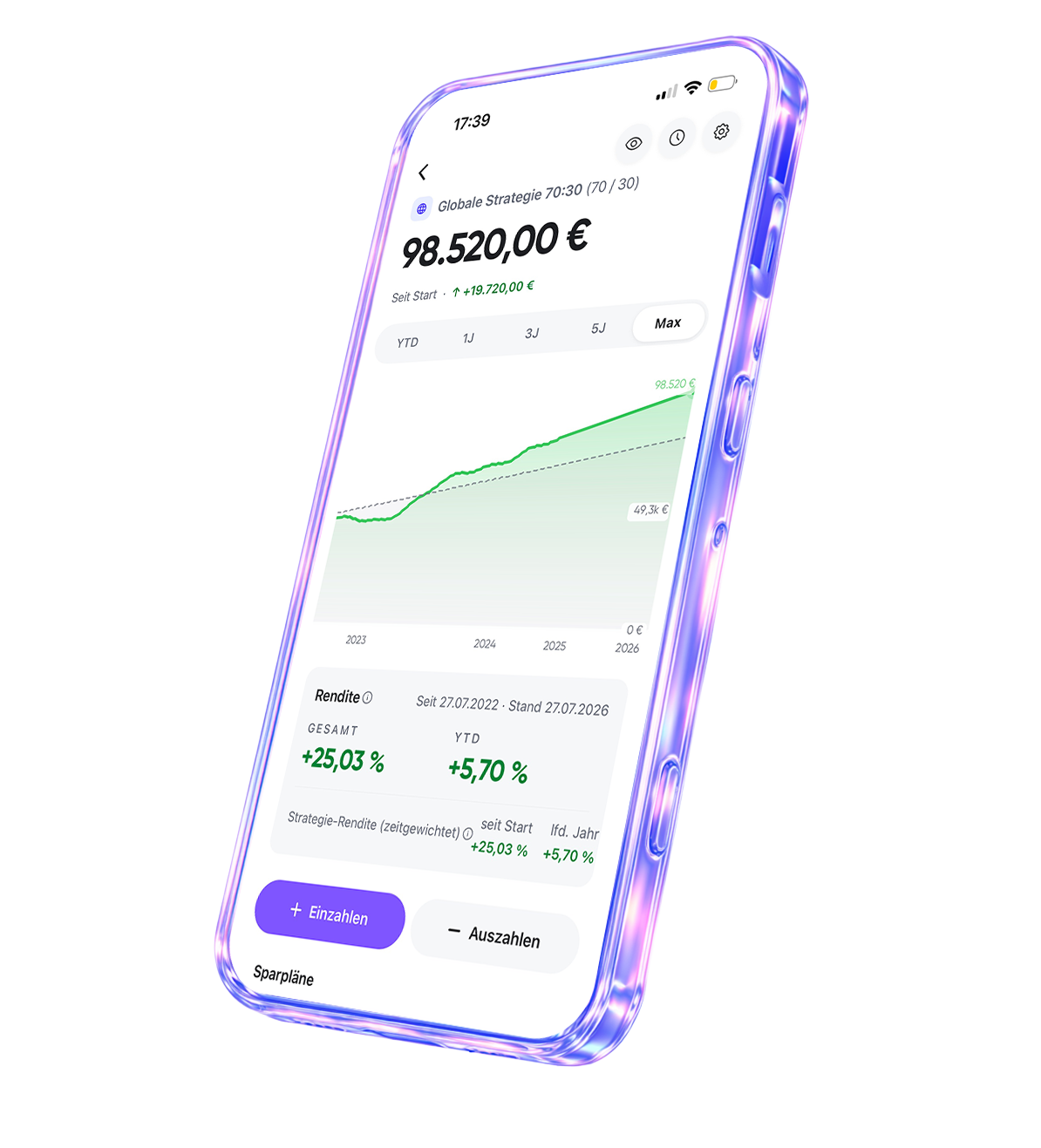
In the app you open your quirion depot with a globally diversified portfolio. So you get to know your investment strategy now and secure your place for the Altersvorsorgedepot.
Yay!
The state pays you grants for your retirement savings. At quirion you invest them worldwide with your ETF savings plan.
The basic allowance comes in two tiers: on the first €360 a year, the state adds 50%; on anything above that, up to €1,800, it adds 25%. That makes at most €540 basic allowance a year.
For every child you get child benefit for, up to €300 child allowance is added. If you are under 25 at the start of the contribution year, you also get a one-off €200 career-starter bonus.
You only get the allowances if you pay in at least €120 a year yourself – that is the condition for the allowance, not a minimum for the contract. The most you can pay into one contract is €6,840 a year. Once you reach it, further payments into that contract wait until the next calendar year.
You can also open two retirement contracts and so save up to 2 × €6,840 a year. You get the full subsidy only once, though. Contributions above the subsidy limit also get the tax advantage of the savings phase: you pay no capital gains tax (Abgeltungsteuer) on the returns in the account. Tax is due only when the money is paid out in retirement.
For tax, your contributions of up to €1,800 a year plus the allowance on them count as deductible expenses – up to €2,340 with the full basic allowance. The tax office checks automatically whether the allowance or the deduction gives you more, and you get whichever is better. All you do is list your contributions in your tax return.
Our subsidy calculator shows how much it is for you.
Change your contribution
Raise, lower or pause your monthly contribution in the app at any time – free, and no reasons needed. Only the allowance has a condition: €120 has to come together over the year, or it lapses for that year.
One-off payments
Bonus, inheritance, tax refund: add one-off payments whenever you like, as long as you stay under €6,840 for the year. Want the full allowance in one go? Pay in €1,800 at once.
Pausing
A pause costs you the subsidy for the paused years – the allowance and the tax deduction. What is already invested stays invested, and the allowances you have received stay yours.
Made for your retirement
Your money grows here for the time after you retire. You can cancel at any time – but before payouts start, that counts as harmful use: you pay back the allowances and the tax benefits, and the gains are taxed at your personal rate. After just a few years, that can leave you worse off than a normal ETF account with no subsidy at all.
There is one exception: to build or buy a home you live in, you can take out €3,000 or more early without losing the subsidy (Section 92a of the Income Tax Act) – if your contract allows it. It is not tax-free: the amount is recorded in a housing subsidy account and taxed in retirement.
So, honestly: only put money in here that you won’t need before retirement. For everything else there is the investment account – yours at any time, no notice period.
Our subsidy calculator shows what a different savings rate means for you.
In the app you open your quirion depot with a globally diversified portfolio. So you get to know your investment strategy now and secure your place for the Altersvorsorgedepot.

In 2027 you do this directly in the app, and you apply for your state grants at the same time.

We invest your money, monitor your portfolio and adjust it to the strategy you chose.

With two broadly diversified Vanguard ETFs you invest worldwide in equities and bonds. You choose and change your equity share yourself.
No product costs: we refund the TER of 0.07–0.08% p.a. to you. The same goes for all transaction costs inside the ETFs.


We steer your investment for you: more broadly diversified, monitored continuously and realigned regularly.
Depot & service 0.48% p.a. plus ETF costs.
Standard
A solid start.
Free of charge.
Pro
Monitored continuously.
We take care of it.
2 Vanguard ETFs
Global equities and bonds, hedged to euro
Over 10,800 equities and 7,000 bonds
from more than 70 countries, weighted by return factors.
Suitability check
Not included
Included
We check that your strategy fits your goals.
Set by law
30% equities at the payout start
Matched to your profile
one of three variants.
Not included
Continuous
with rebalancing, also in strong market moves.
Riester switch
Free switching service
1% bonus
on your transferred balance, plus the free switching service.
Depot & service
€0
0.48% a year
On €1,000 that is €4.80 a year.
Order & savings plan costs
€0
€0
included in depot & service.
ETF costs (TER)
€0
No product costs: we refund the TER of 0.07–0.08% p.a. to you. The same goes for all transaction costs inside the ETFs.
0.13–0.20% a year
depending on the selection.

FTSE Global All-Cap UCITS ETF
ongoing charges (TER) 0.07% a year – we refund them to you
ISIN IE000VAHT5T0
Global Aggregate Bond UCITS ETF
ongoing charges (TER) 0.08% a year – we refund them to you
ISIN IE00BG47KH54
Why Vanguard
Like a cooperative. Vanguard is not listed on a stock exchange and has no outside shareholders. The Vanguard Group in the US is owned by its US funds and so by the people who invest in them. Investors in Europe benefit from this too.
A price leader on principle. Vanguard uses its profits to lower the costs for investors, and has done so since 1975. The two ETFs in Standard cost 0.07% and 0.08% a year.
Source: Vanguard, “About us”, global.vanguard.com/de-de/about-us, as of 18 November 2026.
The closer your payout gets, the fewer equities your depot holds. So your savings fluctuate less when you will need them soon.
Set by law
50% equities five years before the payout start, 30% two years before.
30 % equities At the payout start
40 % equities At the payout start
From 11 years before the payout start we shift step by step into bond ETFs, 40% equities at the end.
Example for a start with 100% equities. One dot stands for 10% of your depot.
Broader diversification
With Pro you invest your money worldwide:
We also give more weight to five equity segments that capital-market research has studied for decades:
Less concentration risk
The broader the spread, the less your depot depends on single countries, sectors and companies. This is how the two depots differ:
Less concentration risk does not mean less market risk: if the global market falls, your depot falls too.
Basis: calculation by Prof. Dr. Stefan May, Head of Investment Strategy and Product Development, as of 28 October 2026, for a depot with 60% equities, a €10,000 start and €195 a month over 30 years, based on the Quirin strategies and the Vanguard indices in euros from December 2014 to October 2026. Calculations are not a reliable indicator of future results.
With Standard
Two Vanguard ETFs: global equities via the FTSE Global All-Cap and bonds via the Global Aggregate Bond, hedged to euro.
With Pro we keep a continuous eye on your portfolio. So your risk stays where you agreed it with us – even when the markets shift it.
Why your risk shifts
If equities rise by 30% in a year and bonds stay flat, 60% equities become around 66%. Your depot then carries more risk than you agreed.
How we rebalance
We sell what has risen strongly and buy what has fallen back. You do not have to do anything.
What the research shows
Studies from more than 30 years draw a clear picture: the most reliable benefit of rebalancing lies in risk control. It keeps the allocation stable and dampens fluctuations. It does not promise a sure extra return, and it does not protect against losses: if the global market falls, your depot falls too.
Sources (selection):
Booth, D. G. and Fama, E. F. (1992): Diversification Returns and Asset Contributions. Financial Analysts Journal 48(3), 26–32.
Dichtl, H., Drobetz, W. and Wambach, M. (2016): Testing Rebalancing Strategies for Stock-Bond Portfolios Across Different Asset Allocations. Applied Economics 48(9), 772–788.
Hilliard, J. E. and Hilliard, J. (2018): Rebalancing versus Buy and Hold: Theory, Simulation and Empirical Analysis. Review of Quantitative Finance and Accounting 50(1), 1–32.
Levy, M. (2024): Does Constant Asset Allocation Dominate Buy-and-Hold? Finance Research Letters 62, 105207.
What you get out of it
On the 3.1%: 100,000 market paths of 30 years each were simulated for a depot with and without rebalancing, at the same average risk. The worst 5% are the paths in which the depot without rebalancing ends lowest. Source: our own simulation, as of 28 October 2026. Simulations are not a reliable indicator of future performance.
With Standard
Standard has no continuous risk monitoring. Your allocation follows the statutory glide path.
How the switch works
From 2027 your Riester balance including the grants can be transferred to your Altersvorsorgedepot without losing the state support. We check your contract free of charge and take care of the switch.
Whether your current provider transfers the capital directly also depends on the terms of your old contract.
More on this: Transfer your Riester contract
Bonus if you choose Altersvorsorgedepot Pro
With Altersvorsorgedepot Pro you get a 1% bonus on your transferred balance.
When payouts start
Payouts start between the ages of 65 and 70 – you choose the date. Until then your money stays invested and can keep growing.
If you retire earlier on your state pension or civil-service pension, you can start earlier too.
Your three options
Up to 30% of the account value can be taken out in one go at the start. You keep the subsidy, but the payout is taxed just like the monthly pension.
The rest is paid monthly as a payout plan until age 85. We do not offer a lifelong annuity.
It can stay invested during the payout phase, too.
The monthly amount is reset every one to three years – so gains made in between end up in your payments, not on a frozen account.
A full lump-sum payout is not possible: the retirement account is built to top up your pension, not to be a savings book.
To buy or build a home you live in, or to repay a loan for it, you can take money out of your retirement account, in full or in part, from €3,000.
This works until the payout starts. You apply at the latest ten months before.
You request the payment with three months’ notice to the end of a quarter.
The subsidy stays as long as you live in the home yourself.
It is not tax-free: the amount is recorded in a housing subsidy account and taxed in retirement.
Personal customer support, Monday to Friday from 9 am to 6 pm.
AI financial advice: around the clock.
If you later switch to another provider, we charge nothing for it: €0 with Standard and €0 with Pro.
Find out in seconds what your pension could look like.
Pictures created with AI.
€1,037
Pension per month from 67
€12,915 is added by the state
In this example that grows to around €77,270 by 67.
Example calculation for a sample person – not an offer and not a promise. Assumption: 7.5 % a year before costs. Such forecasts are not a reliable indicator of future performance. Investing in the capital markets regularly involves the risk of loss. Investors should therefore always inform themselves about the opportunities and risks of an investment. All assumptions are in the calculator. Advertising by quirion AG.
Unlike Riester, the Altersvorsorgedepot has no guarantee obligation. That means more return potential with ETFs, and price fluctuations are part of it. From 2027 you take your Riester balance with you, grants included. The Riester check and the transfer to quirion are free, and with Pro you get a 1% bonus on your transferred balance.
€175
Riester
basic allowance a year
up to €540
Altersvorsorgedepot
€365 more from a €1,800 own contribution
No hot tips. No perfect timing. Instead, a strategy that prevents mistakes, gets you to your goal with ease – and simply makes you happy.
The subsidy starts on 1 January 2027, and the account can’t be opened before then – but you can reserve a spot now, so your application is ready on day one. The reform is passed and published: the Bundestag passed the Retirement Provision Reform Act on 27 March 2026, the Bundesrat approved it on 8 May 2026, and it was published in the Federal Law Gazette on 29 May 2026 (2026 I No. 156). The government will still set some implementation details by regulation.
Almost everyone who works in Germany: employees, apprentices, civil servants, soldiers, farmers, mini- and midi-jobbers who pay pension contributions, employed members of a professional pension scheme, and artists and writers insured through the artists’ social insurance fund. Self-employed people qualify too – if they pay into the state pension, or if they are under 67 and file a tax return every year. And the subsidy keeps running through times without a salary: parental leave, child-raising periods, caring for a relative from care level 2, sick pay or transitional benefit, voluntary service, and unemployment benefit after earlier contributions.
On the first €360 a year the state adds 50%, on anything above that up to €1,800 it adds 25% – at most €540 basic allowance a year. For every child you get child benefit for, up to €300 is added, and if you are under 25 at the start of the contribution year, you get a one-off €200 career-starter bonus. You don’t have to apply every year: give us a standing request when you open the account, and we collect the allowance for you each year from the central allowance office.
The retirement account is meant for the time after work. Payouts start between the ages of 65 and 70. If you retire earlier on your state pension or civil-service pension, you can start earlier too.
If you take the money out before payouts start, that counts as harmful use: you pay back the allowances and the tax benefits. The gains stay yours, but they are taxed at your personal rate.
One exception is your own home: to buy or build a home you live in, or to repay a loan for it, you can take money out, in full or in part, from €3,000. The subsidy stays as long as you live in the home yourself. It is not tax-free: the amount is recorded in a housing subsidy account and taxed in retirement.
Two. The commitment: if you take the money out before payouts start, that counts as harmful use – you pay back the allowances and the tax benefits. The gains stay yours, but they are taxed at your personal rate. And the choice: not every fund is allowed. We think that’s fair, because the limits keep return and risk in a balance that actually gets you to your retirement goal. You’re not tied to us, though – you can switch provider later without losing the subsidy.
Your retirement account is held by Quirin Privatbank AG, which has a full banking licence and is supervised by BaFin. You invest in ETFs whose assets are legally separate from the fund company’s own: the units in your account belong to you, not the bank. They stay untouched if the fund company, Quirin Privatbank AG or quirion ever became insolvent.
None of this protects against market movements. The retirement account has no required contribution guarantee, so the value of your investment can fall. The closer your payout gets, the fewer equities your depot holds. So your savings fluctuate less when you will need them soon.
With Riester, at least the contributions you paid in must be there when payouts begin. The provider has to secure that promise over the whole term. That limits how much it can put into more volatile investments. The retirement account has no such requirement: products without a capital guarantee are explicitly eligible. That means more return potential, but also price swings you have to be able to sit out.
The tax deduction is shaped differently, too. With Riester up to €2,100 a year counts, allowance included. Under the new rules it is €1,800 of your own contributions plus the allowance on them. Whether you come out ahead depends on how large your allowance is.
You can leave an existing Riester contract running as it is. It then stays an old contract under the old rules. There are two ways into the new subsidy: you tell your current provider, irrevocably, that the new rules should apply. Or you take out a new subsidised contract after 31 December 2026. Then the new rules apply to all your contracts.
Moving your balance is a separate step: you cancel the old contract for a transfer, with three months’ notice to the end of a quarter. We check your contract free of charge and take care of the switch. With Altersvorsorgedepot Pro you get a 1% bonus on your transferred balance.
This is based on the Retirement Contracts Certification Act and the Income Tax Act as they apply from 1 January 2027. The Riester points describe the legal minimum, not any one provider’s product.
Altersvorsorgedepot Standard: €0 for depot & service and €0 order & savings plan costs. No product costs: we refund the TER of 0.07–0.08% p.a. to you. The same goes for all transaction costs inside the ETFs.
Altersvorsorgedepot Pro: Depot & service 0.48% p.a. plus ETF costs.
Separately, the law caps the effective costs of the statutory standard contract at 1.0% a year. The cap doesn’t apply to other retirement accounts.
Scan the QR code with your phone to download the app.
Continue on the webOur new account opening: shorter and simpler
Verify your identity right on your phone
Afterwards, your portfolio is always with you
Continue on your phone Scan the code with your camera