
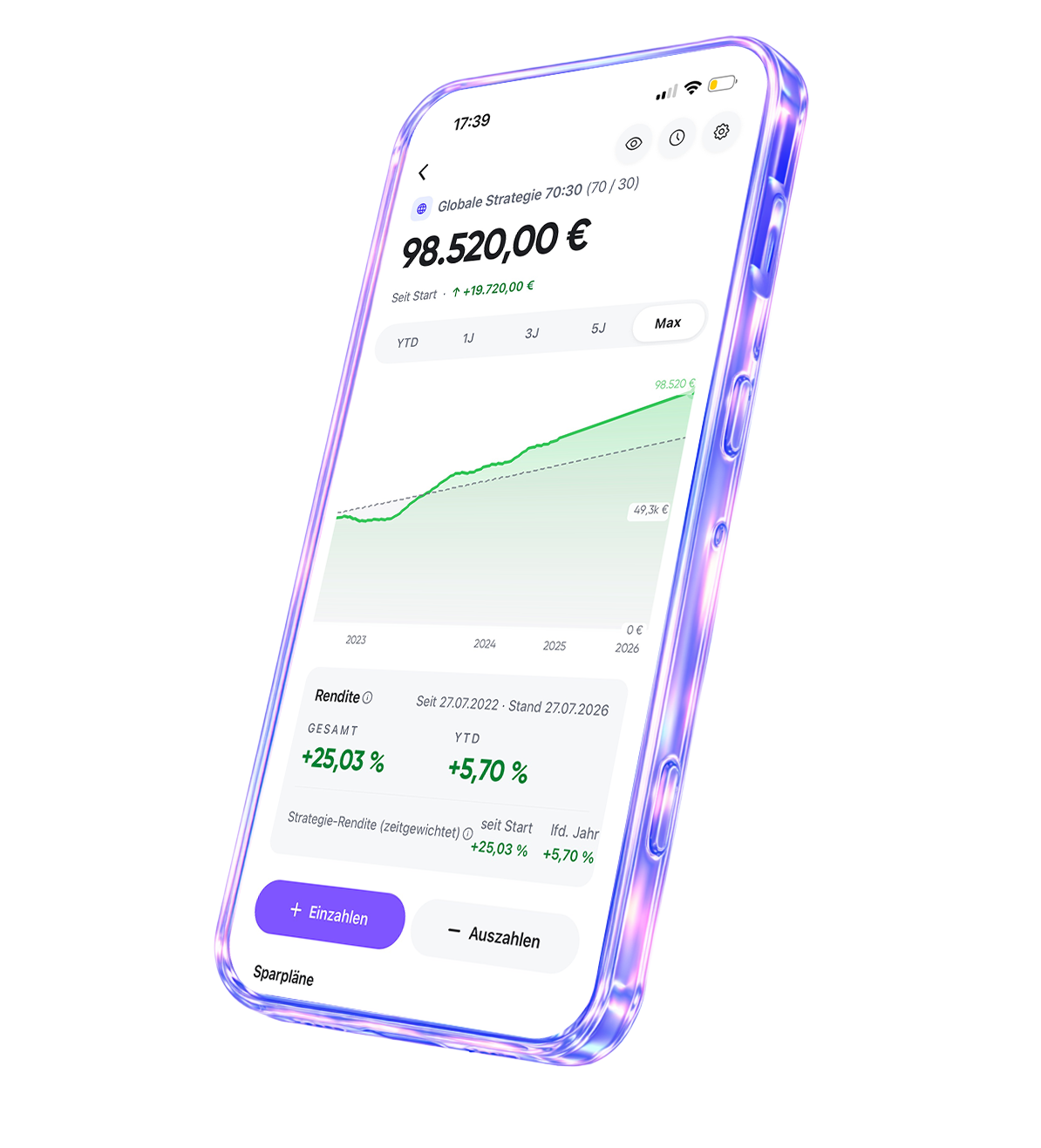





1. Open
First you open your own account, then you add the Kinderdepot alongside it – both digitally in the app.
Awww!
A professionally managed ETF portfolio for your child. From €25 a month. For 0.48% a year.
The earlier you start, the harder compound interest works.
Value on their 18th birthday
of which paid in 5,400 €
Hypothetical example calculation assuming a 7.96 % expected annual return before costs, less 0.48 % portfolio management and 0.20 % ETF costs (TER). Such projections are not a reliable indicator of future performance; losses are possible. Advertising by quirion AG.

Every child deserves the chance to go their own way. The Kinderdepot builds the financial foundation for that, so more possibilities are open to them later on.
Education
University or vocational training – a decent financial cushion can help your child decide freely what, how and where they learn.
Self-determination
The freedom to make your own decisions is one of the greatest gifts in life. A driving licence, a year abroad, starting a business or other plans – extra financial means create more room for a path of their own.
Opportunities
The future cannot be planned. But you can create the conditions for meeting it with more options open. The Kinderdepot helps lay that groundwork early.

When many people believe in a child’s future, remarkable possibilities emerge. Because together you get further than alone.
Parents
The parents with custody have access to the Kinderdepot and plan for their child’s future – together, or one parent alone where they have sole custody.
Family and friends
Birthday money, Christmas or simply in between – family and friends can support the Kinderdepot with a straightforward bank transfer, without needing access to the account themselves.
Share the IBAN once
Grandparents, godparents, friends: anyone who wants to chip in transfers straight into the Kinderdepot – once, or as a standing order. All you pass on is the IBAN. Nobody needs access to the account, and you don’t have to collect the money and forward it.
Broad diversification instead of single bets
Our portfolio-management experts work from the findings of capital-market research: forecast-free, broadly diversified, disciplined even in turbulent times, and as close to the world market as possible.
Instead of trends, timing and single bets we back the global market as a whole: through selected ETFs and index-tracking funds we invest in more than 13,000 shares and 2,000 bonds from over 70 countries. On top of that we deliberately hold the segments research has shown to earn higher returns: value, small-cap, low-volatility, momentum and profitability stocks.
Equity share
We propose a strategy that fits the child’s age. More equities means more return potential and bigger swings – over some twelve-month periods well up, over others down.
Global or sustainable
For a Kinderdepot you can choose between the Globales Portfolio and the sustainable portfolio. Same price, same management – just different ETFs.
You decide on the risk
At the start the portfolio is mostly equities – 18 years is enough time to sit out the swings. There is no automatic switch into more defensive assets on a Kinderdepot: if you want to take risk off the table before the 18th birthday, you switch strategy yourself – at any time and free of charge.
Adjusting the contribution
The monthly contribution starts at €25 and is open-ended upwards. You can raise, lower or pause it in the app at any time, free of charge – there is no minimum investment.
One-off payments
Bonus, savings, birthday money: one-off payments are possible at any time with no minimum. Grandparents, godparents and friends can pay in by bank transfer too, without having access to the account.
Low costs
Our all-in fee of 0.48% a year covers everything: the investment proposal, custody, transaction costs, ongoing monitoring, rebalancing, the AI assistant and every strategy switch. On top of that come around 0.2% of ETF costs a year, which sit inside the fund price and are not billed separately.
There is no custody fee, no front-end load and no minimum investment. One note: the Kinderdepot is excluded from new-customer promotions.
At the age of majority the Kinderdepot automatically becomes an individual account. Your child identifies themselves once more and then controls it alone – you lose the power of disposal. We contact you beforehand so it can be arranged in good time.
Let it keep running
Nothing has to be liquidated. The account can stay invested and keep working – turning an 18-year horizon into 40 or 50.
Or take part of it out
Your child can have part of it paid out and leave the rest to grow. There is no deadline by which anything has to be decided.
And it can’t be taken back
The money legally belongs to your child from the very first payment. That is the point of it – but it also means that what you pay in here cannot later be used for yourself. And it has to be lived that way: if the account is in practice treated as your own and money is taken out of it for the family budget, the tax office may attribute the income back to the parents.
The cabinet has approved the Frühstart-Rente – the Bundestag and Bundesrat still have to agree. From 2027 the state is to pay €10 a month towards your child’s retirement, from their 6th to their 18th birthday and only for children born in 2020 or later; older children have no claim. It cannot be drawn before 65 – for a driving licence or a first flat, the Kinderdepot stays the route.
€10
a month
planned by the state, for children born 2020 or later
First you open your own account, then you add the Kinderdepot alongside it – both digitally in the app.

Savings plan from €25 a month, one-off payments with no minimum. And anyone can pay in – grandparents, godparents, friends: all they need is the IBAN.

We monitor the risk, bring the weightings back on target free of charge (rebalancing) and review the products.
The child. The account is held in their name, and the assets legally belong to them from the very first payment – every payment in is a gift. Until they come of age, their legal representation – the parents with custody – manages it under the elterliche Vermögenssorge (their statutory duty of care for the child’s property): as someone else’s money, kept apart from your own – but the contracting party is the child. That also protects it: in the Zugewinnausgleich (the equalisation of accrued gains on divorce) the account counts in neither your opening nor your closing assets, and if a creditor enforces against you, your child can defend their property. Two limits are worth knowing all the same. Unusually large gifts that go beyond what is appropriate for your child are added back to your closing assets in the Zugewinnausgleich – unless they were made at least ten years before the marital property regime ended, in a divorce meaning ten years before the petition was served, or your spouse agreed to them. And in personal insolvency the administrator can challenge payments made in the last four years as gifts and claw them back; the same four-year window applies to creditors outside insolvency. The only exemption is for customary occasional gifts of low value – a standing savings instalment is not one of those. In practice an administrator rarely claws back small monthly instalments; the real risk is large one-off payments made in financially strained times.
It is automatically converted into an individual account. Your child identifies themselves once more and then controls the money alone – no conditions, no exceptions; your power of disposal ends. That is the price of this account, and the question to settle with yourself beforehand. Nothing has to be liquidated: the account can simply keep running, or your child can take part of it out and leave the rest to grow. No tax arises when they come of age – the money was always your child’s and does not change owner. What matters for tax is not the 18th birthday but the payment in: every payment is a gift, and Schenkungsteuer (gift tax) arises – if at all – at the moment the money reaches your child. Inheritance tax does not come into it; that exists only where someone has died.
Yes, through the client account – but with strings attached. You are managing someone else’s money and may use it only in your child’s interests: a year abroad, an expensive course of education, a driving licence, the first place of their own. For your child’s day-to-day maintenance – food, clothing, housing, school supplies – you may use the income the account produces; family law actually provides for that. The capital you have built up should not be touched for it. For tax there is a second rule on top, and it is the stricter one: spend the income on your child and keep a traceable record of what for. If the money instead flows regularly into the general household budget, the tax office can attribute the income back to you – permitted under family law, expensive under tax law. Off limits in any case are your own purchases and your own debts: the assets legally belong to your child, you must hand them over when they come of age and account for how you managed them if asked. So a Kinderdepot is not a substitute for your own reserve; an ordinary account is the right place for that. Ordinary purchases, sales and withdrawals need no family-court approval – that is reserved for special cases, such as borrowing money on your child’s credit or giving something away out of their assets. For larger amounts, take legal advice first if in doubt.
Paying in, yes; opening, no: only your child’s legal representation can open a Kinderdepot – as a rule both parents with custody together; where one parent has sole custody, that parent alone is enough. Grandparents, godparents and friends can then pay in at any time by bank transfer or standing order – they get the IBAN from you and don’t need access to the account. Schenkungsteuer (gift tax) only arises once the allowances are exceeded: €400,000 per parent and €200,000 per grandparent, each covering all gifts to the same child within ten years. The count runs per person giving – so mother and father have €400,000 each, and every grandmother and grandfather €200,000 each. Where the parent the relationship runs through has already died, that grandparent’s allowance is €400,000 too. Everything that person has given within those ten years counts towards it, not just payments into the account. Ordinary savings instalments are nowhere near it. (As at 2026)
Your child has their own Sparerpauschbetrag (annual tax-free allowance for investment income) of €1,000 per year – up to that, gains stay tax-free; you file the exemption order directly in the account, for which you need your child’s tax identification number. If gains exceed it, a Nichtveranlagungsbescheinigung (non-assessment certificate) can help: combined with the €1,000 Sparerpauschbetrag, the Grundfreibetrag (basic personal allowance) of €12,348 and the €36 Sonderausgaben-Pauschbetrag (standard allowance for special expenses), roughly €13,384 a year then stays tax-free – provided your child has no other income. The certificate is issued for a maximum of three years and always ends at the end of a calendar year. As at 2026; tax rules and amounts can change – in individual cases, professional tax advice is worthwhile.
It can. In the BAföG calculation the account counts as your child’s own assets: only what exceeds the allowance is offset – spread across the months of the approval period, reducing the monthly award accordingly. Currently €15,000 stay exempt while your child has not yet completed their 30th year of life, and €45,000 after that; what counts are the circumstances at the time of application. So a well-filled Kinderdepot can reduce the entitlement – worth factoring in if university is likely.
0.48% a year for the management, plus around 0.2% of ETF costs that sit inside the fund price and are not billed separately. There is no custody fee, no front-end load and no minimum investment. One note: the Kinderdepot is excluded from new-client promotions.
That is a separate subsidy scheme and not the same thing as a Kinderdepot – the section further up this page sets out how the two differ. Three things that did not fit there: only children born in 2020 qualify at first, with younger cohorts joining year by year. Children born in 2019 or earlier do not get the state’s €10, not even retrospectively – what counts is the year of birth, not today’s age. You choose the provider yourself; if you do nothing, the state invests the money collectively via the Deutsche Bundesbank, and your child can later draw that share as starting capital into a contract of their own – which has to be concluded before they turn 35, otherwise the money goes back to the federal budget. And as for where the law stands: the account itself is already settled – the Standarddepot-Vertrag (standard retirement custody contract) with its 1% effective-cost cap is in the Altersvorsorgereformgesetz of May 2026 and applies from 2027. The Frühstart-Rente comes from a law of its own, and that one is not through: the bill cleared the cabinet on 12 August 2026, and the Bundestag and Bundesrat still have to approve it. The rule that no acquisition or distribution costs may be charged until the child turns 18 comes from that bill too – as does the rule that from 2027 the same Standarddepot-Vertrag is to be available for children with no entitlement, then simply without the state’s €10.
Scan the QR code with your phone to download the app.
Our new account opening: shorter and simpler
Verify your identity right on your phone
Afterwards, your portfolio is always with you


