
Robo-advisors in 2026: definition, how they work and their benefits




Robo-advisor translates as roughly „advisory robot“. Indeed, a robo-advisor digitalises the services of traditional financial advice. To do this, a typical “robo” determines – via an online questionnaire – the investment goals, the risk appetite and the financial situation of each individual investor.
From the data gathered in this way an optimal portfolio can be created for your personal investment strategy. You can find out exactly how this works in detail, and how you can personally benefit from it, in this comprehensive guide, which leaves no question unanswered.
The key facts at a glance:
- How it works: Every robo-advisor pursues its own investment concept and ensures that portfolios suit each individual person. The robo-advisor from quirion, for example, creates a scientifically grounded portfolio that replicates the global market (equities & bonds) as closely as possible to 1:1 – while matching the investor’s personal risk profile.
- Target groups: In principle, “robos” are suited to investors who want to provide for retirement or build up wealth – while saving themselves time and effort.
- Benefits: Good robo-advisors are low-cost, have a well-founded investment concept and maximum transparency, and offer a convenient way to invest money.
- Costs: For the majority of providers, service fees range between 0.4 % and 0.8 % p.a. quirion’s asset management fee of 0.48 % p.a. is therefore comparatively favourable.
- The myth of the self-trading AI: With a robo-advisor, it is only in the rarest of cases that a machine trades independently on the stock market. Such approaches do exist, but investing in this way carries high risks. quirion does not rely on such technologies, because they offer no proven added value.
- The human factor: Behind the selection of ETFs and the investment strategy there are usually real people – and quirion is no exception.
- Diversification: Many robo-advisors rely on broad diversification – at quirion, investors can invest their money indirectly, via ETFs, in around 8,000 equities and just under 3,000 bond issuers.
Contents

Best to start today!
You might also be interested in




















What is a robo-advisor?
A robo-advisor is a digital asset managerthat issues investment recommendations and manages portfolios with the help of analysing large data sets. Thanks to its automated way of working, the process is highly cost-efficient and, with many providers, leads to broad diversification across global markets.
Good to know: Robo-advisors are above all a good option for investors who have little time or experience to manage their own portfolio.
How it works: how a robo-advisor creates and manages your portfolio
When it comes to how a robo-advisor works, there are generally two levels:
- a technical level (= tasks carried out by algorithms)
- a human level (= tasks carried out by people)
At quirion this works in practice, for example, as follows: The human level is responsible for developing the investment concept, the specific selection of products and portfolio management (e.g. processing buy and sell orders). To do this, the investment experts primarily draw on insights from financial science.
For private investors this is of interest, because – from a scientific perspective – it leads to the best ratio of expected return to expected risk .
In addition, there is the technical level:
The investment goals and the risk appetite of investors must be taken into account individually with every portfolio composition – with almost all robo-advisors, this is done using an online questionnaire – quirion included.
Investors with a higher risk appetite receive a portfolio at quirionthat consists primarily of equity ETFs. ETF is the abbreviation for „Exchange Traded Fund“. Investors who are less willing to take risks have more bonds in their portfolio. Compared with equities, bonds usually generate compared with equities a lower return, but they provide greater stability within the portfolio.
Finally, there is also digital support for portfolio management, e.g. in monitoring the investment limits (known as rebalancing).
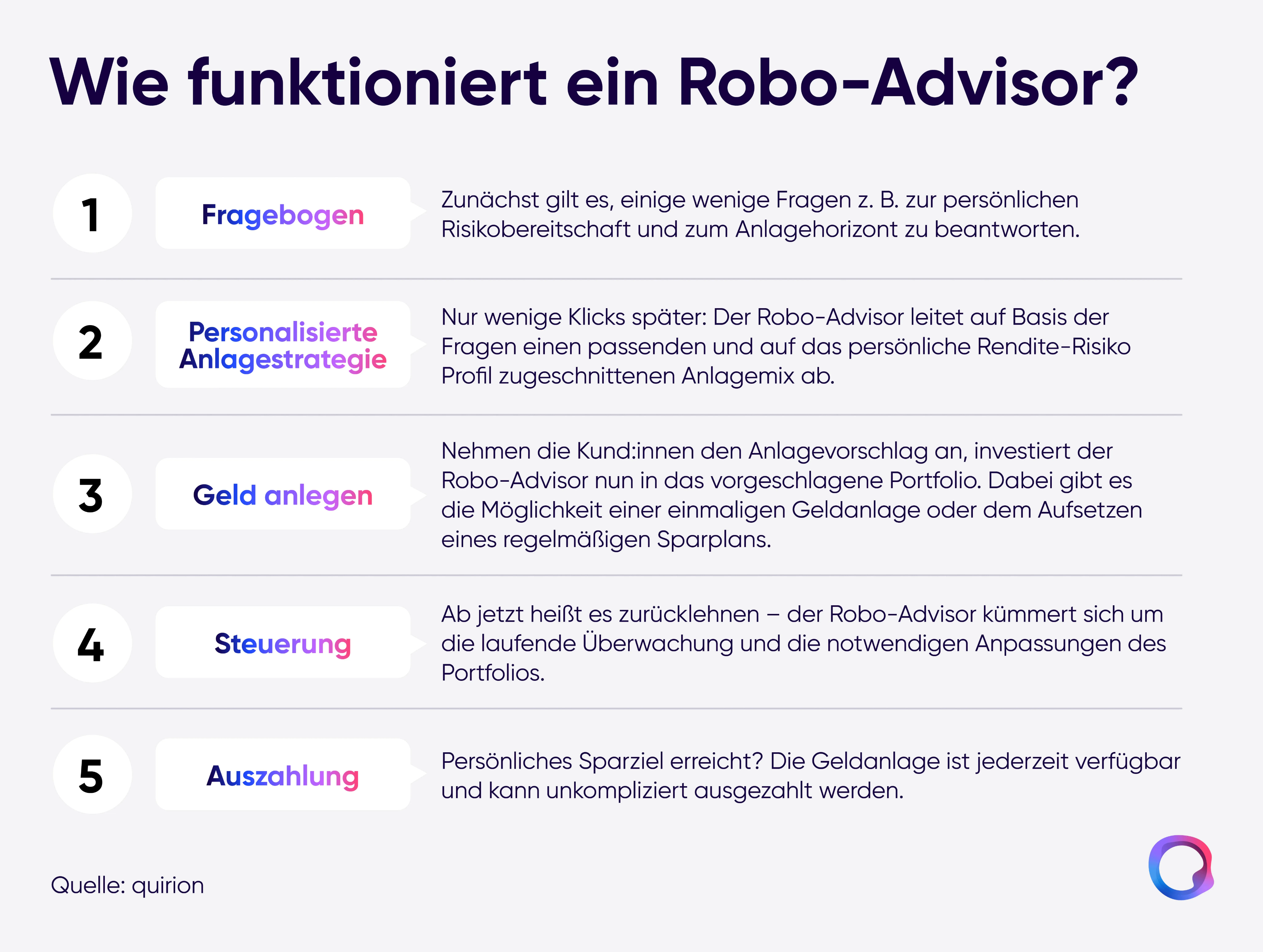
Good to know: The simple, easy-to-understand and low-cost investing that a robo-advisor makes possible does not work to a one-size-fits-all pattern, but is guided by the investor’s personality profile. So there is not one single portfolio for everyone, but rather only an individually suitable portfoliothat matches the savings goals and risk profile of each respective investor.
Types of robo-advisor: active vs. passive
There are two types of robo-advisor, those with an active and those with a passive investment strategy. The difference between active and passive robo-advisors is an important topic for your personal investments.
1. Passive robo-advisors
Passive robo-advisors pursue a passive investment strategy, in that they try to replicate the marketrather than beat it. They therefore invest in ETFs, with the aim of diversifying the portfolio as much as possible and minimising risk.
In this regard, people also speak of “forecast-free investing”.
Good to know: Investing forecast-free means building broadly diversified portfolios and making long-term investment decisions that are maintained with discipline. The aim is to achieve long-term stable investment success on the basis of scientific insights – independent of short-term market fluctuations and crises.
2. Active robo-advisors
Active robo-advisors pursue an active strategy and aim thereby to outperform the market. They use, for example, up-to-the-day data, forecasts and in part also machine learning, and in this way try to continuously optimise the portfolio and to make the (supposedly) most lucrative investment decisions at the right time.
It is the exact opposite of forecast-free investing, which is based on the premise that it is impossible to predict market movements and extremely unlikely to beat the market consistently.
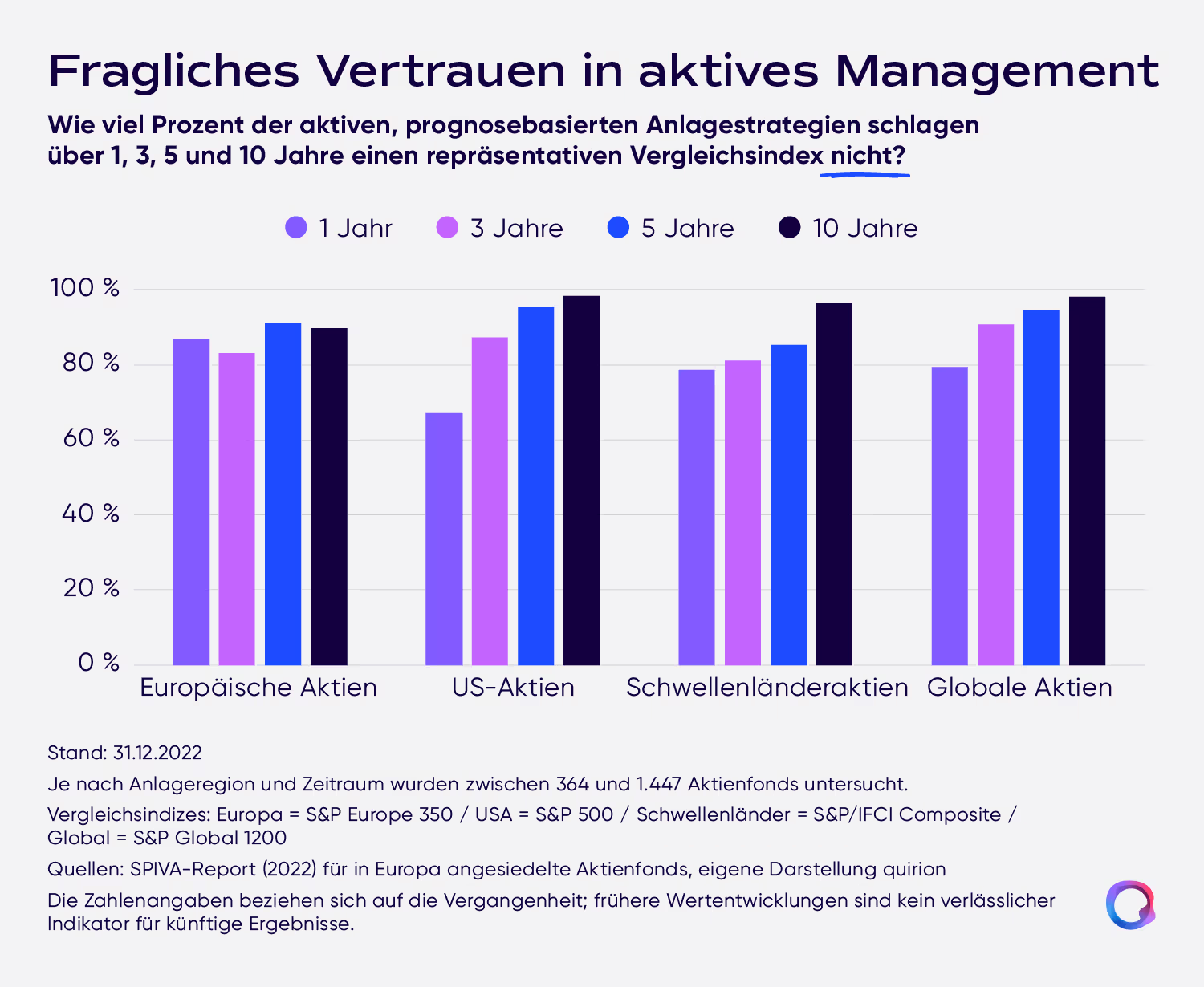
Good to know: Scientific studies clearly show that active strategies are not sustainably successful . That is to say, sooner or later they fall behind representative benchmark indices. This is due to poor timing and misplaced investment focuses.
3. Passive vs. active: which is better?
Passive robo-advisors are as a rule more cost-effective and offer broader diversification. They are also less susceptible to human error and emotional decisions. Active robo-advisors, on the other hand, try to achieve higher returns by attempting to predict market movements.
According to a study by Morningstar – the Robo-Advisor Landscape Report 2023 – passive robo-advisors have in recent years achieved higher customer satisfaction than active robo-advisors.
Good to know: No question about it: active strategies can be successful and beat the market. But that usually succeeds only in the short term – never in the long run. And which strategy will temporarily beat the market in future cannot be foreseen in advance. Scientific findings from capital market research show that investors who want to provide for retirement should favour passive, forecast-free strategies, because participating in the market is less risky and can nevertheless deliver a fair return.
Which investment strategy does quirion’s robo-advisor pursue?
At quirion, we want to cover the global equity market as representatively as possible , because only in this way is an optimal return-risk ratio achieved.
From the perspective of all investable markets, three levels in particular should be taken into account:
- Countries: investing as broadly as possible across developed & emerging markets
(Asia, Europe, emerging markets, North America, etc.) - Sectors: investing across as many industries as possible
(technology, finance, healthcare, consumer goods, real estate, etc.) - Company size: investing in companies of varying size
(small caps, mid caps, large caps / blue chips)
For an optimised portfolio, you should only select ETFsthat invest as broadly as possible across the whole world, in as many industries as possible and in companies of varying size.
That is why, at quirion, we make the most of the positive effects of broad diversification for our investors – by investing worldwide in around 8,000 companies . And that means in all regions, industries and company sizes. In our selection, we also take into account the so-called „equity factors“ and reflect these in the optimal ratio.
Our analyses have shownthat, for the broadest possible equity market coverage – alongside a block of standard stocks (blue chips) – the following four equity segments, also known as factors, prove relevant:
- Value (= equities with a high intrinsic value)
- Low volatility (= equities with low fluctuations in the past)
- Small caps (= equities of smaller companies)
- Momentum (= equities with strong recent price momentum)
Good to know: The relationships between these individual factors are complex, but not impenetrable. Based on historical performance data going back more than 20 years, our analysts develop a cost-efficient ETF portfolio for our clients. Because, owing to the complex relationships between the factors, a single equity index – such as a world ETF – proves too weak a representative of the overall global market.
>>> You can find out more about this in the guide on diversification
{{konzept-component}}
5 benefits of robo-advisors compared with traditional investment methods
Many people still shy away from investing in the capital markets, because they think it requires a lot of capital. In asset management there were indeed in the past high barriers to entry.
Today, private investors have access to a great many investment products and can build up wealth with even very small savings amounts – e.g. from 25 euros a month.
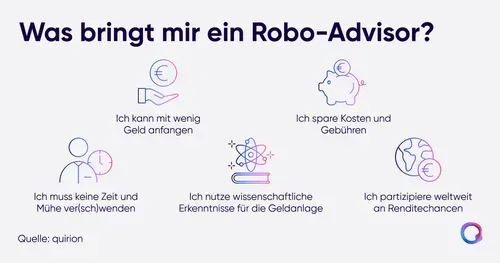
1. I can start with little money
An important factor is still today the so-called minimum investment. This is the amount that must be invested at a minimum in order to be able to use an offer.
With private asset management, many banks require minimum investments of over 100,000 euros .
Most robo-advisors have dismantled such hurdles to investing:
- So at quirion, investors can use digital asset management in global ETF portfolios with no minimum investment, that is, from just 1 euro.
- At quirion, savings plans can be set up from as little as 25 euros a month .
- The aim is an increasing democratisation of investing, that is, that more and more people can participate in the development of the capital market.
Good to know: Interest-dependent forms of saving such as instant-access savings accounts or savings bonds yield – despite the current interest rate turnaround – too little return to sensibly provide for retirement or to be able to build up wealth .
2. I save on costs and fees
The costs of investing reduce the return. The fees incurred, for example, when investing in actively managed funds include, among other things, a one-off front-end load. On top of that come recurring costs, such as the annual management fee.
Such recurring costs then not infrequently add up to two per cent and more.
A robo-advisor is considerably cheaper. This is shown by sample cost calculations:
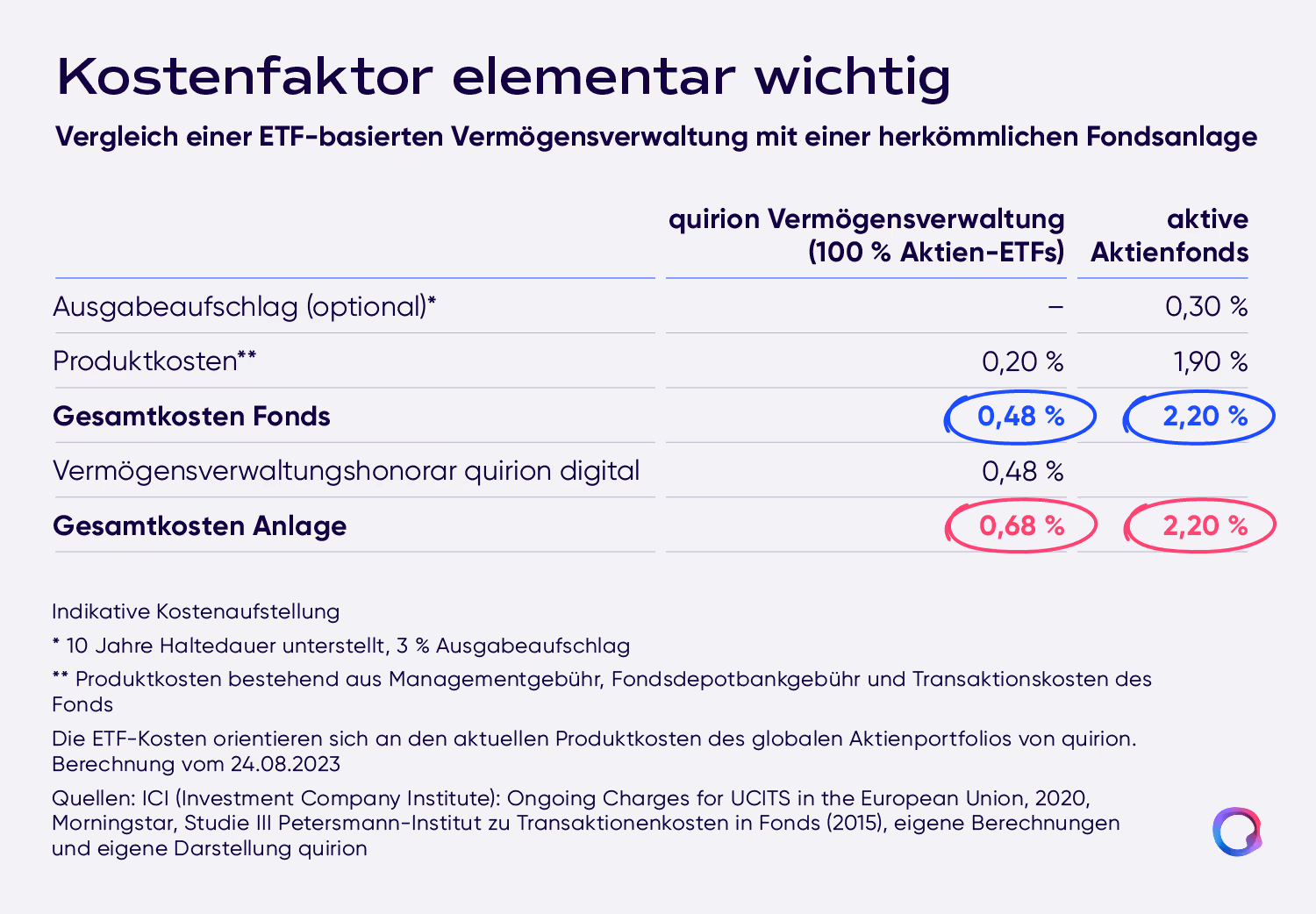
Just how great the influence of fees on investment success is can also be shown by this example, which assumes an average annual return of 7 % achieved by both investment variants:
- From 20,000 euros there becomes, at an annual return of 6.32 % p.a. after costs – after 30 years, mathematically 125,742 euros.
- If the same amount of money is invested in active equity funds, the annual return is reduced – due to the higher costs – to 5.1 % p.a. (after costs, any front-end load not taken into account)
- The result: The initial 20,000 euros then become only 88,943 euros.
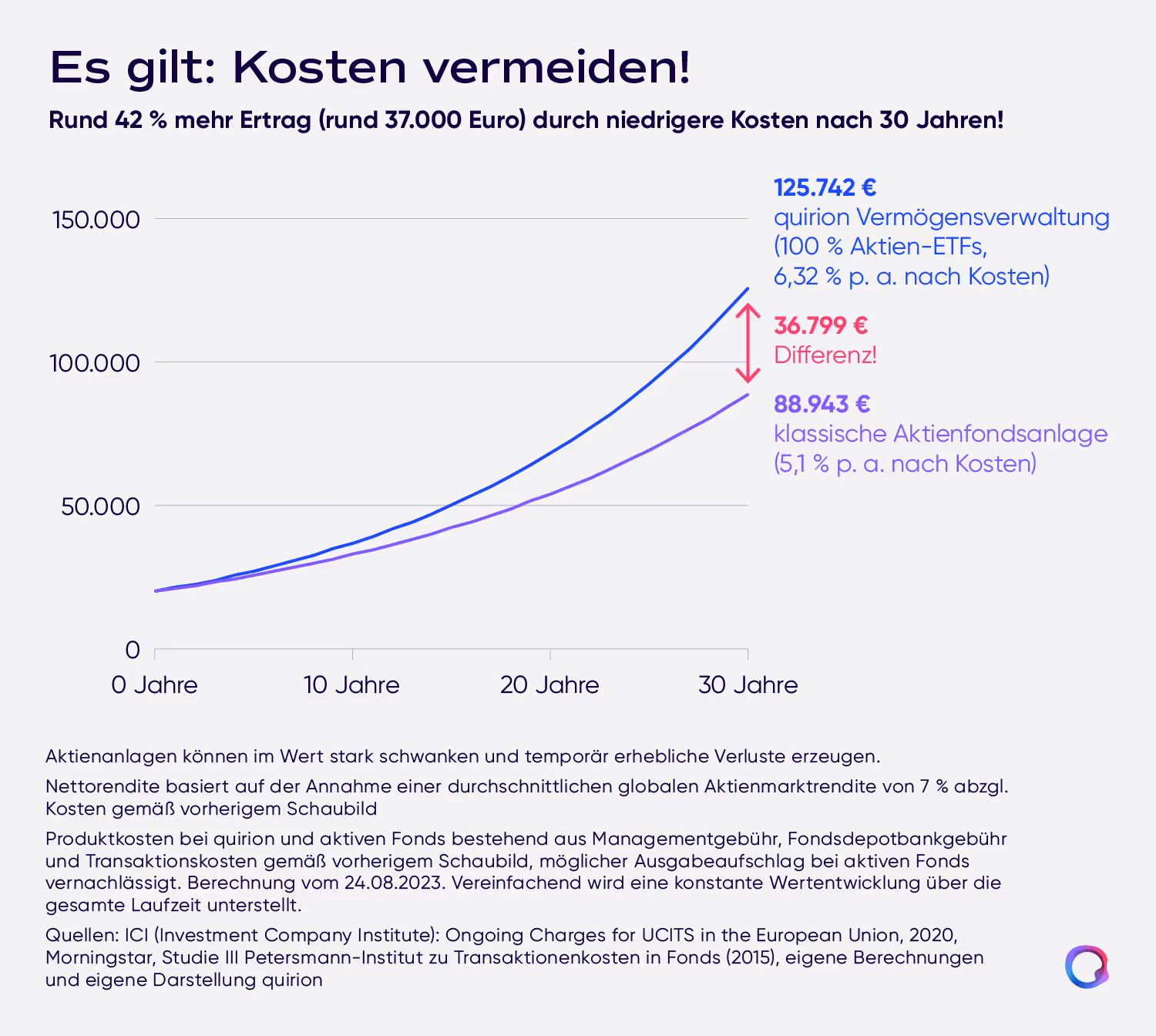
This creates a calculated difference of 36,799 eurosthat potential investors would then have missed out on, because the costs of investing always end up affecting the return.
3. I invest less time and effort in my own investments
Selecting individual securities to invest inis not easy for most investors. On the Frankfurt Stock Exchange alone, around 13,000 different equities can be traded.
With ETFs, too, the choice is now large. Currently, over 2,000 different ETFs are listed on German stock exchanges (as at January 2024) – and the trend is rising.
Alongside the almost insurmountable number of alternatives , the number of possible influences on performance is also enormous. The possible influences on the movement of a share price include, for example:
- companies’ earnings development
- industry trends
- the economic outlook
- interest rate decisions by central banks
Good to know: Anyone who uses a robo-advisor like quirion does not need to give a thought.
to such aspects and the selection of individual securities.
The investment strategy of a robo-advisor, like quirion, is based on scientific insights from capital market research. Among the pioneers of this branch of research is Eugene Fama, who for his scientific work received a Nobel Prize in 2013 .
One of his central insights isthat no one can beat the market permanently . Yet that is exactly what active funds try to do.
Performance comparisons show, however,that they outperform their benchmark index only in the rarest of cases – particularly over the longer term.
On top of that: which funds might possibly manage it cannot be determined in advance.
5. I participate in return opportunities worldwide
quirion’s global ETF portfolios give investors a stake in the development of around 8,000 equities from more than 70 countries.
The selection of ETFs at quirion takes place in an elaborate, multi-stage process. The aim is to come as close as possible to the return of the „global equity market“ .
The global equity market, which consists of more than 60,000 companies , cannot be bought with a single product or with the help of a special ETF combination. In order to get as close as possible to this global portfolio, our investment strategists develop the model portfolios on a scientific basis using quantitative methods.
At quirion, your money flows indirectly into around 8,000 equities and just under 3,000 bond issuers.
>>> You can find out more about this in the article: How to bring the whole world into your portfolio
Good to know: quirion’s digital asset management covers various investment strategies. These differ in the ratio of equities to bonds. In the global ETF portfolios, investors have ten variants available: from 10 per cent equities combined with 90 per cent bonds up to 100 per cent equities with no bonds. In addition, there is a portfolio specifically geared towards sustainability – likewise with 10 gradations.
Which types of investor are robo-advisors particularly recommended for?
In general, robo-advisors are suited to peoplewho are looking for investments that are as simple, secure and low-risk as possible. Accordingly, quirion’s client base also forms a kind of cross-section of the population. Among our most important clients are:
Investing in the capital markets is, however, always particularly recommended when you are young, or when you can commit to savings periods that are as long as possible .
(Young) investors who want to save up a private pension
Young investorswho want to build up wealth or save for retirementbenefit, with any form of investment, from the time factor. As a rule, robo-advisors are geared towards long-term investment strategies – keyword: buy-and-hold – and offer broad diversification across various asset classes – usually a mix of equities and bonds.
They are therefore particularly suited to investorswho pursue a passive and thus forecast-free investment strategy along with a long savings period.
Investors who want to provide for their children & descendants
The earlier you start saving and the longer the savings period, the higher your prospects of a high return. This has the following 2 reasons:
- Over the long term, share prices rise because companies generate profits and because the global economy has been growing for three centuries.
- Investors benefit from the powerful compound interest effect.
Robo-advisors can therefore be a good optionfor making financial provision for children and descendants. They offer a cost-efficient way to invest for the long term in a scientifically grounded portfoliothat can grow over the years.
Good to know: Through the management of the portfolio, investors can ensure that their investment is regularly monitored and adjusted – by both people and machines – in order to meet the long-term goals.
Investors who want to save time and effort
Finally, robo-advisors are also suited Robo-advisors to investors who have no time or extensive knowledgeto make their own investment decisions. Portfolio management by financial experts, supported by automation, has the advantage for investors that you save the effort involved in managing it yourself.
Investors do not need expert knowledge in order to be able to invest their money sensibly.
Good to know: Once commissioned, a digital asset manager pursues a strategy that matches the investor’s risk profile precisely. While many self-directed investors now and then take on too much risk and, after disappointments in the capital market, often act too risk-averse, a robo-advisor sees its strategy through consistently.
The cost structure of a robo-advisor simply explained
The cost structure of a robo-advisor consists of various fees that investors have to pay.
What costs are there?
First, there are the asset management costs, which are often charged as an annual service fee – e.g. 0.50 % or 0.65 % per year. This fee covers the costs for
- the management of the portfolio,
- the monitoring of the investments
- and for rebalancing.
In addition, there are transaction costs, which arise with every purchase or sale of securities. These are usually – as at quirion – included in the asset management fees and can vary considerably depending on the investment strategy and trading volume.
Good to know: Some robo-advisors charge additional fees for certain services or personal advice on financial matters. In addition, some robos have a performance fee, i.e. a performance-related additional fee levied on gains. At quirion , for example, there is no performance fee, but there is the option, if needed, to add personal advice for a fee.
Are there hidden costs?
In principle, with robo-advisors only the asset management fee or service fee – e.g. 0.48 % p.a. on the invested capital – is relevant for drawing meaningful comparisons between the individual providers. To do this, you need to know:
- The service fee is a flat rate that investors pay on the invested capital.
- In addition, there are product costs for holding ETFs – in quirion’s case, on average 0.18 % p.a. These costs are not billed separately, but are already factored into the prices of the ETFs by the ETF issuer. Incidentally, investors always have to bear these ongoing costs, even in a self-managed portfolio.
- For comparison: Investors pay a far higher fee for actively managed funds – in the equity segment, for example, around 2 % p.a. on average.
What costs arise at quirion?
The fee in the Digital package is annually 0.48 per cent of the investment volume including VAT.
Here is a worked example:
- For an investment volume of 50,000 euros you pay us only 0.48 per cent a year, that is, just 240 euros.
- In addition – for example, for a portfolio with 70 % equities and 30 % bonds – there are 0.18 per cent (that is, 90 euros a year) in ETF costs (as at December 2023), which the ETF providers retain directly from the fund price. The amount is therefore not additionally invoiced.
- The total costs of 330 euros in the first year thus correspond to 90 cents per day.
- No further (hidden) costs and fees apply.
Good to know: The fee is charged pro rata and settled monthly. This makes quirion relatively favourable. For comparison: for a conventional mixed fund, you can reckon with total costs of about 2 per cent per year , that is, around 1,000 euros per year for an investment volume of 50,000 euros.
ETF portfolio: self-managed vs. robo-advisor
Of course, you can manage your ETF portfolio yourself, without making use of a robo-advisor. Both methods have advantages and disadvantages, which we will discuss briefly below.
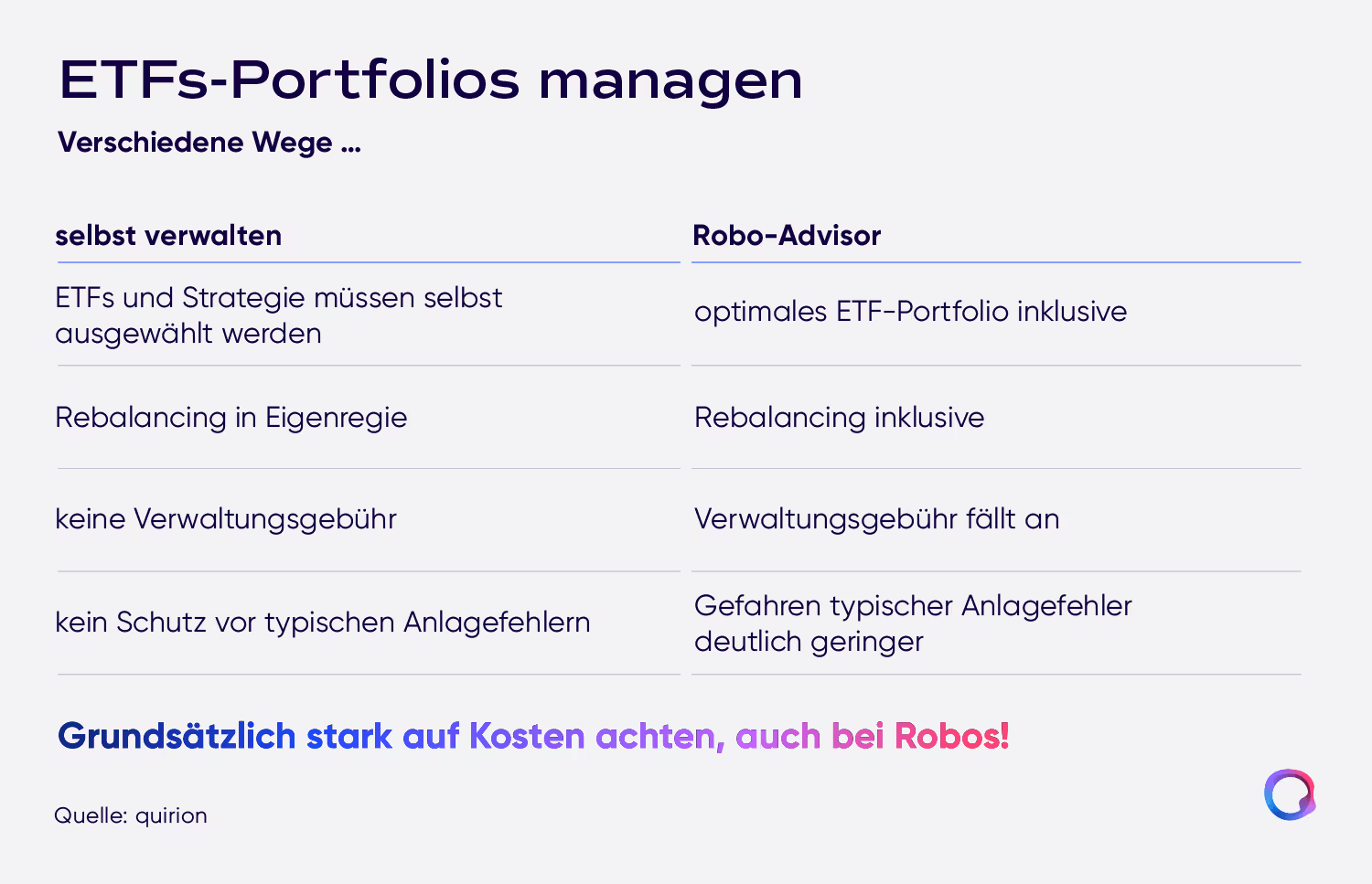
Opportunities and risks in self-managing ETF portfolios
First of all, self-management is cheaper, since of course no additional fees are incurred for managing the portfolio. That applies at least to many online brokers. With traditional banks, however, there may be custody account fees.
In addition, investors who manage their portfolio themselves are more flexible in deciding which adjustments they make and when.
But this greater degree of personal responsibility comes with risks:
- The self-managed strategy requires time and knowledge.
- Investors have to inform themselves about the various ETFs and how they are constructed.
- Moreover, in almost all cases it is better to stick to a chosen investment strategy and not to make (day-to-day) current decisions about your investments.
- The risk of emotionally driven investment mistakes should by no means be underestimated.
Put another way: Buy-and-hold can be a challenge for investors who have no experience with investing.
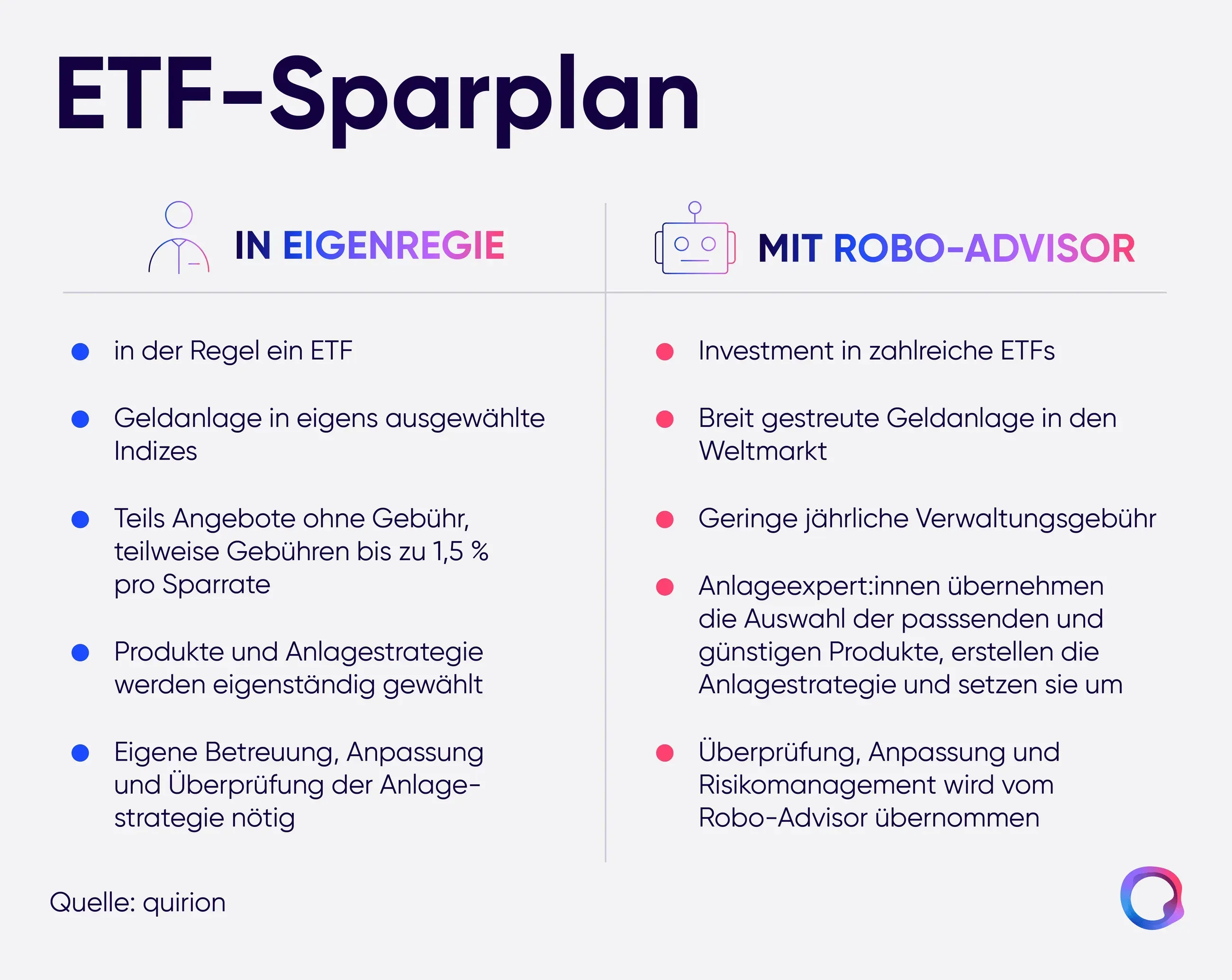
Which variant should you choose?
That is, of course, a matter of taste: A robo-advisor in any case offers convenience and represents a simple as well as low-cost way to invest in ETFs, without investors having to devote much time and knowledge to it.
Investors state their investment goals and risk appetite and the robo-advisor automatically selects the appropriate investment strategy. The portfolio is then regularly adjusted in order to ensure the chosen strategy on a lasting basis.
The bottom line is: a robo-advisor simply makes fewer investor mistakes. By this we mean in particular mistakes that only humans make (can make):
- Lack of experience: Many private investors do not know how to build and manage an effective ETF portfolio.
- Insufficient diversification: An ETF portfolio that is not sufficiently diversified can be highly susceptible to painful losses.
- Emotional decisions: People can make wrong decisions due to emotions such as fear or greed; a forecast-free robo cannot.
- Insufficient monitoring: An ETF portfolio requires regular monitoring and adjustment. With a robo-advisor, this is firmly programmed in.
Good to know: It is important to be aware of such risks and to develop a strategy that suits you . Investors should inform themselves thoroughly about the ETFs they invest in, develop a diversification strategy and always base their decisions on a rational analysis .
Robo-advisors put to the test: which is the best?
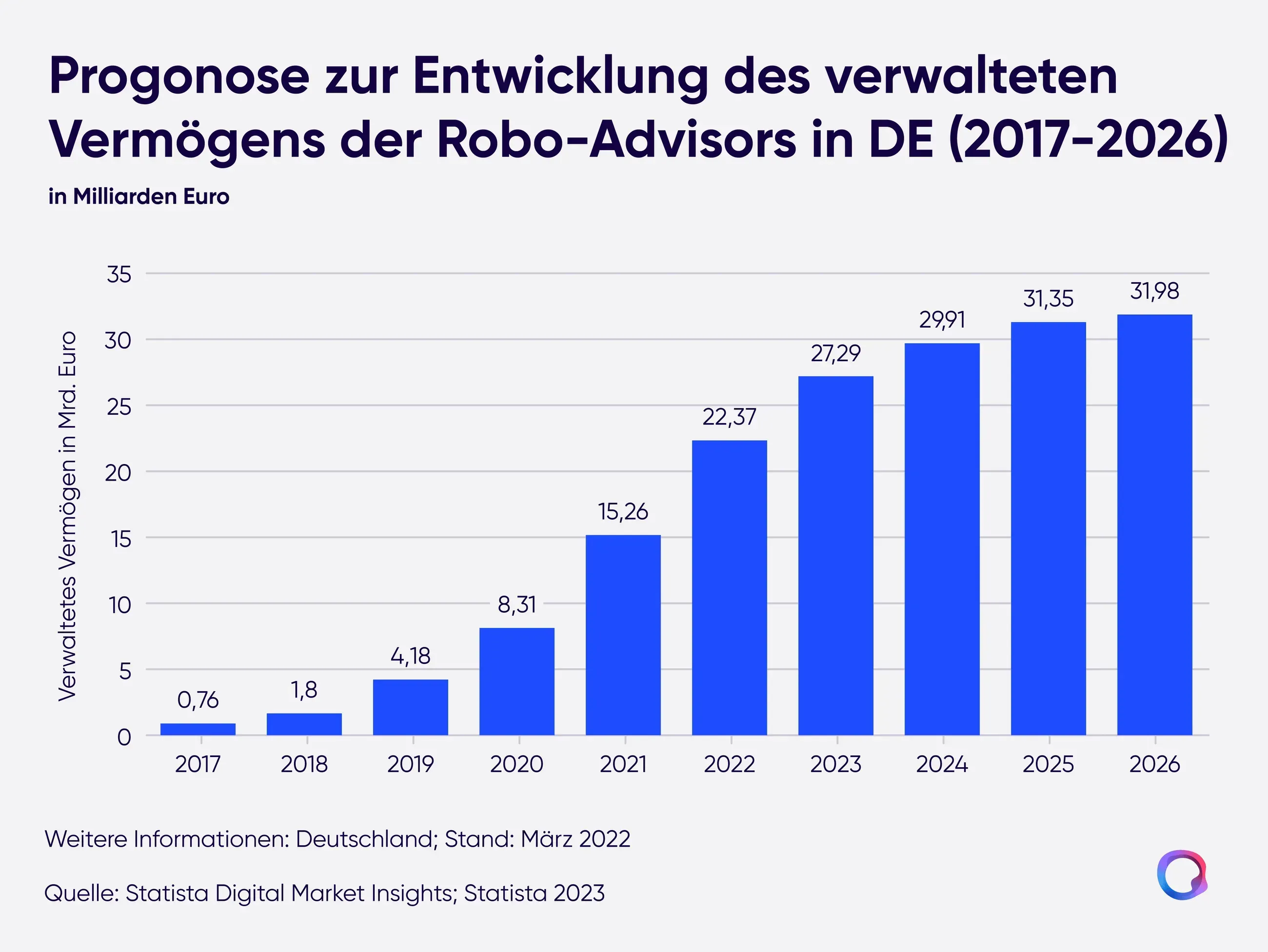
„Digital investing is conquering the financial markets“ states the magazine Finanztest in a large robo-advisor comparison in issue 7/2021 . Within the European Union (EU), Germany leads the market for robo-advisors.
This is shown by the figures from recent studies. At the end of 2024, robo-advisors in Germany managed around 29.9 billion euros in funds.
In addition, the assets managed by robo-advisors in Germany are continuously increasing:
Which robo-advisor is the best?
The question of which robo-advisor is more suitable has to be guided by the individual goals and needs of the investor . When comparing the offers, however, a few criteria are important.
- Minimum investment: There are considerable differences in the minimum investments – from 1 euro to 100,000 euros.
- Independence: If the asset manager belongs to an issuer of investment products, this can severely cloud neutrality in the selection of products.
- Costs: The important comparison criteria also include costs and fees as well as transparency in the product and cost information.
Good to know: The flat-rate asset management fee at quirion in the Digital package is only 0.48 % p.a. on the entire invested capital.
Be cautious with performance comparisons and best-of lists
Many investors are interested in performance comparisons, that is, a comparison of the performance of robo-advisors.
However: A performance comparison can be misleading for various reasons:
- For one thing, many robo-advisors are still young on the market and cannot point to long-term performance data.
- For another, different different investment strategies can only be compared to a limited extent.
- An example: Portfolios with differing equity ratios inevitably generate differing returns.
- But that says nothing about the quality of my investment.
- Finally, „best-of lists“ change from year to year and from month to month.
The phenomenon of orienting oneself around best-of lists has a name of its own: „performance chasing“. Translated, this means something like the „chasing of performance“.
5 myths about robo-advisors: true or false?
Among the many myths and rumourscirculating about robo-advisors, we would like at this point to set the following 5 misrepresentations in the right light.
1. Robo-advisors are only suited to young investors
Completely wrong. As with any investment, it depends, as with any investment, on the savings period. Anyone who still has more than 5 or better still 10 years to save money – for them a robo-advisor is just as good a choice as for young people who are only just starting out with saving.
Good to know: quirion’s clients include all age groups – starting with children, through students, career starters and employees all the way to best agers (50+) and older investors in retirement.
2. Robo-advisors trade without human oversight
That is not correct. The robo-advisor does two things:
- It develops a portfolio, matching the risk profile of the investor.
- It supports the management of the investment, e.g. the rebalancing.
But behind the selection of ETFs, and thus behind the investment strategy, there are real peoplewho make this broad diversification across equities and bonds possible worldwide.
3. Active fund managers are superior to robo-advisors
Of course, there are some active fund managerswho are very successful. But the vast majority of active funds do not manage to beat the market regularly.
On top of that: no one can predict which funds will beat the market for a certain period in the future. The best-of lists of the past have no predictive value for the future.
That is why the passive and forecast-free strategy is superior here: It offers private investors the opportunity to invest relatively safely in the whole market and to benefit from the development of the markets.
4. Clients are only offered simple model portfolios
No! Behind quirion’s portfolios, and thus behind the selection of specific ETFs , lies meticulous work that we like to call the „engineering craft of investment management“.
Based on capital market datagoing back more than 20 years, the path leads in many steps via a specific equity factor-index combination to an ETF portfolio for our clients that is low-cost and maximally diversified.
>>> You can find out more about this in the guide on diversification
5. Investing yourself is cheaper
At least as a blanket statement, that cannot be said. It always depends on the costs of the bank holding the custody account or the online broker, and also on how often trading ultimately takes place.
And when it comes to costs, it also depends on what you compare. Of course, on balance it is cheaper if you invest yourself in a single world ETFrather than using a robo-advisor.
However, a robo-advisor never invests only in a single world ETF – if only because it is too weak a representativeto reflect the entire global market. At quirion, investors have up to 16 ETFs in their portfolio and nevertheless pay an asset management fee of only 0.48 % p.a. (as at January 2024).
Conclusion: With a corresponding investment of time, it may be possible to save on fees, but in return you forgo a great deal of know-how and convenience.
The asset management fee at quirion includes, for example:
- scientific portfolio construction
- rebalancing of all portfolio positions in the event of strong deviations and with every deposit, but guaranteed at least once a year
- determination of your personal risk profile
- all transaction costs
- selection of the most suitable individual ETFs for the portfolio
Excursus: the development and rise of robo-advisors over the past decades
Financial service providers are pioneers in the digital provision of products and services. Evidence of this is provided, for example, by the third Digital Life Index from the digital consultancy Publicis Sapient, which was published in November 2021.
This comparison shows: Consumer satisfaction with digital experiences is higher among financial service providers than in all other sectors of the economy, such as retail, travel, automotive or healthcare.
1990: first wave of digitalisation through online brokers
Financial service providers were early to bet on the use of digital technologies. In the 1990s, for example, the market entry of online brokers fundamentally changed securities trading. They first spread in the USA. In Germany, Karl Matthäus Schmidt founded one of the first online brokers with Consors in 1994 one of the first online brokers.
Before the new competition from online brokers, the fees for private investors were very high. They were often at least one per cent of the order volume. Orders from private clients were frequently executed only once a day.
Good to know: Flexible, variable trading was reserved for institutional investors. Today, round-the-clock trading on favourable terms is taken for granted.
2000: robo-advisors digitalise advice
After securities trading, digitalisation increasingly reached digitalisation around the turn of the millennium investment advice and asset management. Automated software for the composition of a portfolio had existed since the early 2000s.
But it was not available to most private investorsuntil the first robo-advisors came onto the market.
2010: robo-advisors in Germany since 2013
Among the pioneers in robo-advice is Betterment from the USA. This independent robo-advisor started in 2010 accepting investments. Impetus came not only from the technological side.
At the latest in the course of the financial crisis, trust declined in many advisory offerings. This was because in-house products in particular were often recommended. Sales commissions were frequently to the fore.
In Germany, quirion was one of the first robo-advisors in 2013. It belongs mainly to Quirin Privatbank, the first independent fee-based advisory firm in Germany. That had been founded by Schmidt in 2006. The model: clients pay for the independent advice, which thereby remains independent of sales commissions.
2020: ETFs help the rise
The growing interest in robo-advice is closely linked with the strongly grown spread of ETFs. In November 2021, according to the research company ETFGI, around 9.7 trillion US dollars were invested worldwide in ETFs. For comparison: in 2005, it was just 417 billion US dollars. ETF is the abbreviation for „Exchange Traded Fund“.
ETFs are also referred to as „passive funds“. Unlike with active funds, it is not the fund management that decides on the securities they contain. ETFs replicate, forecast-free, the performance of an underlying index, a bundle of equities or bonds.
Trading via the stock exchange makes it easier for private investors to buy and sell such securities. The broad diversification of the funds reduces the risks.
Good to know: Compared with active funds, the ETFs are considerably cheaper. They are therefore a very good instrument for making asset management more efficient.
The future prospects of robo-advisors
Overall, the future prospects of robo-advisors are promising. Robo-advisors have gained strongly in popularity in recent years and are expected to continue growing in the future too. Here, in closing, are a few reasons:
- Convenience: Robo-advisors offer a convenient way to invest in ETFs, without investors having to devote much time and knowledge.
- Lower fees: Robo-advisors have comparatively much lower fees than traditional financial advisors, which continues to make them attractive for investors.
- Automated investment strategies: At best, robo-advisors combine the know-how and experience of independent financial experts in investment design and portfolio management with efficient automation of the investment process, with the aim of maximum diversification and fair returns.
- Personalisation: Robo-advisors offer a personalised investment strategy that is tailored to the individual needs and goals of the investor.
- Demographic development: The younger generation often prefers digital solutions and is open and willing to manage their finances online.
Conclusion: what a robo-advisor can offer you
As digital platforms, robo-advisors make financial planning easier and support building wealth.
A typical robo-advisor determines for this purpose, via a digital questionnaire, e.g. the investment goals, the risk appetite and the financial situation. The robo-advisor uses the data gathered in this way to make suitable investment proposals and to invest the capital accordingly.
Good to know: A good robo-advisor offers a low minimum investment, low fees, a scientifically grounded portfolio and a high degree of transparency.
quirion’s robo-advisor offers you the following benefits:
- You can start saving at any time – from as little as one euro.
- You pay only 0.48 % p.a. asset management fee on the invested money.
- You don’t have to worry about your investments – we do that.
- Your portfolio is maximally diversified – on the basis of scientific insights.
- Your investment matches your risk profile – with worldwide return opportunities.
{{anlage-component}}
Arndt Kussmann
Arndt Kussmann is Head of Investment Communication and Analysis at Quirin Privatbank, to which the robo-advisor quirion also belongs. The certified securities analyst has worked in the group for over 15 years. Before his time at Quirin Privatbank, Kussmann worked for more than 10 years in the savings bank sector, primarily as a securities advisor for wealthy private clients and later also as an asset manager.
Still have questions?
All FAQsWhat does a robo-advisor do?
Which robo-advisor has the best performance?
Who are robo-advisors suited to?
Are there savings plans too?
What benefits do robo-advisors offer?
What are the arguments against robo-advisors? Disadvantages?
How many robo-advisors are there in Germany?
What happens if quirion goes bankrupt?
How many people use robo-advisors?
How safe is investing in ETF portfolios?
Why does „rebalancing“ reduce risks?
With a robo-advisor, does everything work automatically?
Invest now and build wealth.


You are in good hands

Save now with the test winner
Best to get going today!
Read more about our awards.
