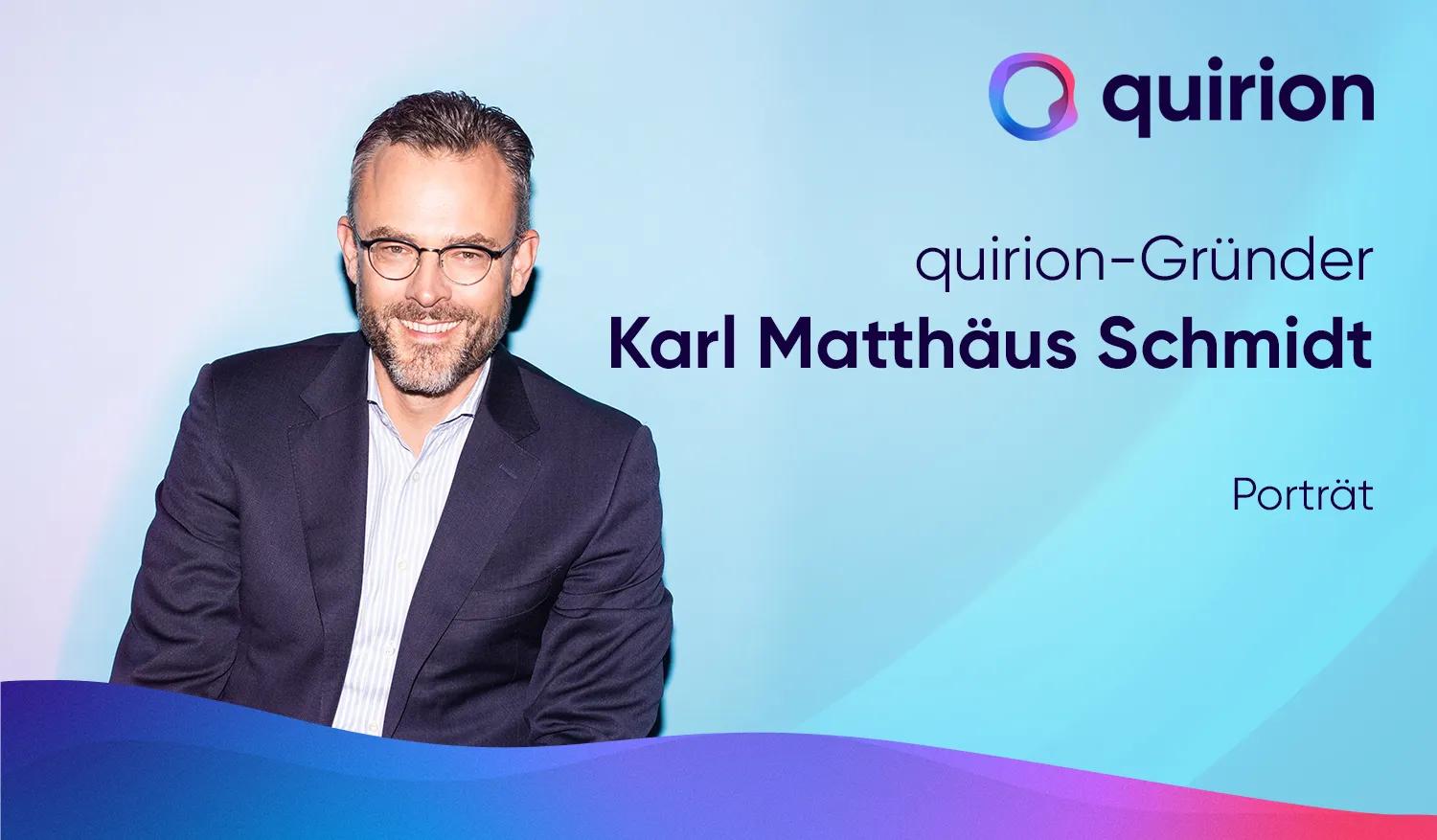
Ten years ago, Karl Matthäus Schmidt founded quirion — and with it the first robo-advisor in Germany. But that isn't the only one of his innovations to have caused a stir in the finance industry.
He inherited the "entrepreneurial gene." The first banker to found a bank in his family was his great-great-great-grandfather. Karl Matthäus Schmidt is now a banker in the sixth generation. But preserving traditions in the banking business really isn't his thing. Schmidt prefers to look to the future rather than the past. And he likes to break new ground, even when it means ruffling feathers.
"Even as a child I got to know the banking business from the ground up. Over dinner, we often talked about nothing else," Schmidt recalls. "That said, my family's bank was mainly about lending to mid-sized businesses, not about investing." So when people ask him how he discovered his passion for investing, he doesn't point to his family history. He talks about his time doing military service. About how he watched the "Telebörse" stock-market show on Sat.1 on TV every day. And about how the ups and downs of the markets "hooked" him back then.
Disruption instead of tradition
But like many others, one thing bothered Schmidt: "In the 1990s, the fees for trading stocks were outrageously high." On top of that, orders from private clients were often only executed once a day. "Cheap and flexible trading was something only for institutional investors." Backed by his father, he took matters into his own hands. Still while studying business administration, in 1994 he founded Consors, one of the first online brokers in Germany. Trading as a private investor the way the pros do — that was the underlying idea. The idea was hugely successful and caught on.
Being able to trade securities cheaply at any time is completely taken for granted today. But not everyone wants to handle their investments themselves. Even during his time at Consors, Schmidt was repeatedly asked which bank he could recommend for advice on wealth matters. "I really couldn't think of one. Because back then we ourselves were focused on enabling people to invest on their own." That got him thinking. Internal analyses added to his pondering. According to them, the most active investors lost money in an average of ten months a year and only made gains in two months.
Schmidt wondered: What would a bank look like that he would recommend? And how could it help improve the chances of investment success? "After the Consors chapter had closed for me, I took a look at the market." What jumped out at him was that advice was, as a rule, all about pure product sales. "Because of the dependence on product commissions, the client's interest usually takes a back seat to this day." The result: "Investors pay far too much money for products that don't even suit them and their goals."
A new category of bank
He didn't stop at that observation. In 2006, Schmidt founded Quirin Privatbank, which he still leads as CEO to this day. In doing so, he created an entirely new kind of bank in Germany. It forgoes commissions, advising clients independently on a fee basis instead. "In terms of investment strategy, we initially pursued a multi-asset approach, drawing on various product categories," Schmidt looks back. "We passed on commissions from issuers to our clients."
With the rise of ETFs and their growing variety, Schmidt and his team were able to take another decisive step. "We recognized the opportunity these products offer for our advisory concept." In 2010, Quirin Privatbank aligned its investment strategy — built around the global market portfolio — essentially toward investing in ETFs. The advantages for investors were, and remain to this day, obvious. Active funds are far more expensive than ETFs. And over the long term, the "passives" usually outperform the "actives."
Venturing into digital asset management
The fact that Quirin's new investment concept was well received was confirmed by growing client numbers as well as regular surveys. But the latter also showed that younger people in particular wanted an affordable digital solution rather than classic asset management. "I was still missing an offering that would also appeal to those who want to build wealth in the first place," Schmidt says. By founding quirion — initially as a brand of Quirin Privatbank — he brought the idea of robo-advice, a digital form of asset management in ETF portfolios, to Germany in November 2013.
Schmidt is proud that this idea has also caught on in this country. Together, Quirin Privatbank and quirion now serve around 88,000 clients and manage assets of €7.8 billion. But as much as he is pleased about the success, Schmidt regrets that even more people don't use the capital markets to invest. Professional asset management for every risk appetite, with savings plans starting at just €25: the hurdles to getting started are very low at quirion.
Harnessing the power of the capital markets
In the past, Schmidt was a passionate trader of individual stocks. Today he is convinced: a broadly diversified, global ETF portfolio significantly improves the chances of investment success. "That was a learning process for me too. Today, apart from my entrepreneurial holdings, I no longer have a single individual stock in my portfolio."
What the power of the capital markets can do for building wealth still fascinates the seasoned investment professional. "If my parents had invested €30,000 for me in a well-diversified portfolio when I was born, it would have grown to over a million euros by today." There is a great opportunity in systematic investing for everyone, he says.
Schmidt is the father of five children. He invested money for them early on. But would he also recommend that they follow in his footsteps? "If they want to become entrepreneurs and realize their dreams that way, I'd be delighted — no matter what industry it might be in." Being an entrepreneur, to him, means driving forward an idea you're passionate about. "That can be very exhausting, but also very rewarding." He continues to pursue the goal of making Germany a better place for investing. "That drives me on, and I'm certain: we will achieve a great deal more on our path toward 'returns for all.'"