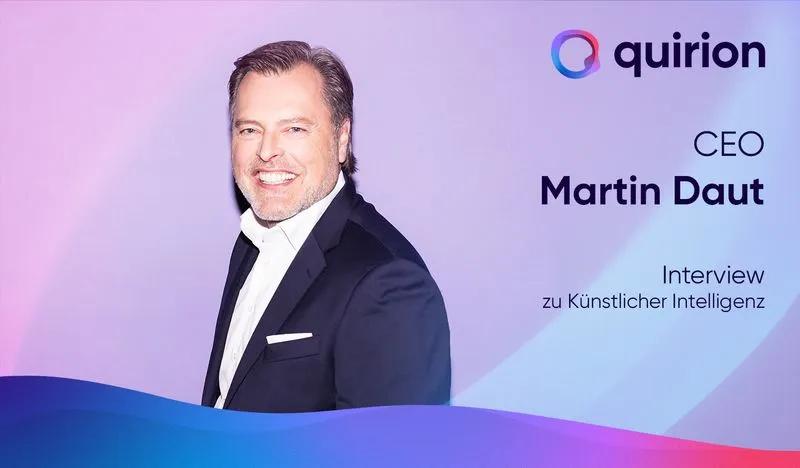
Since ChatGPT was introduced to the public around a year ago, artificial intelligence (AI) has been a hotly debated topic. New applications are spreading step by step. Our CEO Martin Daut explains how he assesses the potential of AI - and which misunderstanding he keeps having to clear up in these discussions.
With „Large Language Models“ like ChatGPT, AI has taken a big leap forward. And Microsoft has declared its goal of making AI accessible to everyone. Will this be the big breakthrough?
The potential of AI for the economy as a whole is truly enormous. And Microsoft is certainly a company that can drive its broad adoption forward in a big way. It's really rather clever how Microsoft CEO Satya Nadella is handling this topic. I was recently invited to a CEO talk with him and other chief executives, as part of the Axel Springer Award. The award goes to individuals whose innovations create and transform markets - this year to Nadella, above all for his advances around AI. Microsoft applications are used by hundreds of millions of people all over the world. That gives the company a huge platform for spreading AI tools.
At the CEO talk for the Axel Springer Award, you were the only expert from the financial industry, and you were asked what consequences AI will have for it. So what are the conceivable effects?
I think AI can be a game changer in our industry too. The financial sector is very data-driven. Broadly speaking, AI will make new applications possible in everything that has to do with data. AI can also simplify and speed up heavily routine-based processes even further, for example during onboarding. As an asset manager, we have to ask new customers more questions than an online broker does, for regulatory reasons. Imagine if this onboarding could run through a chat where you can switch languages at the touch of a button. Or verbally instead of in writing, through a conversation. That would make the process easier for many people. In the linguistic capabilities of „Large Language Models“, I see a great many opportunities to remove barriers - for example for people with disabilities.
But at the CEO talk for the Axel Springer Award, I once again had to make a point clear that is often misunderstood. Even an AI cannot foresee future market developments. It doesn't make superior investment decisions.
Why are you so sure about that?
Take the stock market, for example: what matters for prices is not a company's earnings over past years, but expectations for how profits will develop in the future. And those change constantly in unpredictable ways. There are no fixed rules that would let you systematically predict what will shape expectations next week or in two years' time. That's why no algorithm, however sophisticated, can outperform a broad market portfolio over the long term through the targeted selection of securities. Many studies have confirmed again and again that active selection does not increase investment success, but usually diminishes it. I don't expect that to change.
How will quirion use AI?
AI isn't built against people, but for people. Using technology to remove barriers and simplify processes, while leaving the fundamental decisions to people - that's what we want to hold on to at quirion. Right now we're carefully exploring the possibilities. And I have to say: AI projects are so very different from the classic IT projects I've known for many years. The expertise isn't yet as widespread and available as one would sometimes like. You can't plan and budget the implementation as well as we're otherwise used to with IT projects. With AI projects there are sometimes phases where little seems to be moving forward - and then suddenly comes a big leap ahead.
Even if it will still take some time for AI to fully unfold its potential: how can investors benefit from its growing adoption?
Artificial intelligence, for example, is one of our thematic investments that we offer for megatrends. But you don't have to focus specifically on one particular segment of the market at all: the fields where AI is applied run right through the entire economy. According to a study by the McKinsey Global Institute, the use of generative AI alone - which includes chatbots like ChatGPT - could lead to annual productivity gains of 2.6 to 4.4 trillion US dollars worldwide. That's on the order of the United Kingdom's annual economic output.
There are various scenarios and forecasts. But with a broadly positioned global ETF portfolio, you benefit quite generally from the growth of the world economy. With us, you can do that with a savings plan starting from as little as 25 euros a month. Our goal is „returns for everyone“. And on the way there, AI can help.