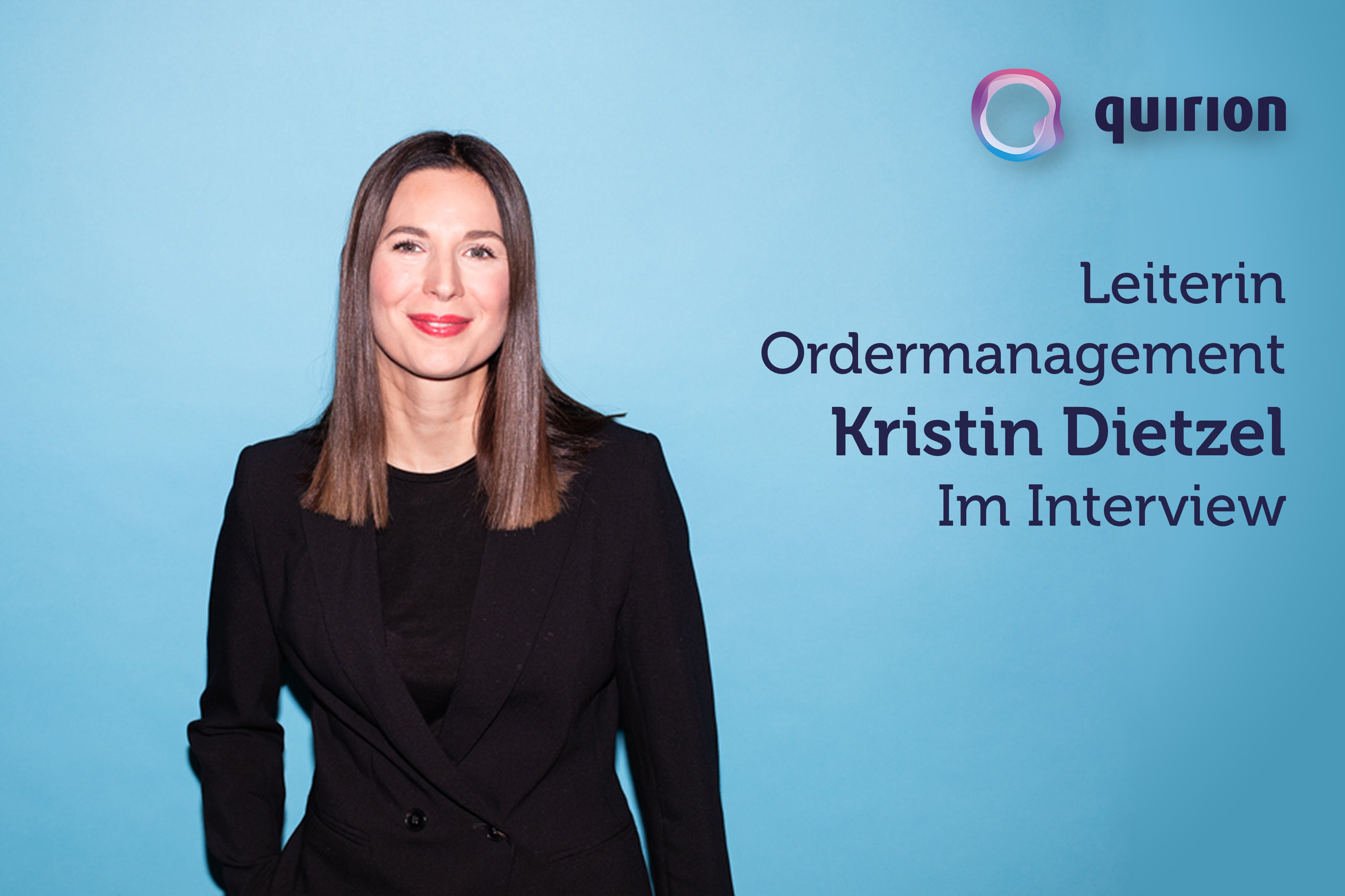
For investors at quirion to set up a managed portfolio, top up their account or switch strategy simply and affordably, a lot has to mesh together behind the scenes. Kristin Dietzel, head of order management at quirion and Quirin Privatbank, offers insights into the processes.
A few details and clicks on the website or in the app, and investors at quirion have placed a new order. With a robo-advisor, does everything run automatically behind the scenes too?
It's not quite that simple. For the accounts to follow the planned strategy, several processes have to mesh together. Our order management is something like the „engine room“ where this gets implemented: while our colleagues in investment strategy design and monitor the model portfolio, we take care of what's known as product allocation. We bring the model portfolio into the accounts. We process client orders, bundle them into block orders and check that they're executed. We also answer client enquiries that concern the details of an account – for example when questions come up about how a strategy switch is handled. Because a large number of orders reach us every day, this is a complex task. It doesn't get done „at the push of a button“, even if much of it runs digitally.
A client has opened an account or wants to top up. The money has been transferred. What happens now?
Our system registers when the free capital in the client's cash account exceeds 0.4 percent. It then first checks whether there are any other orders relating to this account – a withdrawal, for example. If not, the product-allocation process begins. It's important to understand here that we don't simply pass an order on to a trading venue like an online broker. When someone tops up their account by 500 euros, we don't just order units of a particular ETF. What's central every time is the target-versus-actual comparison against the relevant model portfolio.
What does that mean in practice?
Our software calculates what proportions the account should hold in each of the up to 15 different ETFs of the model portfolios according to the intended strategy. Logically, 500 euros for a strategy with 70 percent equities produces different orders than a top-up with a 30 percent equity share. In both cases, though, we need to determine which units across all 15 ETFs of the model portfolio should be ordered for the 500 euros. Almost always, these end up being fractions – right down to hundredths of a unit. Once this has been calculated for all of a day's orders, the block order can be created. In doing so, we combine all purchases and sales into a single order. An example: if, for a day's order in the Amundi Prime Global, we've calculated 4,000 purchases and 2,000 sales, that results in a buy order of 2,000 units. Once the order is executed, all clients get the same price. By bundling, we keep trading costs as low as possible.
Does it work the same way with savings plans?
Yes, the process is the same. With every savings instalment, too, the comparison against the model portfolio is key. What counts here is the account, not the individual instalment. Let's say an investor has had the savings plan for some time and the next monthly instalment is due to be invested: in the target-versus-actual comparison of the account against the model portfolio, we look at which ETFs are underweighted overall. Those are the ones we top up with the savings instalment. That effectively produces an automatic rebalancing.
Why is rebalancing important?
Because of price fluctuations in the markets, the weightings within a portfolio shift over time. When an ETF's price rises, its share increases relative to the others. Once a year, we regularly realign all accounts with the planned allocation. In addition to this regular adjustment, we monitor closely on every trading day whether the weights targeted in the model portfolio are exceeded or fallen below by 10 percent. If the threshold values in the model portfolio are exceeded, an unscheduled rebalancing of all individual accounts is triggered. In portfolios where the share of equities or bonds is very small, threshold values of 15 or 20 percent respectively apply.
quirion's investment strategists check from time to time whether the ETFs in the model portfolio are still the ones best suited to it. What happens when a product there gets replaced?
The process behind the scenes is essentially the same as with a rebalancing. In this case, the swap simply affects one position in the model portfolio. After that, all individual accounts are realigned to the new setup through a target-versus-actual comparison. The ETF being replaced is sold via a block order, and the new one is bought. A change like this costs clients nothing extra.
Setting aside the technical details: what makes working at quirion special for you?
I've now worked in wealth management for nine years, seven of them at Quirin Privatbank. A managed portfolio with no minimum investment amounts: I think that's simply a great offering. Wealth management is usually only available from six-figure assets upwards. We can only make this offering possible with efficient processes behind the scenes. I'm proud that our team makes an important contribution to keeping minimum investments and costs so low.
You can find more about building wealth with quirion here.