Put the MSCI World Index into your portfolio – and you've got “the” global equity market in your pocket? Unfortunately, it isn't quite that simple. Why quirion makes it easy for investors, but has to do a fair bit of tinkering to get there. An article by Prof. Dr. Stefan May
Decide once how high the weighting of equities and bonds should be, in 10% increments up to a 100% equity share. Really, that's about all investors need to decide at quirion. Simple, isn't it? Capturing market returns without relying on forecasts, spreading the risks as broadly as possible – that is our goal. This is implemented with the help of a global portfolio composed of high-quality ETFs, because our strategy is most efficiently realised with low-cost index products. But now some of you might be wondering: why not just invest in ETFs yourself? Where is the added value in investing through quirion?
As diversified as possible
Capital market research confirms it time and again: when it comes to the relationship between expected return and expected risk, a portfolio of all the equities on the global market, weighted by market capitalisation, is superior to any other investment. The problem: you cannot buy the global equity market, which consists of around 48,000 companies, with any single product. So to approximate this global portfolio as closely as possible, you cannot take the direct route. The key question for how to proceed is therefore:
“How can the global equity market portfolio best be represented?”
In any case, it is not enough simply to rely on one or a few standard indices. Statistical analyses show us that individual indices always form unintended and uncontrollably shifting concentrations – the MSCI World, for example, is currently concentrated in the technology sector. It also contains no smaller secondary stocks (small caps), thereby leaving their performance out of the picture. Concentrating on individual indices and the corresponding ETFs therefore leaves important aspects of risk and sources of return out of consideration. Ultimately, every stock has a number of characteristic features that decisively influence both its performance prospects and its risks. These so-called “factors” include, for example, the valuation level (a stock's “value” content), volatility, or company size as measured by market capitalisation.
Factor indices pave the way
As part of the most recent evolution of our investment strategy, we analysed a total of 16 factor indices from the MSCI family in a multi-stage process. In doing so, we took into account that these indices sometimes overlap strongly with one another. For example, a large US stock may appear both in a low-volatility index and in a value index, which in a specific combination of indices can, under certain circumstances, lead to uncontrolled concentration risks. To avoid this, we carried out, among other things, a principal component analysis – a statistical method for structuring data that can rule out such effects.
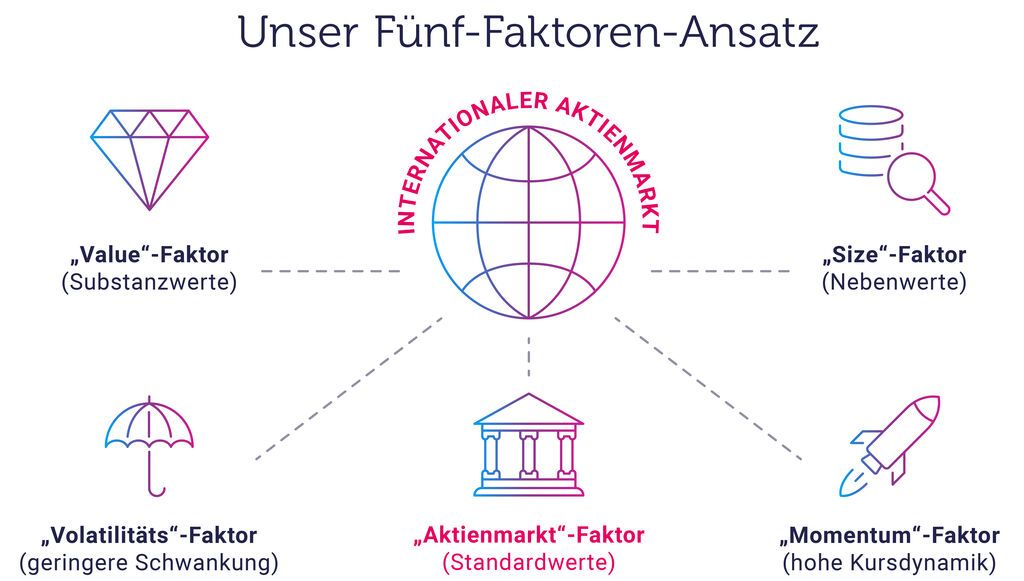
These are the factors that matter
Our analyses show that, for maximum breadth of equity market coverage – alongside a block of standard stocks – the following four factors in particular prove relevant: “value”, “low volatility”, “small caps” and “momentum”. In a further analytical step, these are condensed into a specific factor-index combination, from which a strategic portfolio weighting can be derived. We put this into concrete form using selected, cost-efficient ETFs in our customers' portfolios. What matters to us is this: many investors are constantly on the lookout for tomorrow's outperforming segments, but this is ultimately doomed to fail.
At quirion, we don't want to be “on the right side” more or less by chance; instead, we want to cover the entire international equity market as representatively as possible, at all times and free of forecasts. Only this ensures an optimal risk-return ratio. However, as outlined, this requires meticulous work behind the scenes – what we like to call the engineering craft of investment management. The quirion customer notices little of this. In the end, they receive a low-cost, scientifically grounded capital market investment that represents the quintessence of rational investment behaviour.
About the author
Stefan May is Professor of Financial Market Analysis and Portfolio Management at the Technische Hochschule Ingolstadt and head of investment management at Quirin Privatbank and quirion.