With the right diversification, you can optimize the balance between return opportunities and risk in a portfolio. But what exactly does that mean, and how do we put it into practice in our global ETF portfolio? A deeper look at our investment strategy.
Which stocks are hot and which are a flop? Does a particular sector have especially good prospects right now? For many people, questions like these take center stage when investing in the stock market. But the honest answer to those questions is: nobody knows! Even experts can't see the future. All you can do is guess, more or less well. Logically enough, that's pretty risky.
That's why we take a completely different approach. With our global ETF portfolio, we don't want to end up on “the right side” more or less by chance. So we steer clear of speculation. Instead, we aim for an optimal balance between return opportunities and risk.
Different types of risk
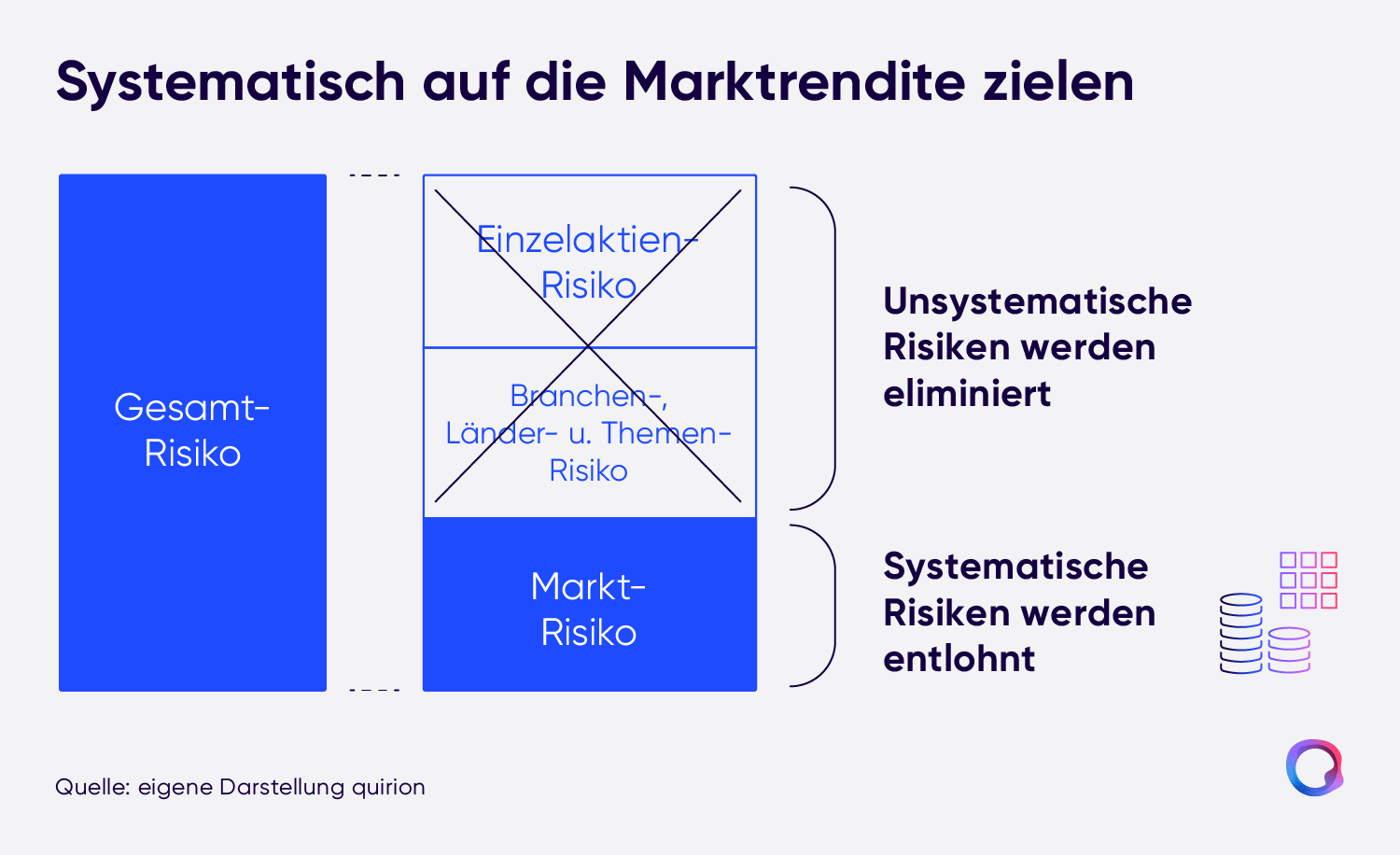
Return and risk are closely linked. Return is the reward for the risks you take on. Some of those risks relate to individual companies, sectors, or regions: a company can go bankrupt, a sector can lose relevance, a region can slide into a long-lasting crisis. “In academic terms, risks like these are called unsystematic risks,” explains Philipp Dobbert, Head of Asset Management. “If you invest in individual stocks or specific market segments, you expose yourself to very high risks. Yet the prospect of a corresponding reward is small.” The reason: you can largely avoid such risks through diversification.
Not all risks can be “diversified away.” What remains after scientifically grounded diversification is systematic risk. And that is rewarded with the market return. “Over the long term, and on average, the trend in the stock markets points upward,” Dobbert points out. “Stocks are shares in companies. So the markets are closely tied to the economy. And the economy, in turn, is fundamentally geared toward growth.”
From the idea to relevant “factors”
The goal of the investment strategy is to bring the international stock markets into the global ETF portfolio as representatively as possible. The benchmark is the “global equity market.” But replicating it isn't so simple. According to figures from the “World Federation of Exchanges”, there are currently almost 50,000 stocks listed on the exchanges. Trading all of them individually would be far too complicated and far too expensive. To build a global portfolio efficiently, you have to take a different route.
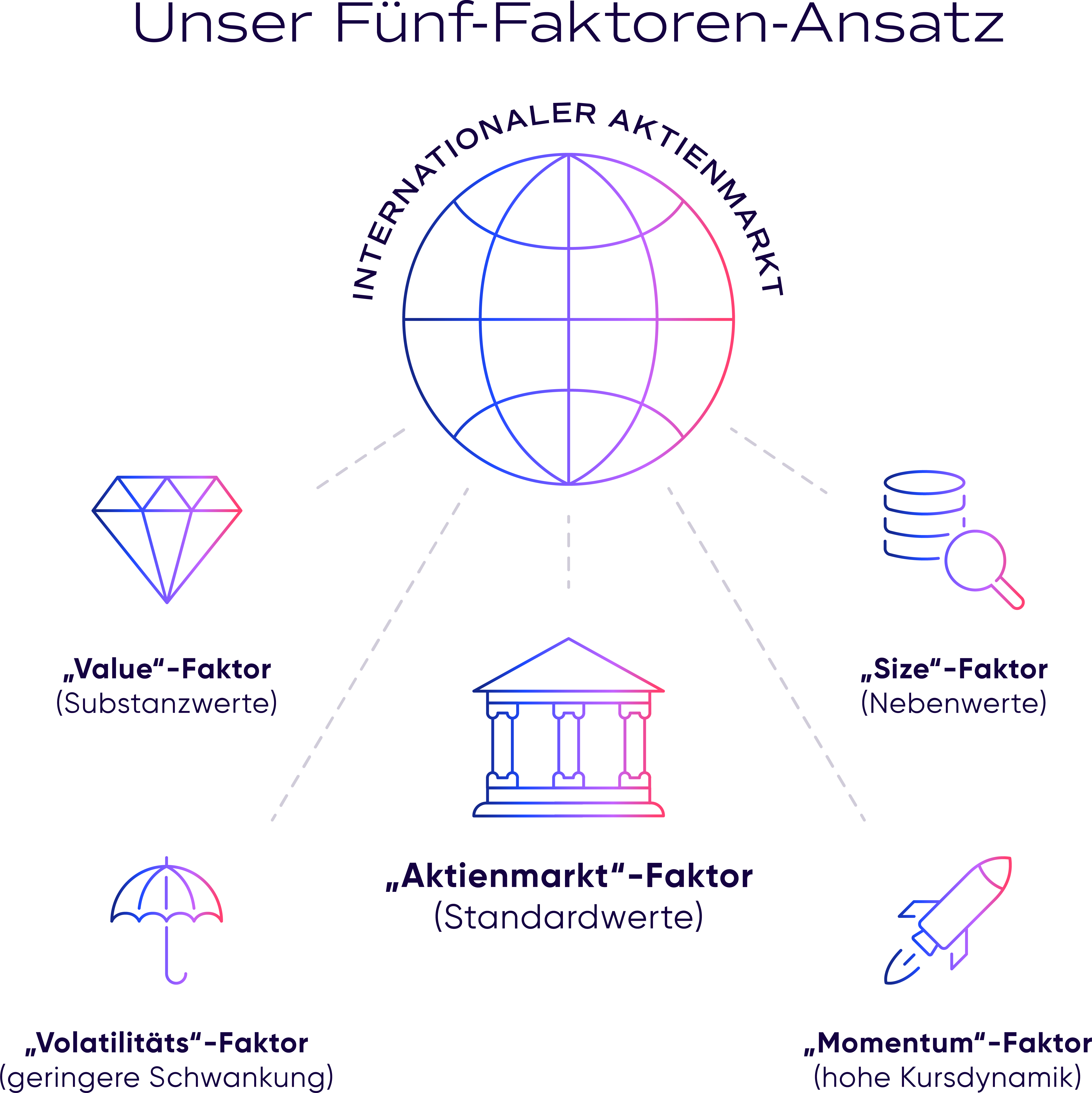
To explain that route, first one more basic idea: every single stock has a set of typical characteristics that influence both its return opportunities and its risks. “These include, for example, company size, valuation, or the extent of price fluctuations,” Dobbert explains. With the help of these and other characteristics, the diversity of all stocks can be categorized. “In technical jargon, these categories are called ‘factors,’ and for our global portfolio we currently take five of them into account.”
All in the name of diversification
Among the best-known factors are “size” and “value.” Recently in particular, there has been frequent debate about whether, given the high valuations of some large technology stocks, it might be advisable to focus more heavily on value stocks. And indeed, “value” had a strong run in many regions of the world in 2025 – for the first time in quite a while.
But even when it comes to factors, the same principle applies: “We don't speculate on trends and we avoid forecasts. We take the factors into account solely in order to diversify the portfolio as optimally as possible,” Dobbert emphasizes. “For each factor, we have defined a weighting geared toward that goal.” This way, the portfolio benefits both from rising value stocks and from rising technology stocks. Thanks to the diversification, the overall risk is lower. “Large tech stocks, for example, no longer have anywhere near as heavy a weighting in our portfolio as they do in the popular MSCI World.”
From factors to the ETF portfolio
The most efficient way to bring factors into portfolios is through ETFs. That sounds simple, but it isn't. “There are, in fact, special factor ETFs. But whatever they're called, they always replicate several factors at once,” Dobbert notes. The reason is that individual stocks carry several characteristics at the same time. A small-cap stock, for instance, can also be a value stock, or exhibit low volatility.
So when putting the portfolio together, you have to pay close attention to ensure that overlaps don't allow avoidable risks to creep back in. This is fine-tuning work that investors can hardly manage on their own. With digital asset management from quirion, it's included. “When it comes to investing, it pays to attend to the details,” Dobbert stresses. “Because only that way can you tap into the long-term return opportunities of the world's capital markets without taking on unnecessary risks.”
For an even deeper look at our strategy, see our white paper.