Banking pioneer Karl Matthäus Schmidt founded both Quirin Privatbank and quirion. But the companies share more than a common history: the two work closely together in wealth management and advisory services — to the benefit of customers.
"Private banking": for many people, this term conjures up very particular associations. You think of a certain exclusivity and high barriers to entry, but also of a very personal client relationship. It is quite different with the term "robo-advisor": here, most people probably picture a machine rather than a human being. You might imagine an app that is easy to access, but where investing remains anonymous and impersonal.
In many cases, there is something to these clichés. The barriers to accessing a private bank, or classic wealth management, are still fairly high today. Six-figure minimum investments are common. With "robos", on the other hand, there is usually no genuine investment advice — let alone personal advice.
It is completely different at quirion. And that has a lot to do with its close ties to Quirin Privatbank, which owns a majority stake in quirion. This combination does not exist in this form anywhere else in Germany.
Democratising wealth management
Banking pioneer Karl Matthäus Schmidt first launched Quirin Privatbank in 2006, followed by quirion in 2013. His core ideas can be summed up quickly: create independence in advice, free of sales commissions. In doing so, put customers at the centre. And then make the benefits of professional wealth management accessible to more and more people.
As far back as 1994, Schmidt had already shaken up the German financial world. With Consors, he founded one of Germany's first online brokers. Trading securities flexibly around the clock at low cost: what is taken for granted today was, back then, reserved for institutional investors. "After we had, in a sense, democratised brokerage with Consors, we wanted to achieve the same in wealth management," is how Schmidt describes the underlying idea.
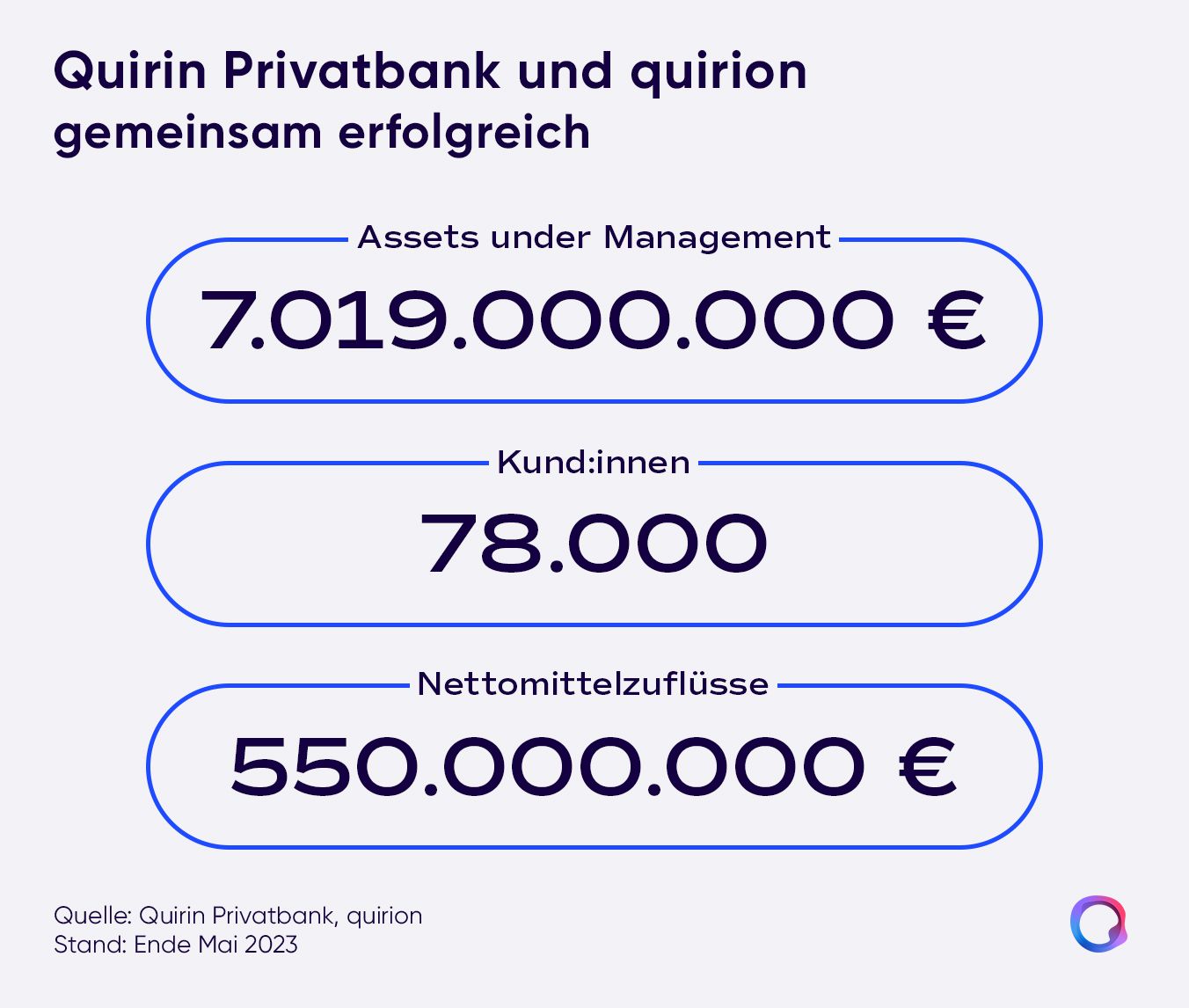
Schmidt and his team deliberately harnessed advances in digital technology and the growing supply of low-cost ETFs to put the plan into practice. Step by step, they built up and expanded the offering. One milestone was the introduction of an ETF savings plan that goes far beyond a simple product-based savings plan. Today, the two together manage over seven billion euros for around 80,000 customers.
The offering is proving popular. "The days when you went to your local bank branch and let someone talk you into a fund with high fees will soon be a thing of the past," Schmidt is convinced. Among the younger generations in particular, Schmidt sees a shift in expectations. "Many people today want to approach investing and building wealth digitally — quickly and cheaply. But some want additional support when they need it, online or in person."
A well-founded investment strategy
quirion's offering is geared to these expectations. Asset management — that is, the investment strategy and portfolio management — is handled by a team of experienced professionals based on insights from capital market research. Some colleagues work in dual roles for both quirion and Quirin Privatbank. That is because the basic rules for investment success are the same for everyone: the core portfolio should be diversified as broadly as possible in order to optimise the balance between return opportunities and risk.
As at Quirin Privatbank, investors are not left to fend for themselves at quirion either. While other robos generally limit themselves to customer support, customers at quirion have a choice: use "just" the wealth management in the Digital package, or take advantage of additional advisory services. These are available online, by phone or in person at 13 branches across Germany. "Over 90 qualified advisors work at Quirin Privatbank. quirion draws on this network too," Schmidt explains.
As a team rather than in competition
While other banks often draw sharp dividing lines between classic wealth management and robo-advisors, Quirin Privatbank and quirion are not in competition with one another. "We want to offer everyone a suitable option," Schmidt emphasises. Which one is right for them depends on the individual wishes and needs of each customer. "We can handle it this way because both companies operate independently of sales commissions and therefore do not have to compete for it," Schmidt underlines. "Together, we can simply achieve more for our customers."