
Trading back and forth empties your pockets: as far as possible, we avoid changing positions in our clients' portfolios. But sometimes it's necessary after all. With what's known as rebalancing, we ensure that the balance between return opportunities and risks continuously matches the chosen profile.
Imagine the markets are really heating up right now. Prices are plummeting. Like in April, when Donald Trump's tariff chaos threw the exchanges into turmoil. As a quirion client, you might then suddenly receive a series of securities settlements. That's because, depending on your personal split of equities and bonds, we may have carried out a balancing of fluctuations in value for you. This so-called rebalancing is an important tool for managing the risks in a portfolio.
The background: prices on the markets are constantly in motion. As a result, the weightings in portfolios are always shifting. This effect gradually changes the portfolio's risk profile. It can be illustrated particularly clearly over the long term – as in a study from 2021. In it, the authors shine a light, among other things, on a portfolio that initially consisted of 50 percent large-cap US equities and 50 percent long-term US government bonds. After 65 years, the ratio had changed drastically – purely as a result of price movements.
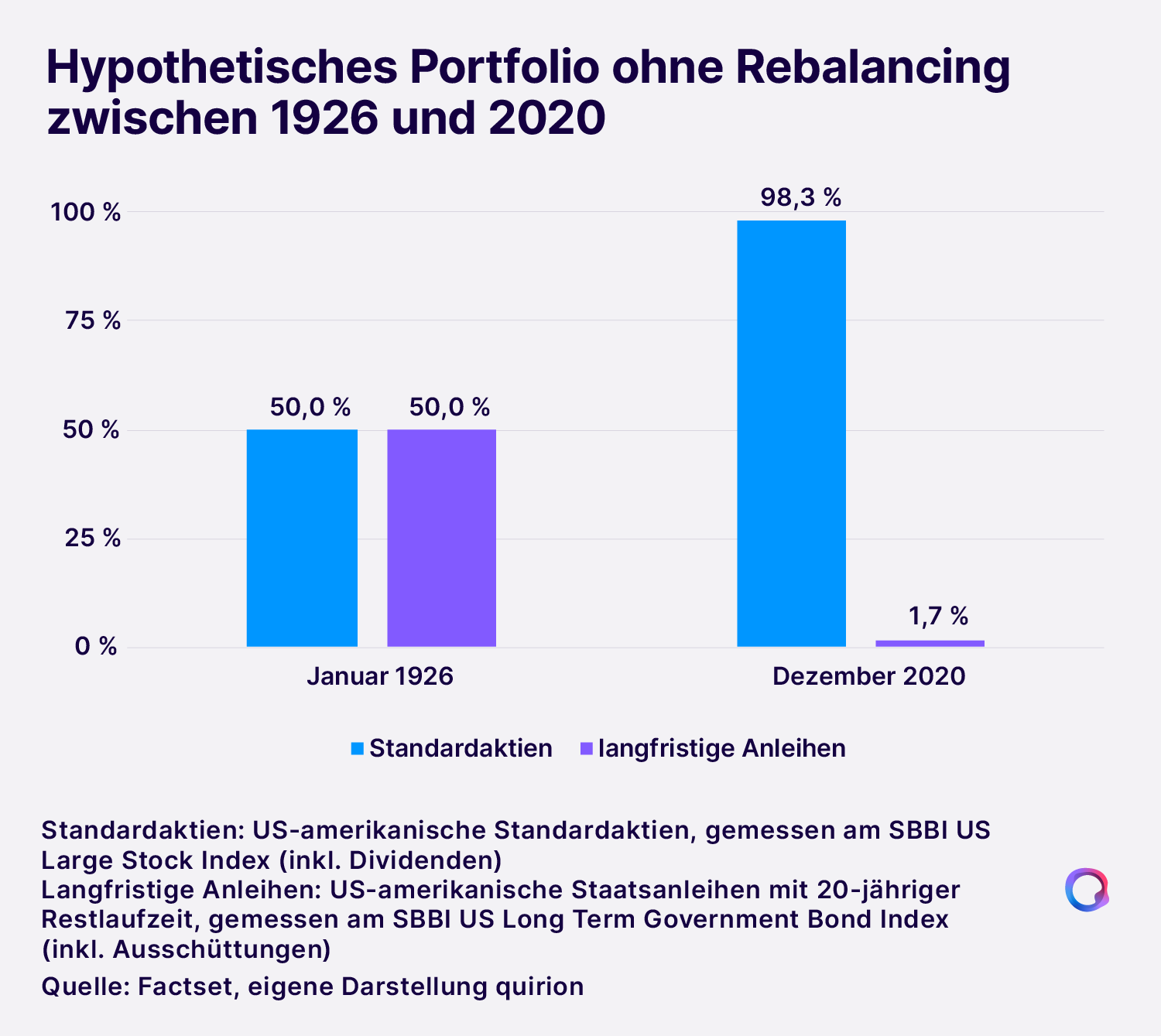
So the risk of the hypothetical portfolio grew enormously. After all, equity prices fluctuate far more than bond prices. With a rebalancing, the effects of value fluctuations on the portfolio are evened out. To do this, you sell part of the securities whose weighting has grown too heavy. You put that money into securities that have become too light. After rebalancing, the balance between return opportunities and risks once again matches the original risk profile.
Keeping a constant eye on the portfolios
At quirion there are two different occasions for a rebalancing. The scheduled one takes place once a year. "For this, we go really deep into the details," explains Philipp Dobbert, head of asset management at quirion and Quirin Privatbank. "We look at all the weightings and how precisely they fit the target values we aim for in the investment strategy. On this occasion, products are also swapped out where appropriate."
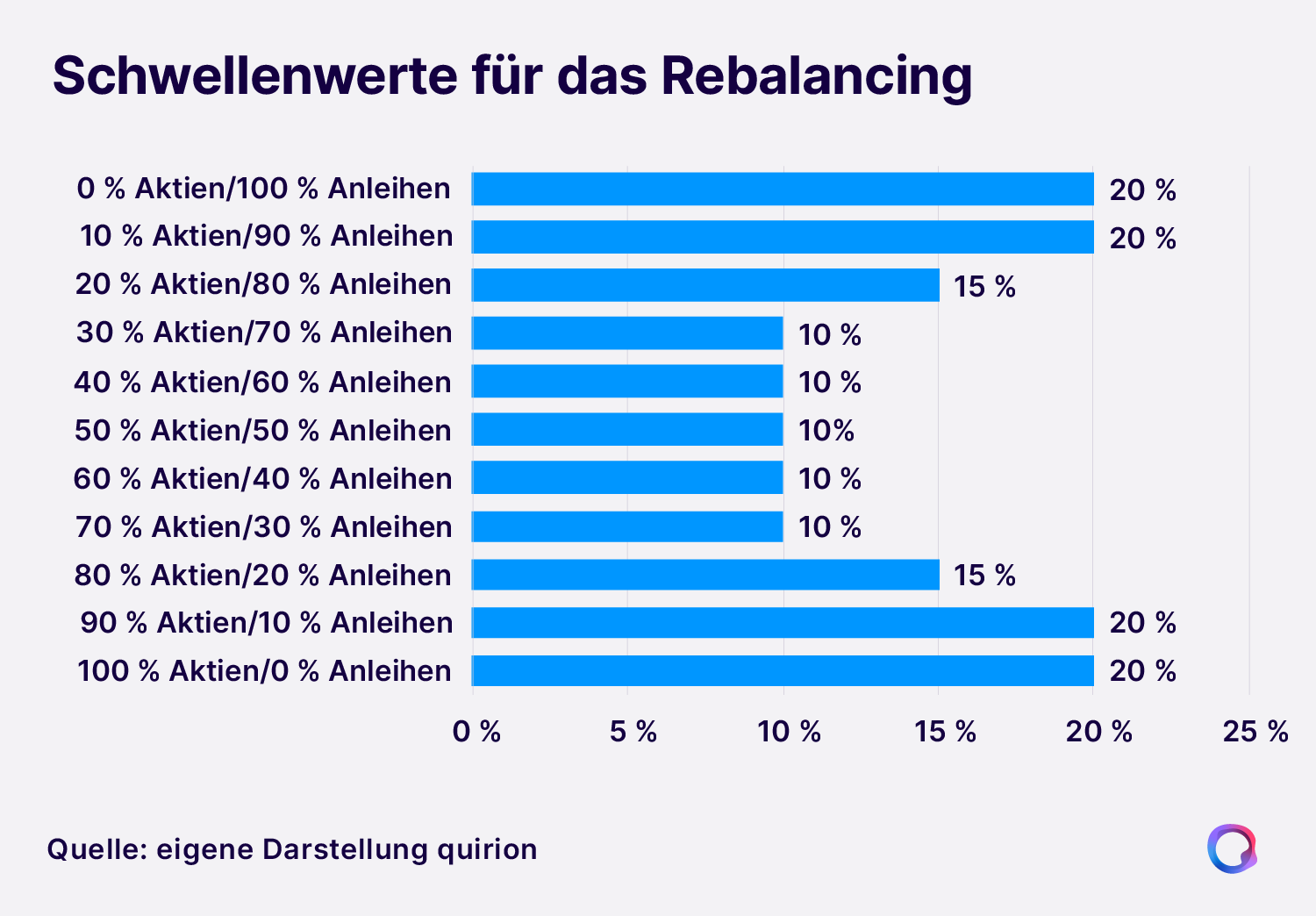
An unscheduled rebalancing happens when the actual weighting of equities or bonds drifts too far from the target weighting in the meantime. "We monitor this individually for each and every mandate," Dobbert emphasizes. The thresholds depend on the personal share of the respective asset classes in the portfolio. If the share of an asset class is particularly high, the threshold is set higher. "Otherwise the rebalancing would be triggered too often."
Managing the portfolio without forecasts
In its investment strategy, quirion always aims for the best possible balance between return opportunities and risks. "We achieve this through diversification. And not by relying on forecasts," Dobbert underscores. "Because that would be far too risky."
No one knows the future. Everything can always turn out completely differently than previously expected. Take April, for example: after surprisingly high tariff threats, a sharp downward move on the equity markets triggered an unscheduled rebalancing for many clients. Equities were topped up. Then the market shot back up just as surprisingly fast. "It looked as if we'd had a real knack for timing – but that would be a misunderstanding," Dobbert clarifies. "Had prices fallen significantly further, we would have bought even more."
If that didn't happen, the weighting of equities might, under certain circumstances, keep falling further and further along with prices. "Let's assume the weighting of equities in the portfolio drops from a target value of 50 to 30 percent. If prices later rise again, the portfolio would only benefit from the upswing on the smaller base," Dobbert explains. "That wouldn't be in investors' interests."
Costs and taxes
Balancing out fluctuations happens with both falling and rising prices. At quirion it's included – there are no additional fees for it. That said, if securities are sold at a profit, that profit has to be taxed. "There's sometimes an assumption going around that it's therefore better to do nothing, because then no taxes are due," Dobbert notes. "But that's a misjudgment."
Dobbert points out that distributions from non-accumulating funds, for example, have long been taxed. "And since 2019, a preliminary lump sum has been due on accumulating funds." You can of course also use your saver's tax allowance for capital gains from rebalancing. But even once that allowance is used up, you don't incur costs without gaining a benefit. "The tax burden isn't that large. The benefit of rebalancing for reaching your investment goals far outweighs the tax effect."
More information on rebalancing can be found in our whitepaper.