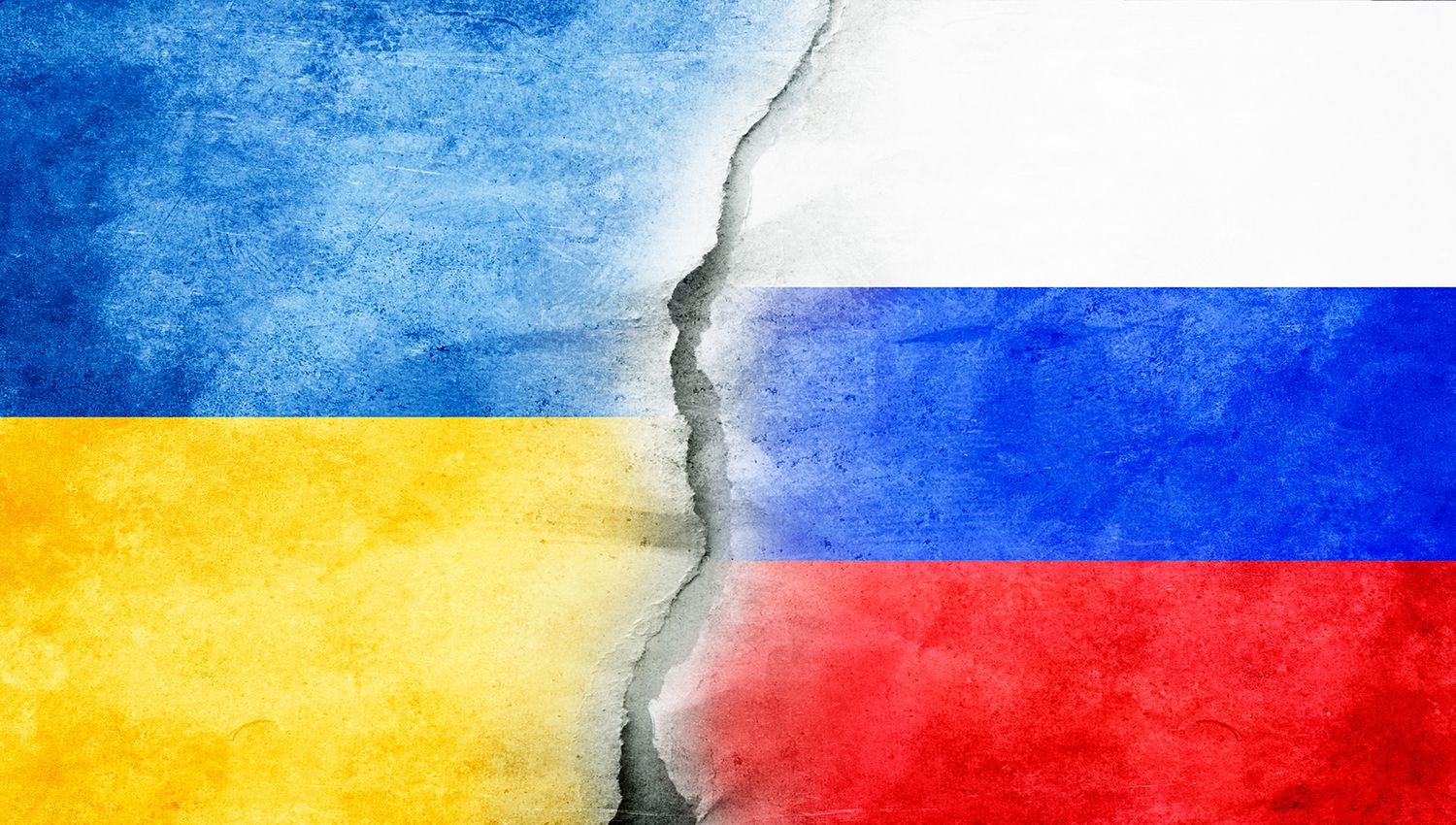
Our world today is a different one than it was just a few weeks ago: Russia's invasion of Ukraine is a serious blow to the founding values of the free Western world and a catastrophe for the people affected. In the face of the suffering among our European neighbours, most of the topics that previously seemed important have faded into the background. Understandably, many of our clients have nonetheless approached us and our founder Karl Matthäus Schmidt in recent days with questions about their investments. We have answered the most important ones for you, and we hope that in doing so we can bring at least a little more clarity to these issues and help ease the uncertainty in this respect.
1. Even though the markets have not yet reacted all that violently: shouldn't I, as an investor, get out now to be on the safe side, before things get even worse?
No, you should not. We receive this question regularly during crises, and the answer is and remains the same: do not get out, but stay invested. Keep calm and please do not make any rash decisions — that is essential in a crisis. Because the fundamental problem with getting out is this: you cement the losses you have already incurred and lose the chance to recoup them through the countermovements that will set in sooner or later. The widespread idea of "getting back in once the markets have calmed down" is an illusion, because it assumes you can get back in at the right time before prices recover significantly again. But there is no one who can announce the right moment to get in.
2. How have the stock markets generally reacted to the war so far?
The world's capital markets have reacted nervously and with noticeable declines, but we are a long way from the kind of market crashes we had to experience two years ago at the outbreak of the coronavirus pandemic. What's more, it has by no means been all downhill since the war began. Really severe upheavals have so far failed to materialise. That could, of course, change at any time. On top of that, one thing also holds true: the specific impact of the war cannot be pinned down so easily, because many other factors are moving the stock markets.
3. It goes against my instincts to sit idly by if prices do end up plummeting after all — which certainly can happen if the situation becomes even more dramatic ...
We are well aware that this is an incredibly difficult exercise for every investor. Yes, the markets could fall even more sharply — the crucial word here is "could". And that is why we stand by our position: we consider getting out of the stock markets to be the wrong move, even in the current murky situation, in the full knowledge that investment discipline is emotionally anything but easy, especially in times of military conflict. Because it is precisely in phases like these that many investors feel almost compelled to act, which is of course deeply human. After all, in everyday life we constantly experience that reacting quickly and actively in critical situations is usually better than simply waiting it out. Successful equity investing, by contrast, should never be guided by emotions — however hard that may be in the current situation.
4. Do we have to brace ourselves for long-term turbulence?
Geopolitical conflicts — or their worst manifestation, armed hostilities — unsettle investors and market participants alike and usually also lead to dislocations on the capital markets. But — and unfortunately this has to be said quite plainly — unlike us humans, the markets have little empathy. That is to say, the short-term turbulence usually subsides quickly again, and over the long term geopolitical conflicts and even wars — as long as they are geographically contained — have hardly any impact on the performance of an internationally broadly diversified capital-market investment. This has already been demonstrated empirically many times. The current situation, however, remains murky and can change at any time, which means that overall it also remains difficult for experts to assess.
5. Could the war in Ukraine lead to a market crash like the one in March 2020, at the start of the coronavirus pandemic?
The world's stock markets have indeed reacted to the current events in Ukraine with downward movements, but at the moment we are a long way from experiencing market crashes similar to those at the outbreak of the coronavirus crisis. Given that the economic impact is currently still regionally contained, that should also remain the case. But because the situation is extremely dynamic and therefore unpredictable, it continues to be difficult to assess.
6. Do the Quirin Privatbank portfolios contain Russian securities?
Yes, in the "Markt" (Market) asset-management strategy and the "Verantwortung" (Responsibility) asset-management strategy, the bank's clients are also invested in the Russian market via emerging-market ETFs, though only with a minimal share. Even before the war in Ukraine, this stood at well under one percent. As a result of the developments since the war began, the share of Russian investments in our strategies most recently amounted to no more than 0.21 percent.
7. Can't you sell off the Russian holdings promptly?
Since Russia's assault on Ukraine, the Russian stock market has collapsed sharply, and by now almost no securities can be traded on the Moscow exchange any longer. In response, the leading index provider MSCI has since announced that it will remove Russian equities from its indices. Other providers are doing the same. The first ETF providers have announced that they will write down the Russian holdings contained in the relevant investment products to a value of zero. Other providers are likely to follow.
8. Does the exclusion of Russian stocks from the MSCI Emerging Markets Index have any impact on my Quirin portfolio?
No, this has hardly any impact on the Quirin Privatbank portfolios, because, as already explained, the Russia exposure most recently stood at well under 1 percent. In other words, even a complete loss of value is entirely bearable for the portfolios.
9. Am I supporting Russia by being invested with you?
The investments in the asset-management strategies do not support Russia. That would only happen through the direct subscription to securities when new bonds and equities are issued, which would channel fresh capital to the Russian state or to Russian companies. Owing to the sanctions in force, however, that is currently not possible.
10. If things carry on like this on the Russian stock exchange, surely I'll lose everything. Aren't there any alternatives to the Russian holdings — in other words, can't the money be reallocated?
The current loss from Russian securities in the strategies, already mentioned above, amounts to at most a good 0.2%. That corresponds to only about half of the average negative daily fluctuation of the MSCI World Index in 2021, which was minus 0.4 percent. As troubling as the current developments may be in other respects, they are of minor significance when it comes to our portfolios.
11. As part of the worldwide sanctions, Russia was excluded from SWIFT. What does that mean for the country?
Anyone who wants to transfer money securely and quickly across borders cannot get around SWIFT. SWIFT is the international standard for cross-border interbank transactions; a transfer from Germany to Russia, for example, is processed via SWIFT.
In the course of the sanctions against Russia, only individual banks were excluded from SWIFT at first. The consequence of this is that direct international transfers become impossible. Now all Russian banks are set to lose access to SWIFT. That would mean that sending and receiving international payments — for example in connection with foreign trade as well — becomes impossible. This has far-reaching consequences and, of course, then also affects Russia's trading partners, since money for goods exported from Germany, for instance, cannot be transferred to Germany.
In principle, however, this sanction can also be circumvented; this was already practised during the Cold War, for example: a Russian bank then transfers money to a third country with which some other technical means of communication exists. From this third country, the money can then be forwarded via SWIFT.
Despite this possibility of circumventing the sanction, it remains highly effective, because financial flows are severely impeded. Above all because the deposits from outside Russia have been withdrawn from Russian banks, or the banks can no longer access them. As a result, the Russian banks are being destabilised, some EU subsidiaries of these institutions are already insolvent, and the supply of (cash) money in Russia is beginning to falter.
12. It has been reported that Russia's central-bank reserves have been frozen. What does that mean?
A country's central-bank reserves are like a kind of nest egg — just a very large one. There are informative statistics on the exact level of a country's central-bank reserves (including Russia's); the information is less clear when it comes to the question of where these reserves are held. In principle, central-bank reserves can be held in the form of securities (usually bonds), gold, or as liquidity — that is, cash or book money in accounts.
Of the roughly 600 billion US dollars in Russian central-bank reserves, about 450 billion are held in US dollars, euros or yuan, and thus abroad — a full three quarters of all reserves. Estimates assume that about half of all Russian reserves, i.e. around 300 billion US dollars, are held in countries that have frozen these reserves — the USA, Canada, the EU and the United Kingdom, for example. The Russian central bank's reserves held at the "central bank of central banks", the BIS (Bank for International Settlements) in Switzerland, are blocked as well. In concrete terms, this means that the Russian central bank may not and cannot access the liquidity accounts or trade the securities. In other words, the Russian government is presumably currently unable to access about half of the reserves — this is a further massive economic constraint on its room for manoeuvre.
13. Some experts had warned of a possible crisis. Why didn't you, as a bank, react?
In our many years of practical experience, we have in fact been confronted in more or less each and every one of those years with the most varied scenarios put forward by some prophet of doom or other. So at any given moment there are economists and financial analysts painting a picture of catastrophe. If a crisis then actually materialises, these people feel fully vindicated. If it does not materialise, no one talks about it any more, because there is no headline in that. The problem for asset managers like us, who bear operational responsibility, is that — if we listened to such prophets of doom — we could never invest at all. Because there are always — even in the most gratifying market phases — circumstances and developments, economic and social factors, that are cause for concern. The so-called fundamental environment of financial-market investments is never such that everyone agrees that all is now well and that one can invest. Conversely, even in times of crisis there are always sound arguments in favour of prices rising again — it's just that in a crisis these are usually not heard. Since there are therefore arguments both for falling and for rising prices in every market phase, our strategy is to stay invested. Because experience shows that the attempt to get out and back in at the right time usually fails, and the losses this causes are greater than if one had stayed invested throughout.
14. Shouldn't a portfolio, as a matter of principle, be hedged against price slumps using puts?
Hedging with so-called "short positions" on the futures market or with special options sometimes incurs high costs, which in "normal" times would dramatically diminish a portfolio's performance. That is why, as a general rule, we advise against permanent hedging. Should you nonetheless be thinking about hedging in the current market phase, we would like to point out two aspects. First, the hedging costs mentioned have risen dramatically. And second, this would effectively amount to a (partial) exit from the stock market. All the arguments on the basis of which we warn against getting out therefore apply in this case too — and these are explained in question 7.
15. Wasn't an escalation of the situation in Ukraine foreseeable?
That is a difficult question that every expert would probably answer differently — and, moreover, we are not political experts. Ultimately, though, from our point of view — at least as far as your finances are concerned — it hardly matters, because it does not change how you should be invested, in crises as in non-crises: cost-efficiently, free of forecasts, and diversified as broadly as possible across the world.
16. Even if stock prices have (so far) not given way as sharply as during the coronavirus crisis: aren't we dealing here with a crisis of unprecedented proportions in which one should absolutely adjust one's investment strategy?
We are aware that, especially during a particularly far-reaching crisis, one gets the feeling that this time you really are facing a catastrophe that permanently overrides all empirical experience, all economic laws and all valid investment rules. Investors surely had this feeling during the Great Depression in the 1930s as well, or during the global financial crisis of 2008, and most recently during the coronavirus crisis, to name just three examples. The current armed conflict between Russia and Ukraine seems to top it all. So far the markets have reacted, but not to a dramatic extent. Whether it stays that way depends largely on the further course of the war. As a matter of principle, though, in any crisis there is ultimately no better investment strategy than to be — and to stay — invested broadly and worldwide where prosperity is created, namely in the productive capital of the world's companies. This applies in times of crisis and also in times of war.
17. Should the markets fall sharply: will you buy more to take advantage of low prices?
We take care of any significant "drift" in the allocation ratios automatically: as part of a sensible, rules-based approach, in the "Markt" (Market) component we bring the equity and bond ratios (as well as all other ratios), whenever they deviate substantially from their agreed target levels, back to their original ratios in a way that safeguards clients' interests (rebalancing). We do this in order to restore for our clients the risk-return profile agreed for good reason. This rational, deliberately unemotional and countercyclical approach ultimately pays off over the long term, because securities are bought more cheaply when the market is low.
Author: Karl Matthäus Schmidt, Chairman of the Management Board of Quirin Privatbank and founder of quirion
This text was first published on 4 March 2022 on the Quirin Privatbank website.