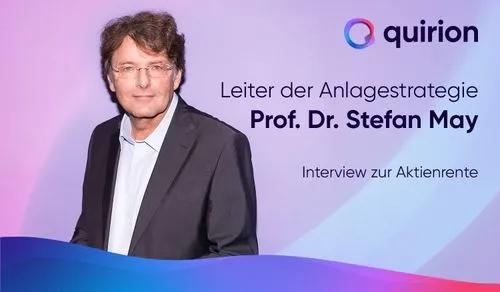
The seed funding for the planned generational capital fell through in 2023. This pushes back the launch of the equity pension. How shares can help with retirement provision – with or without government support – is explained by Prof. Dr. Stefan May, Head of Investment Strategy at Quirin Privatbank and at quirion.
The equity pension is meant to come. Federal Finance Minister Christian Lindner reaffirmed this in early December. But the timeline is set to change „a little“. How likely do you think it is that things will get under way soon?
Mr Lindner emphasised that the revised timeline has nothing to do with the budget. Even so, I find it telling that the seed funding of 10 billion euros for the generational capital was scrapped in 2023. I won’t venture a forecast. But I would be delighted if something finally started moving on the topic of the equity pension.
That said, one shouldn’t expect the generational capital to improve the situation in the pension funds too quickly. At its core, it is about plugging holes that have until now been financed with taxpayers’ money. That amounts to over 100 billion euros a year, and in 2027 it is expected to be 128 billion euros. If you think of the 10 billion euros that is to be paid into the capital stock initially: at an assumed annual return of 7 percent, that promises earnings of 700 million euros. At any rate, it will take a very long time before the capital stock is large enough for its earnings to noticeably ease the financing of the statutory pension.
Do you have a better proposal?
Some time ago we worked out a proposal for policymakers together with our competitor Scalable. Unlike the generational capital, it is about more efficient government support for private retirement provision. It is a simple model, modelled on the British „Individual Savings Accounts“. In broad terms: every employee can open a savings account intended for retirement provision. You can pay a maximum of 20,000 euros into this account each year, up to a certain deadline. All capital gains from this account would be exempt from capital gains tax – provided that the capital is then actually used for retirement provision. Experience from the United Kingdom shows that the tax exemption and the tie to a deadline create a strong incentive to save. In Germany, far too few people are still making adequate provision for old age.
But why does supporting private retirement provision need a new approach?
Most retirement products have shown major shortcomings so far, namely a lack of quality, high complexity and excessive costs. The market will not eliminate these shortcomings on its own. Experience with „Riester“ shows as much. As long as most of those involved are primarily concerned with selling high-commission products, the interests of the people saving take a back seat.
To illustrate, an image from the healthcare sector: patients and doctors do not meet as equals. When I go to the doctor, I expect a competent assessment and can trust the advice. On the subject of retirement provision, the financial industry and consumers likewise do not meet as equals: investing is not self-explanatory and requires trust. Whether that trust is deserved only becomes clear with retirement provision after decades. But by then it is too late. In our proposal we therefore place a great deal of importance on support being granted only for products that meet certain quality standards.
What quality criteria would those be?
The kind that can be derived from the current state of capital market research. Precisely with retirement provision, it has to be about optimising the balance between return opportunities and risks. That can only be achieved through systematic and efficient diversification – whether in equities or in bonds. Low-cost ETFs are ideally suited to building a retirement portfolio that matches investors’ individual risk profile. Individual securities are far too risky. With actively managed funds, the interest in commissions dominates. On top of that, active selection always involves a forecast. But that is pure speculation. And you should absolutely avoid that when building wealth over the long term.
Not entirely by coincidence, these aspects match principles that apply to quirion’s investment strategy…
That’s true, because it too is based on the current state of capital market research. In quirion’s global ETF portfolio, the balance between return opportunities and risks is optimised. The investment strategy aims for the long-term average returns of the „global equity market“. In this way, investors participate in the growth of the global economy. The approach is therefore ideally suited to building wealth over the long term.
Including shares in private retirement provision as part of a global ETF portfolio is always worthwhile – even without government support. With savings plans at quirion, you can start building wealth from as little as 25 euros a month. That is certainly a better way to go than waiting for political decisions to be made.