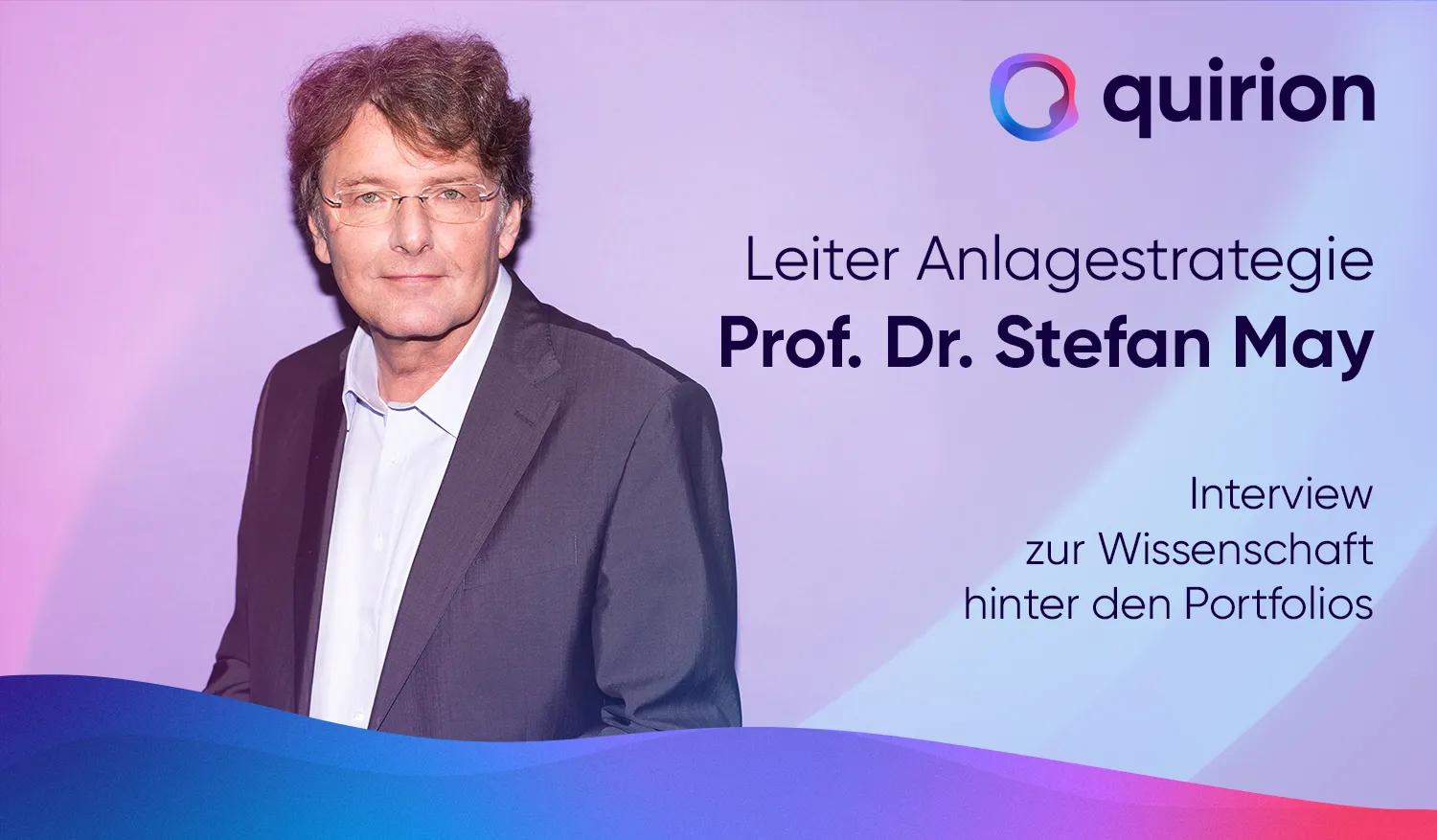
Capital market research has produced many insights that help with investing. But they only slowly filter through to a wider audience. Dr. Stefan May — professor emeritus of financial market analysis and portfolio management at Ingolstadt University of Applied Sciences and head of investment strategy and product development at Quirin Privatbank and at quirion — explains why that is, and which insights can be applied quite simply.
Science has been researching the capital markets for decades. In your view, what are the particularly important insights?
First of all, it should be noted that in capital market research in particular, theory and empirical evidence mesh together almost exemplarily. Yet hardly anyone in the wider public knows that the theoretical and empirical findings gained in this way allow you to derive quite clearly what makes sense when investing. One of the most important results of all is the distinction between unsystematic and systematic risks. Unsystematic risks relate to a specific company, a specific industry or a specific region. A company can go bankrupt, an industry can lose relevance, a region can slide into a political crisis. Systematic risk is, in effect, the residual risk that remains once all these unsystematic risks have — through intelligent global spreading of investments ("diversification") — essentially been squeezed out. What then remains is the systematic risk, that is, the risk of general market movements; but not those of some local market — really those of the global market.
And only those who take on these systematic risks may expect a "premium", namely the market return. Taking on unsystematic risks generally achieves nothing, because in the long run it simply isn't "rewarded" with a premium. It happens quite often, for example, that individual companies disappear from the market. That the global market itself would disappear is essentially impossible — unless you assume that the market economy as such is abolished.
What does that mean for investing?
Anyone who wants to eliminate unsystematic risks has to spread their investments as broadly as possible across companies, industries and world regions. Today that is far easier than it was before the invention of ETFs. For building private wealth on the stock market, no one needs to take on the risk of investing in individual shares anymore. Unfortunately, this often isn't heeded. That is also down to the relevant media and interested banks, which continually lure investors with tips about supposed hidden gems. But with individual investments you bring the risk of a total loss into your portfolio. That is rare, admittedly, but it does happen from time to time. Just think of Wirecard.
If I want to spread my investments, several options are available: actively managed funds, for example …
Active management is the attempt to beat the market return through a special selection of securities or by timing supposedly ideal moments to enter and exit. On average and over the long term, this cannot work systematically and consistently. Because to do so, fund managers would have to know the future. Of course they don't — and so it comes down to lucky hits. Few findings of capital market research are so unambiguously proven. On liquid equity and bond markets like those in Europe, the USA and numerous emerging markets, active management achieves nothing beyond chance successes.
And yet actively managed funds still hold a very dominant position among investors. From a scientific point of view, I can't understand it.
So why aren't these insights taken into account more often?
One important reason is surely the economic interest of the parties involved. Actively managed funds often generate management fees of between 1.6% and 1.8% per year, sometimes even more. With ETFs, by contrast, costs are around 0.2% to 0.5% per year. Differences like that then really need to be very well justified. On top of that, some investors simply like to believe that a fund manager's supposedly special expert knowledge also leads to special results. On the face of it that sounds logical, but ultimately it isn't.
On average, actively managed funds deliver a lower return than so-called "passive" strategies, because over the long term the cost differences have a very negative effect on returns. Professional investors in the institutional sphere, incidentally, know this very well. There, banks are dealing with people who have looked into the scientific findings in greater depth. And you can't so easily pull the wool over their eyes.
Until July of this year, you yourself were not only a scientist but also head of investment management at Quirin Privatbank and at quirion. Why did you hand over that role?
The time was right to pass the baton in the operational business to my younger colleagues Philipp Dobbert and Arndt Kussmann. But I remain with Quirin Privatbank and quirion as head of investment strategy and product development. That gives me the opportunity to continue bringing the findings of financial market research into our bank — as I have done for many years.
What does science have to say about digital asset managers like quirion?
In principle, no different rules apply to digital asset managers, or to so-called robo-advisors, than apply elsewhere in investing. You need a suitable investment strategy. And here the rule is: forecasts are no suitable basis for it. There is no person — and no algorithm either — that could reliably predict the future on the financial markets. To optimise the relationship between return and risk, you therefore have to spread your investments as broadly as possible — ideally in a global portfolio, which is precisely quirion's approach.
Setting up such a global portfolio according to scientific criteria — and as cost-effectively as possible — does take a certain amount of effort. Individual indices and the ETFs based on them, however good these products are otherwise, always form unintended and uncontrollably shifting concentrations. That is how certain unsystematic risks then creep back in. Some time ago we identified five factors that contribute significantly to the market return and along which we diversify scientifically. All of quirion's market-strategy portfolios are structured accordingly. They therefore fully reflect the findings of capital market research.