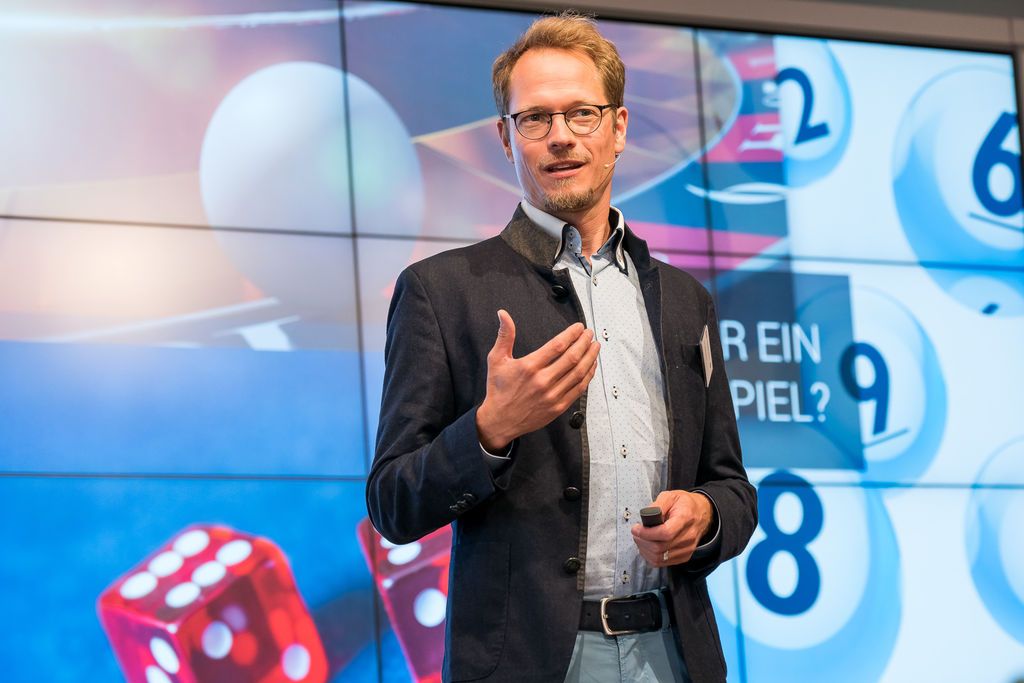
As a keynote speaker, he transfers poker concepts to business decisions. In his talks and intensive workshops, executives learn poker concepts for decision-makers that they can integrate directly into their daily processes. In conversation with quirion, he explains why poker has nothing to do with luck. And many of the concepts he sets out are reminiscent of insights from stock market psychology.
quirion: How do people react when you tell them what you do?
Many say: “You're gambling away house and home” or “you'll become addicted to gambling.” But I enjoy setting the record straight and saying: “This is precisely not a game of chance, it's a game about people and their decisions. With roulette or most casino games it's different. There, there's always a mathematical advantage for the casino, one you can't change either. With roulette you can see that your decision has no influence on the outcome. The little white ball doesn't care whether I bet on black or red.
quirion: Is that different with poker?
Heitmann: Yes, with poker the casino itself doesn't play along at all. As a poker player, you play against other players who make decisions under uncertainty and with incomplete information. The more you know about the game, the more you know about the decision-making processes and about the motivation of the other players, the clearer and better the strategies you can develop. Over the long run, poker is a game of strategy and has nothing to do with luck.
quirion: That sounds more like chess. So is chess similar to poker?
Heitmann: Chess is also a game where you have to think strategically and from which you can learn a great deal. The big difference is: in chess there is complete information. That means there's no information asymmetry or incomplete information as there is in poker. And there are no elements of chance. But that's exactly why chess doesn't reflect reality so well. There's no uncertainty here. Decisions in which there is no uncertainty are pure mathematics. Whoever makes mistakes here has only themselves to blame. In real life, though, we constantly make decisions under uncertainty. Just as in poker. Here it's about decisions where you can't look into the future and don't know exactly what will happen. And at the same time, poker offers a dozen concepts you can lay on top of this.
quirion: You yourself originally studied business administration. Did that benefit you at all?
Heitmann: There are indeed many connections and skills that I acquired during my studies and that are directly transferable to poker. With business administration or economics, you're already strongly anchored in a world of numbers, whether you want to be or not. You're already wired to make profit-maximizing decisions. And that's what poker is about too.
quirion: Many investors find it hard to sit through downturns and often get in when the markets have already reached their peak. What's more, many let themselves be driven by the news and act short-term. What do you say to that from your poker perspective?
Heitmann: These short-term investment periods are extremely strongly influenced by chance. Of course there are people who have a good run, but even that is due more to variance than to any special skill. With a long-term investment there is less chance involved. I believe it's much easier to invest profitably over the long term, but humans are by nature very jumpy and therefore afraid when things go down. When things go up, they wait and see at first, and when it then goes even further up, they finally buy. They then invest at the peak, when falling prices become more likely again in the near future. And then they get nervous once more. With people, the fear of loss is simply stronger than the joy of a gain. I believe that has to do with evolution. If you failed in the distant past, you were eaten by something. We are simply a risk-averse species.
quirion: Can you do anything about it?
Heitmann: You can train it away intellectually with poker. If I invest in positive expected values over the long term, then it pays off in the end. But in the short term I also have to endure negative experiences. This endurance – and repeatedly making the right, sensible decision and still coming away with a negative result – you experience that constantly in poker.
quirion: Can you explain that in more detail?
Heitmann: In poker we have a concept called tilt. The actual idea of poker is that you always deliver your A-game, your best possible play. Tilt is the deviation from the A-game. That happens when emotions get triggered or a player simply isn't at their best. And such tilt moments happen to every poker player. You can't switch these tilt moments off completely, but you can recognize them faster and then do something about them. I've realized I'm not at the height of my decision quality – maybe I'll just step back now or stop playing for the day.
And when you go all in – isn't that part of poker too?
That's another classic cliché associated with poker, this “putting everything on one card” or “betting too high.” And that is exactly what a good player doesn't do. That would be nonsense. Because if the hoped-for card doesn't come, then everything is ruined. A good player is of course willing to bet everything within a single tournament. That's part of it, but those are the resources for exactly that tournament and not their entire wealth.
Is there something like risk diversification in poker too?
Yes, you invest a very, very small part of the total capital you have available for poker into a tournament. When you get knocked out of a tournament, you jump straight into the next one and again invest a small part. That means you don't play one or two or ten tournaments in a year, but hundreds, if not thousands. Of course it also depends on your own appetite for risk. Some players stake two to five percent of their tournament capital per tournament. But there are also people who can live with a 15 to 20 percent risk of loss. That depends on your personality structure. But: there is no good poker player in the world who invests larger portions of their wealth into a single tournament.
And for that you have to grapple with uncertainty and incomplete information – isn't that thankless?
Good players are always fighting against uncertainty and incomplete information, but they also understand: those are our best friends. Without them there wouldn't be any possibility of investing profitably at all. The worst strategy is a completely risk-free one. Because there's simply nothing to be won there. That would, after all, be free money – and where is that supposed to come from? You have to take on a certain amount of risk. It's not about minimizing risks, but about optimizing them. If I want to use risk and uncertainty to my advantage, then part of that is dealing positively with setbacks.
What does that look like?
I ask myself: could I have done something differently? Answer: no. Did I do everything I should have done? Answer: yes. Then I check it off. The overall philosophy that a good poker player develops goes like this: results describe the past, decisions shape the future.
Many thanks for the interesting conversation!