






Diversification: definition & meaning
Definition: Diversification in investing is defined by the broadest possible spread both within an asset class – e.g. many different shares of varying size and origin – and between different asset classes (bonds, shares, commodities, property, etc.).
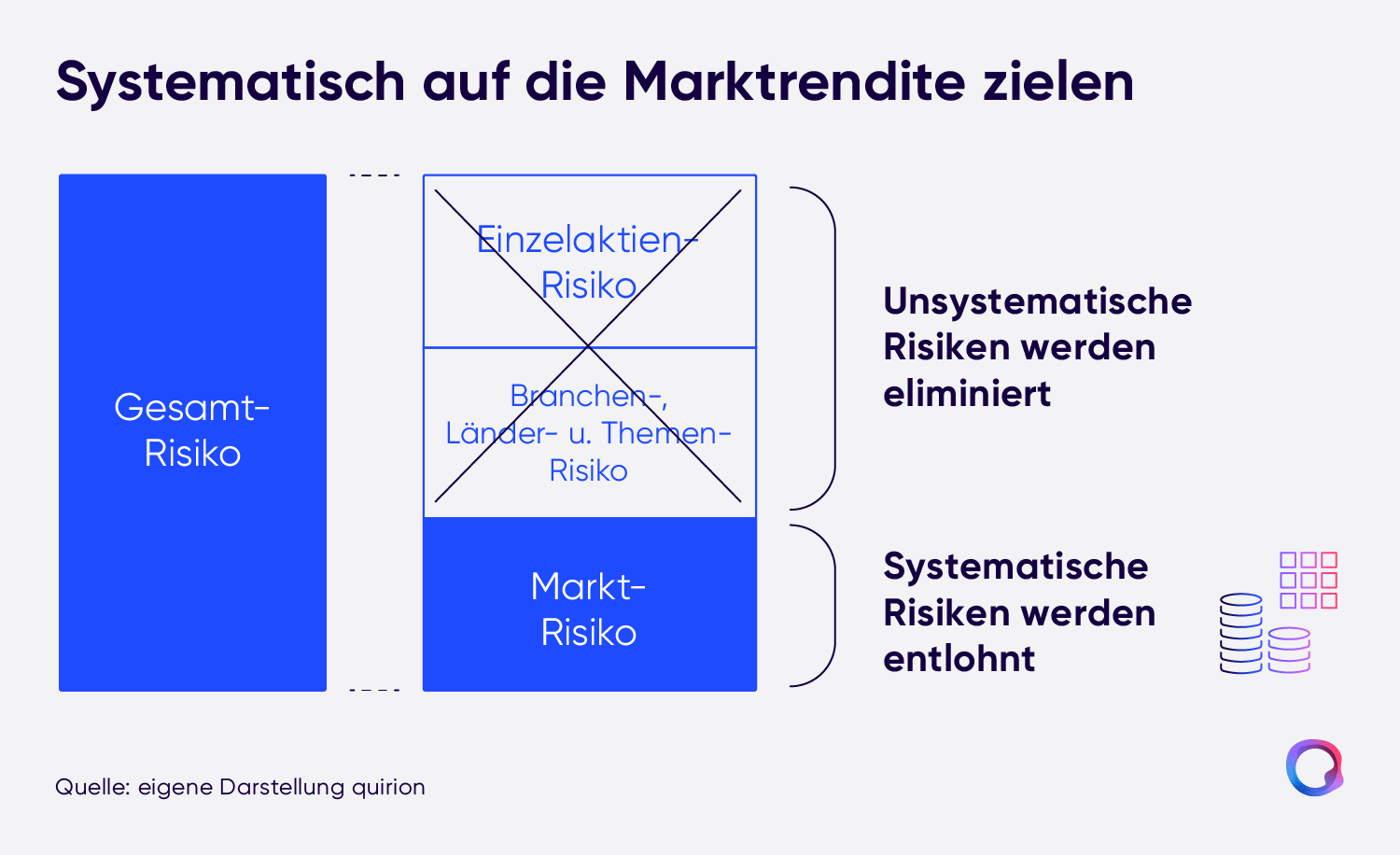
Meaning: The real reason why investors should diversify their investments is this: investors want to reduce potential risks as far as possible. Risks on the capital market can be divided into systematic and unsystematic risks.
Good to know: The term diversification also has a more general meaning in business: companies use it to mean expanding their business model to new products or opening up new markets. The parallels to diversification in investing are obvious: “don't put all your eggs in one basket”.
Systematic vs. unsystematic risks
The systematic risk refers to price fluctuations resulting from general developments that affect the entire market and which must be accepted even with a broadly diversified investment – for example with ETFs.
Examples of systematic risks are global economic crises or wide-ranging trade wars. Price losses in the context of systematic risks can be quite substantial. However, such upheavals occur relatively rarely, and prices ultimately always recover – provided that the market economy system does not collapse.
In contrast to this is the unsystematic risk, which individual countries, industries and companies or shares always carry within them. Certain country-, industry- or company-specific events (e.g. a sovereign default or poor business performance at companies) can lead to considerable price losses (up to and including total loss). In an economic system of free markets there is no reason why losses due to unsystematic risks should have to be offset again at some point.
Unsystematic risks are therefore risks that can in principle be avoided, which strike more often and more intensely than systematic risks. They arise because people often diversify too little when investing.
Unsystematic risks are avoidable, systematic ones are not. Or to put it another way: only unsystematic risks can be “diversified away” through very broad spreading.
Eliminating unsystematic risks = maximum diversification
Caution: ETFs, as good as these products otherwise are, partly form unintended and uncontrolled shifting concentrations. In this way, certain unsystematic risks creep in even in global ETFs. More on this below.
Diversification between asset classes
The diversification between asset classes enables investors to reduce the loss risk of the overall investment and to make use of (negative) correlation effects.
Example of a negative correlation: When share prices rise, bond prices fall in return – and vice versa. However, this is not an automatic mechanism.
Diversification within an asset class
For a successful investment it is also necessary to diversify within an asset class, all the more so if you invest in only a single asset class, for example in shares). Ideally, the spreading is then done across different countries, industries or themes.
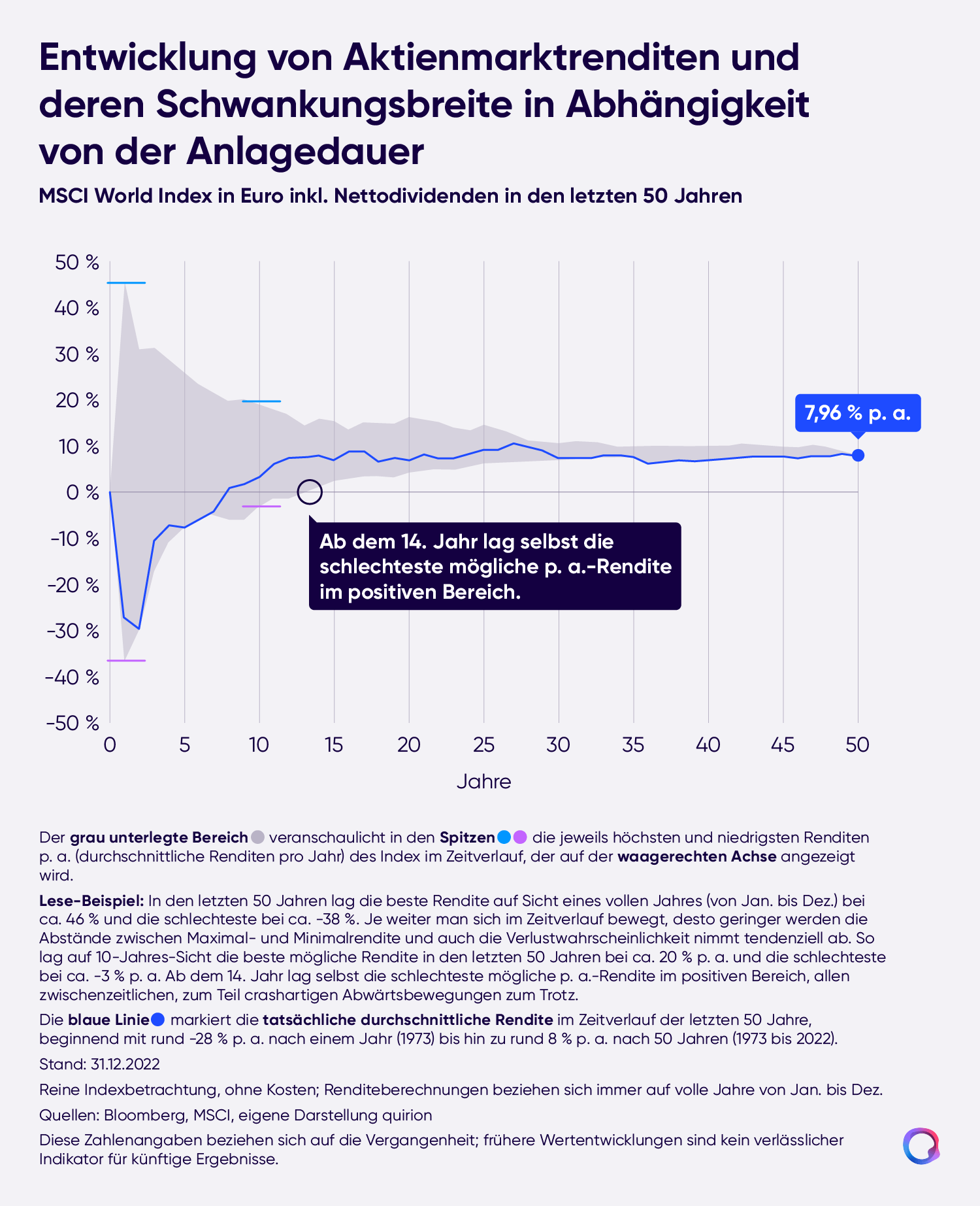
Caution: The be-all and end-all of any investment, alongside the broadest possible diversification, is the factor of time. Correlation effects, like the effects of diversification, often only fully come into play after 10 to 15 years. Investors who give thought to the structure of their portfolio and their personal risk profile should be sure to take their investment period into account.
Diversification to match your risk profile
As for your personal risk profile: While there are many conceivable gradations, a rough distinction can be made between these two types of investor:
- Defensive investors
- Aggressive investors
Defensive investors
Defensive investors who do not cope well with (larger) losses and who become nervous at big swings between gains and losses should not, when building their portfolio, bet 100 % on volatility-prone shares, but should add bonds, because this asset class usually fluctuates less.
Good to know: Of course, defensive investors can also add commodities, property and other asset classes to their portfolio in order to make use of further diversification effects.
Aggressive investors
Aggressive investors who can tolerate strong fluctuations on the markets and who trust that a long investment horizon will pay off in the end (keyword: “buy-and-hold strategy”) can consider a portfolio with an equity allocation of up to 100 %.
Shares – broadly diversified – are, after all, the return driver over the long term.
Expert tip: We generally advise against an investment solely in thematic ETFs, commodity ETFs or property ETFs. Unlike a worldwide investment in shares, the possibilities for broad spreading are more limited and the risk of loss is higher.
Diversification with shares & ETFs in theory
Many investors are put off by the sometimes severe fluctuations in share prices. Yet it is precisely these fluctuations (= volatility) that can be significantly cushioned with a globally spread investment.. With shares, this works for example via global ETFs, which bundle a great many individual shares from different countries into a single financial product and thus significantly reduce the risk of loss.
The portfolio theory of Nobel laureate Harry M. Markowitz and other scientific studies confirm the core idea of diversification:
A globally diversified investment – oriented towards market capitalisation – offers the best ratio of expected return to expected risk.
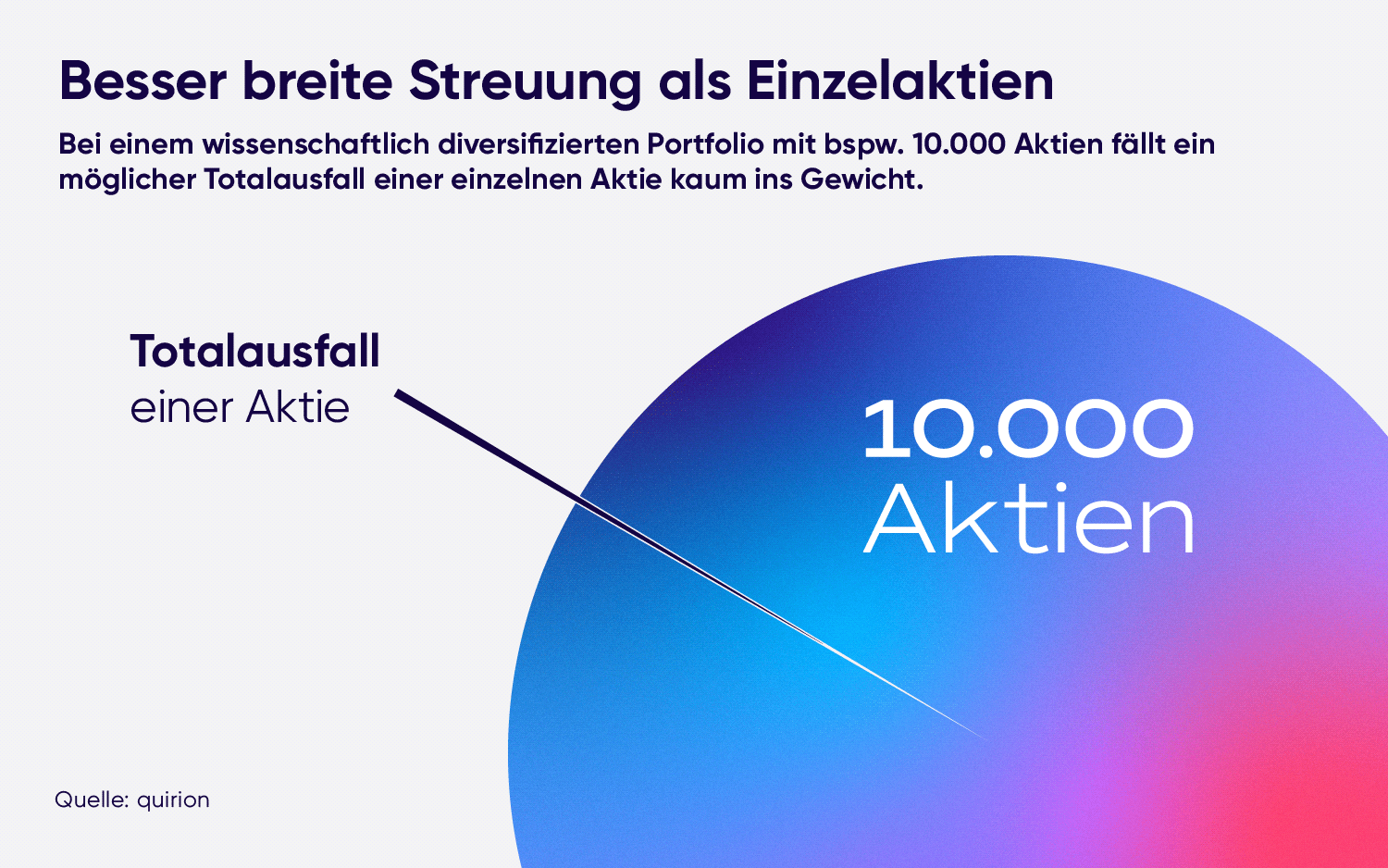
Good to know: The saying “no risk, no return” is correct. A broadly diversified investment brings these two factors into an optimal ratio. The risk of individual shares is cushioned by the large number of shares.
Diversification with shares & ETFs in practice
The best strategy for creating a portfolio – at least in theory – that is optimally diversified with shares and ETFs is to invest in all the shares in the world according to their market capitalisation.
Good to know: With shares, investors deliberately bet on the value creation of the global economy. When the global economy grows, this is reflected in the revenues and profits of many companies. However, the principle does not apply to every single company, but only to the broad market. Returns with shares work above all over the long term, but only with a portfolio that is as broadly based as possible and a long investment horizon (buy-and-hold).
Diversification with shares & ETFs across markets worldwide
Anyone looking for suitable global ETFs should bear in mind that many global ETFs – unlike their name suggests – do not actually invest in the whole world. Some products invest too heavily in individual countries, others too heavily in a single sector (e.g. technology).
From the perspective of all investable markets, you should in particular take these three levels into account:
- Countries: invest as broadly as possible in developed & emerging markets
(Asia, Europe, Emerging Markets, North America, etc.) - Sectors: invest in as many industries as possible
(technology, finance, healthcare, consumer goods, property, etc.) - Company size: investments in companies of various sizes
(small caps, mid caps, large caps / blue chips)
For an optimised portfolio investors should select ETFs that invest as broadly as possible in the whole world, in as many industries as possible and in companies of various sizes.
Good to know: At quirion we make the most of the diversification advantage for our investors – by investing worldwide in around 8,000 companies. And in all regions, industries and company sizes at that. In our selection we also take into account the so-called “equity factors” and map these in the optimal ratio.
Diversification via equity factors worldwide
At quirion we want to cover the global equity market as representatively as possible. Only in this way is an optimal return-risk ratio ensured.
Our analyses have shown that, for the broadest possible coverage of the equity market – alongside a block of standard stocks (blue chips) – the following four equity segments, also known as factors, prove particularly relevant:
- Value (= shares with a high intrinsic value)
- Low Volatility (= shares with low fluctuations in the past.
- Small Caps (= shares of smaller companies)
- Momentum (= shares with recently strong price momentum)
Good to know: The equity market can be divided into factors, special equity segments that can, however, “overlap”. Thus a share can belong to the Small Caps factor and at the same time be a value share. That is why special analyses are needed in order to calculate the most optimal possible combination of factors and to construct a corresponding ETF portfolio. In this way, diversification and correlation effects can be made use of in the best possible way.
Diversification at quirion: the factor index combination
The relationships between these individual equity factors are complex, but not impenetrable. Based on historical performance data going back more than 20 years, the path leads in several steps via a specific factor index combination to a cost-efficient ETF portfolio for our customers.
Good to know: This selection of specific ETFs requires meticulous work behind the scenes, which we like to call the “engineering craft of investment management”. In theory, diversification is in principle easy to depict. Implementing it in practice, on the other hand, is very involved.

Excursus: which equity “factors” are there?
The following equity segments (which in specialist jargon are also called “factors”) can primarily be identified in the course of the portfolio analysis:
- Region of origin
- Industries and sectors
- Dynamics of company growth (“Growth”)
- Level of market capitalisation (“Size”)
- Dynamics of past price development (“Momentum”)
- Extent of volatility (“Low Vola”)
- Quality of the financial metrics (“Quality”)
- Valuation levels (e.g. “Value”)
- Level of dividends paid out
Because of the complex relationships between the factors, a single equity index (which is tracked by an ETF) proves to be only a very weak representative of the global market as a whole.
In a single global ETF, with its design-related limitations – e.g. only standard stocks, only developed markets, etc. – the dynamic interplay and the interactions of the factors with one another can only be inadequately mapped.
Why a global ETF does not create sufficient diversification in a portfolio
If you take diversification really seriously – as a broad investment in the whole world (developed and emerging markets), in as many industries and companies of varying size as possible – many global ETFs do not fare so well, even though their name would actually suggest otherwise.
Using the example of the MSCI World, this can be shown as follows:
- The country allocation with a high US share (currently just under 70 %) harbours a geographical concentration risk.
- The breakdown by sectors is not optimal, because the focus is on the technology industry.
- The index does not include emerging markets.
- It takes into account almost only large companies (blue chips), no small caps.
Good to know: Because of the problems mentioned, many investors like to combine the MSCI World with an emerging markets ETF, which is in principle a good approach. However, this does not allow all the diversification problems – such as “no small caps” and the “high US share” – to be solved.
As explained in detail above: For ideal diversification, other approaches are needed.
Conclusion: what investors should look out for when diversifying their portfolio
In the context of the term diversification there is the well-worn saying “spread broadly, never regretted”.
This is, however, easier said than done: ideal diversification does not really exist in reality, but you can certainly come very close to the ideal.
That is why we conclude with a few tips on how the theory can be put into practice.
Implementing diversification in a portfolio means
- first determining your personal risk profile.
- selecting those asset classes you would like to invest in (e.g. shares and bonds).
- mapping the entire investment universe within an asset class.
- limiting the number of ETFs without losing diversification advantages.
- finally choosing a specific strategy and then consistently sticking to it (buy-and-hold).
How does diversification work at quirion? quirion relies on broad spreading by having investors invest their money indirectly in around 8,000 shares and around 6,000 bonds. Every investment is thus spread worldwide across almost all liquid available investment options. In the event of stronger fluctuations on the capital markets, the originally chosen return-risk ratio is restored through rebalancing.