Numerous legends circulate about investing in stocks. The fact that they persist stubbornly is no proof that they are actually true – quite the opposite: 5 myths that cost return potential especially often.
Myth 1: Stock markets are always going up and down – far too dangerous!
Sometimes climbing steeply, then plunging again: looking at the price charts, you sometimes get the feeling that it is nothing but a constant up and down. On top of that come the many, often contradictory, assessments: yesterday some expert was talking about the dazzling outlook. Today, though, someone else is warning that a major crash looms. This creates the impression that you would be better off not relying on the stock markets when it comes to investing.
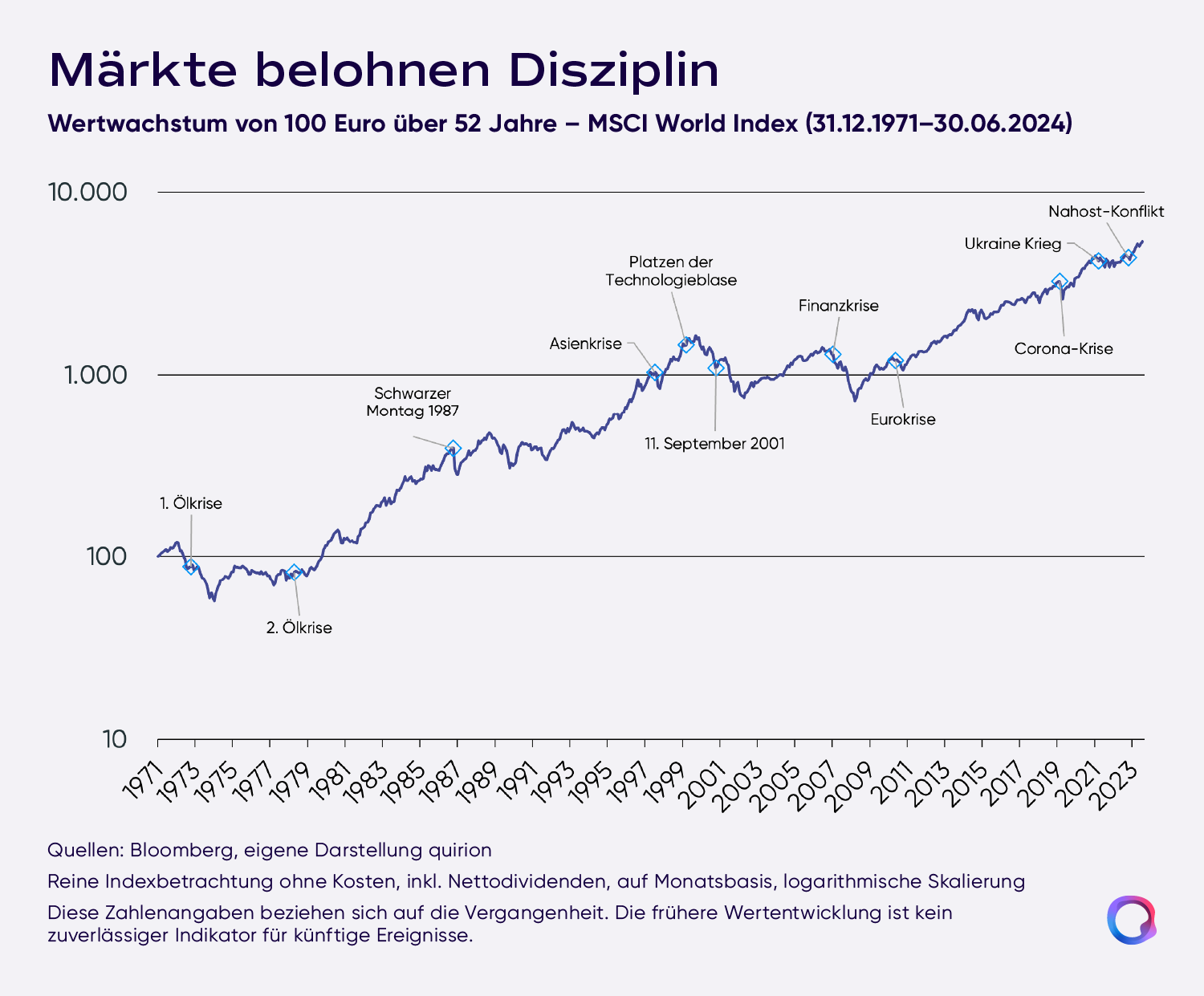
But anyone who avoids the stock markets misses out on return potential. As in many areas of life, a change of perspective helps put things in context. If you look not at the price movements of days, weeks or months, but instead at price movements over the longest possible period, you quickly realise: over the long term, the trend has always pointed upward in the past. That is no coincidence. Equities give you a stake in companies, and therefore in the economy. And the economy is geared towards growth. This connection does not simply dissolve.
Myth 2: You have to hunt for the stocks with the best prospects.
Sounds plausible. But it would only make sense if you had a time machine that let you travel into the future. No one knows today which stocks will be especially successful in one year or in five. You can only speculate about it in advance. In any case, a stock's return potential cannot be read off from the company's balance sheet or from any set of key figures. Such numbers are the basis of expectations, which are then reflected in the prices. But expectations can be disappointed at any time.
Myth 3: It all comes down to the best moment.
Closely tied to the idea that you have to hunt for the „right“ stocks is the notion that you have to find the „right“ moment to buy and sell. Buy as cheaply as possible, sell as dearly as possible: the commercial logic seems obvious. The problem, however, is once again that no one knows the future. Individual stocks can, after all, keep rising far longer than expected beforehand – or sink far lower.
The way out of this dilemma: do not fall for Myth 2 and give up trying to pick the best stocks. Instead, it is better to rely on a portfolio that is as broadly diversified and global as possible. Because then, at the same time, the best time to invest is „always now“. After all, we know that stock markets have always developed positively over the long term and on average – see Myth 1.
Myth 4: Active funds cost a bit more, but they also have more to offer.
ETFs track an index and, in the vast majority of cases, do without a fund management team. That saves costs. It is widely known that ETFs are far cheaper than traditional active funds. Yet the „actives“ remain popular. In part, this has to do with a phenomenon that can also be observed in other areas of life: researchers have found that the very same wine tastes better to people when it is sold at a slightly higher price. Many people automatically associate a higher price with better quality.
But active funds' promise to beat the market with their expertise is broken time and again. A study by S&P Global published in April compared the performance of active funds with stock market indices. The result: over a ten-year period, 85 percent of active funds investing in German equities were unable to beat a corresponding index; for European equities the figure was 92 percent, and for funds investing globally it was as high as 98 percent.
Myth 5: Stocks are only for the rich or for people with nerves of steel.
The idea that investing in stocks is only for the wealthy is another one of those legends. What is not entirely wrong, on the other hand, is that a hundred-percent equity investment is not the right choice for every risk appetite.
Returns for everyone: this was the mission with which quirion launched as a digital asset manager in 2013. The investment strategy is not based on myths, but on scientific findings. It relies on low-cost ETFs and the broadest possible global diversification, reflecting the current state of capital market research. There is no minimum investment for one-off investments, and savings plans can be set up from monthly savings rates of as little as 25 euros. Depending on your individual investment horizon and personal risk profile, quirion adds bonds to the mix to stabilise the portfolio. This way, investors with very different risk profiles can share in the return potential of the stock markets.