When a product carries “ETF” in its name, many people find that reassuring. But not every ETF is the same: leveraged ETFs are high-risk bets that are best left alone.
Big gains from a small stake: at first, that sounds tempting. Products such as leveraged ETFs raise exactly this hope. They are not yet very common in Germany. But they are being heavily promoted.
A classic ETF should ideally track an index one to one. If the index rises by one percent, the ETF also climbs by one percent. Leveraged ETFs work differently: a 2x leveraged product rises by two percent when the index gains one percent. This promise makes some investors forget the very high risks. Because the leverage works in both directions. If the index falls by one percent, the 2x leveraged product drops by two percent.
Investors in South Korea recently learned the hard way what happens when such risks become reality. Leveraged ETFs spread rapidly there this year, in particular so-called single-stock ETFs on shares of the big semiconductor makers Samsung and SK Hynix. During the semiconductor boom, the bet paid off at first. But when these shares came under pressure in July, the leveraged products acted as an accelerant. This even brought in the stock market regulator, which restricted their use.
In Europe, exchange-traded products on single securities are sold as ETPs (Exchange Traded Products) or ETNs (Exchange Traded Notes). Here, leveraged ETFs exist only on broader indices. This is because under European rules, a single asset may make up no more than 10 percent of a fund's total assets. But despite the diversification this provides, leveraged ETFs remain a high-risk bet.
Treacherous leverage effects
Stock markets never only go straight up. And a percentage loss always needs a higher percentage gain to get back to the original value. In a leveraged ETF, the leverage factor greatly amplifies this asymmetry: if an index falls by five percent, for example, the 2x leveraged ETF drops by 10 percent. To get back to its previous level, the index needs a gain of 5.26 percent. The 2x leveraged ETF needs much more, namely 11.11 percent.
And it is not only the 2x leverage that has an effect. So does the so-called “volatility decay” (path dependency). Leveraged ETFs must adjust their portfolio every day to keep the leverage factor constant. A 2x leveraged ETF promises to double the daily return – not the return over a week or a year. The ETF has to deliver on this promise anew every single day. To do this, the portfolio must be rebalanced every day. As a result, leveraged products quickly make losses, even when the index fluctuates but barely moves overall.
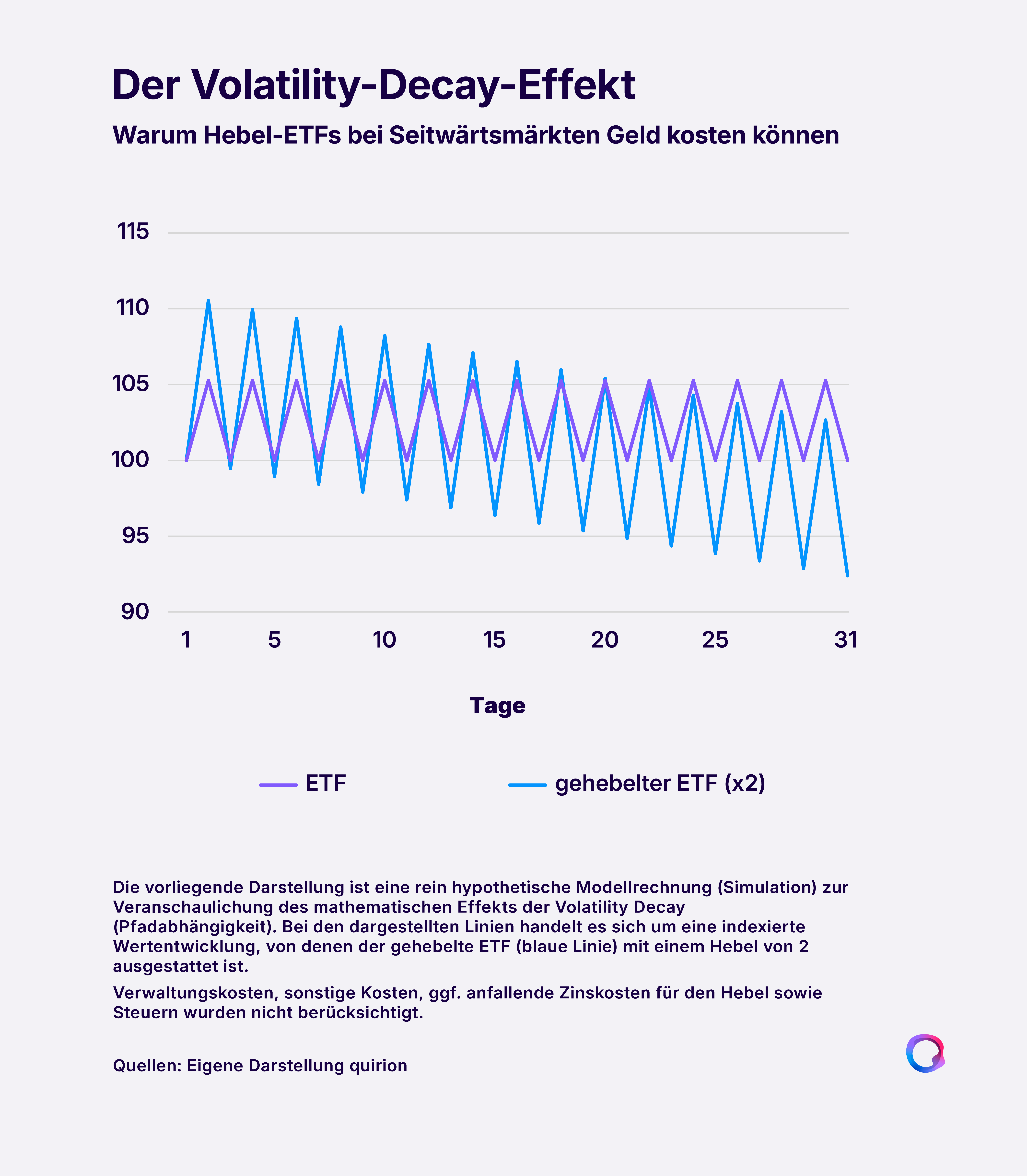
The chart is a purely hypothetical model calculation (simulation) that illustrates the mathematical effect of volatility decay (path dependency). The lines show an indexed value development; the leveraged ETF (blue line) has a leverage of 2. Management fees, other costs, any interest costs for the leverage and taxes were not taken into account. Source: quirion's own illustration.
Unsuitable for building wealth
Risks that cannot be overseen, complex and expensive products: speculating with leveraged ETFs is completely unsuitable for building wealth. Investing in the capital markets needs a long-term investment horizon, and these products are not at all suited to one. An investment strategy for building wealth should aim to use return opportunities – but avoid speculation and unnecessary risks. After all, the point is to reach your own investment goals.
In our investment strategy, we stay away from all forecasts. Nobody knows the future, not even an expert. With our global ETF portfolio, our goal is therefore to get the best possible balance between return opportunities and risks. To do this, we rely on scientifically grounded diversification that is geared to the long-term average return of the world's stock markets.
That global stock markets trend upwards over the long term and on average is not wild speculation. It rests on a very fundamental connection. Shares give you a stake in companies and therefore in the economy. Prices do not always go up. But the global economy is built for growth in principle. With digital wealth management in a global portfolio, you avoid putting your money at unnecessary risk. Instead of an emotional rollercoaster with a constant eye on prices, you can sit back and relax.
Find out more about our ETF portfolio here.