For about 8 months now, both the economic outlook and developments on the capital markets have stood in the shadow of the coronavirus crisis. If we look back to the start of that period, the focus was above all on the economy in China — the geographical origin of the virus.
The logic at the time was obvious: at the start of the pandemic it was mainly China that was affected, and therefore first and foremost its economy — after all, the world's second-largest economy.
In recent weeks and months, things then went rather quiet when it came to reporting on economic developments in the Middle Kingdom. Yet the question of China's economic situation has lost none of its relevance. Quite the opposite: the more the rest of the world economy was dragged into the downward pull of the coronavirus over recent months, the more decisive the question became of the extent to which China might already be on the road to (economic) recovery.
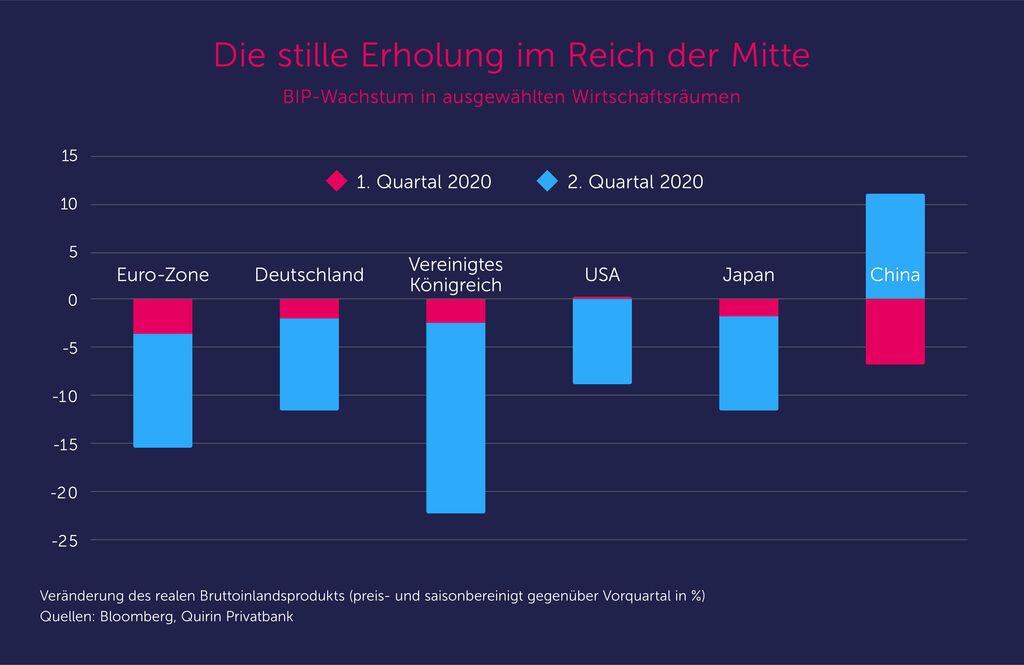
Because the world economy was hit hard (see chart). A look at the GDP figures shows: already in the first quarter, but above all in the second quarter of the year, economic output fell sharply across all industrialised countries — in Germany by almost 10% in the second quarter compared with the (already weak) previous quarter. Similarly weak data were recorded in the US, the eurozone as a whole, and Japan. At the same time (the second quarter), the economy in China was already growing again by more than 11% — exceptionally robust growth. Consequently, the economy that was the first to be hit by the coronavirus recession was also the first to recover.
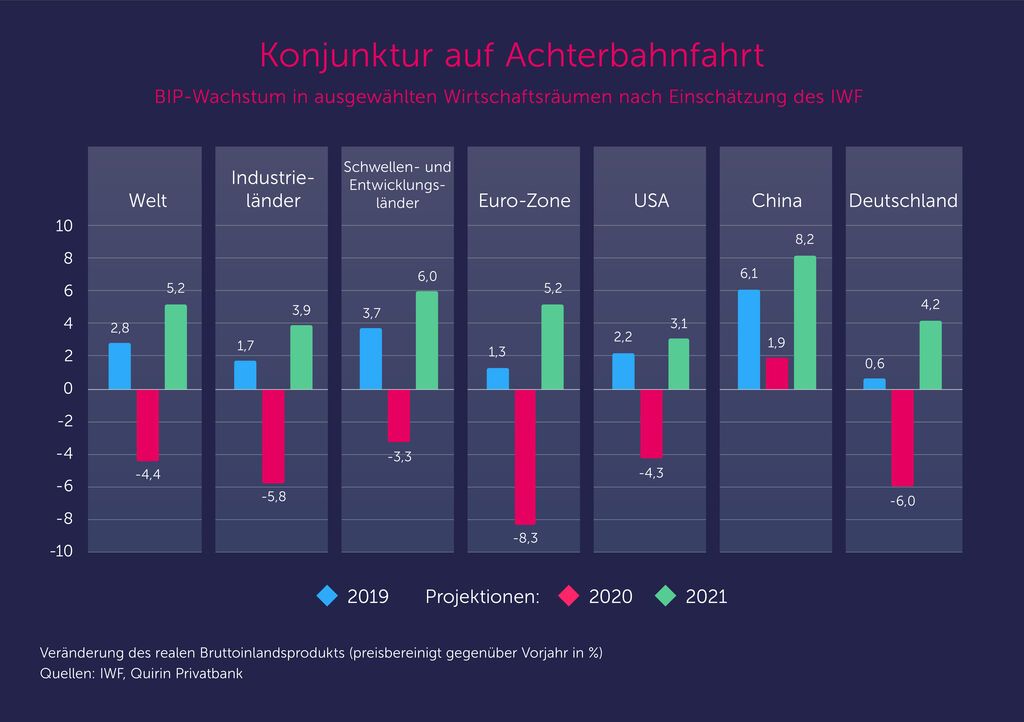
According to the latest forecasts from the International Monetary Fund (IMF), China is likely to lead the way economically not only this year but next year too (see chart).
So that no misunderstandings arise: this is a purely economic assessment. China is an authoritarian state that doesn't take human rights all that seriously — and that is putting it extremely mildly. However, I firmly object to the tone one hears here and there (for example from the mouth of the American president) regarding China's economic recovery. Namely — in essence — how ruthlessly, in China (the very place where the pandemic originated!), the domestic economy is once again being boosted at the expense of the West.
That conclusion could hardly be less well-founded. The entire world economy — above all the exporting nation of Germany, and the US too — is currently benefiting from the once-again fairly robust growth in China. World trade is not, and will not become, a zero-sum game; on the contrary: growth in Asia does not come „at our expense“ but rather fills the order books of companies here at home again. To put it plainly: China is currently rescuing the world economy.
And it has long ceased to do so merely in the form of the much-cited „workbench of the world“; for some time now it has also held a significant share in future technologies as well as in renewable energy and battery technology — with the prospect of sustainable success, then (in the truest sense of the word). Here are a few impressive figures on this: China is already the market leader in many climate-relevant technologies, producing 72% of the world's solar modules, 69% of its lithium batteries, and 45% of its wind turbines.
A second misunderstanding (this time from an investor's perspective) could be the view that the point now is to invest heavily in Chinese equities. That, however, would be an extraordinary speculation — because the portion of the Chinese equity market accessible to foreign investors still accounts for just 6% of global stock market capitalisation. But at precisely this weighting, the equity market of the Middle Kingdom does belong in a broadly diversified international equity portfolio. Not only, but also, because there is indeed currently a virus in China that one can only wish would infect the whole world — namely the Chinese „growth virus“.
Are you invested in China? And are your existing investments nonetheless broadly enough positioned to secure the return opportunities of the world's markets? Find out — with our free wealth check. Simply enter your existing assets and receive an assessment worth €500.
quirion invests your money broadly diversified on the capital market — across more than 60 countries and 8,000 companies. Here you can find out more.