Against the backdrop of soaring government debt in almost every country in Europe, together with the unchecked bond-buying programs for European government debt on the part of the European Central Bank (ECB), there is a widespread fear that the associated increase in the money supply, or the "flooding" of the markets with liquidity, must inevitably lead to massive inflation. Sometimes the suspicion is even voiced that inflation might perhaps be brought about deliberately, in order to allow heavily indebted states to shed their debt in this way1. More than a few even fear the collapse of the entire euro currency system.
Whether intentionally or not, holding such fears means aligning oneself with the teachings of the highly controversial economist Milton Friedman, for whom inflation was always and exclusively a monetary phenomenon, a view that also gave rise to his quantity theory of money. Together with Anna Schwartz, he established, in groundbreaking empirical work, a close relationship between the growth of the money supply and the rate of inflation, meaning that the larger the money supply in circulation, the higher inflation tends to be, as shown in the chart below.
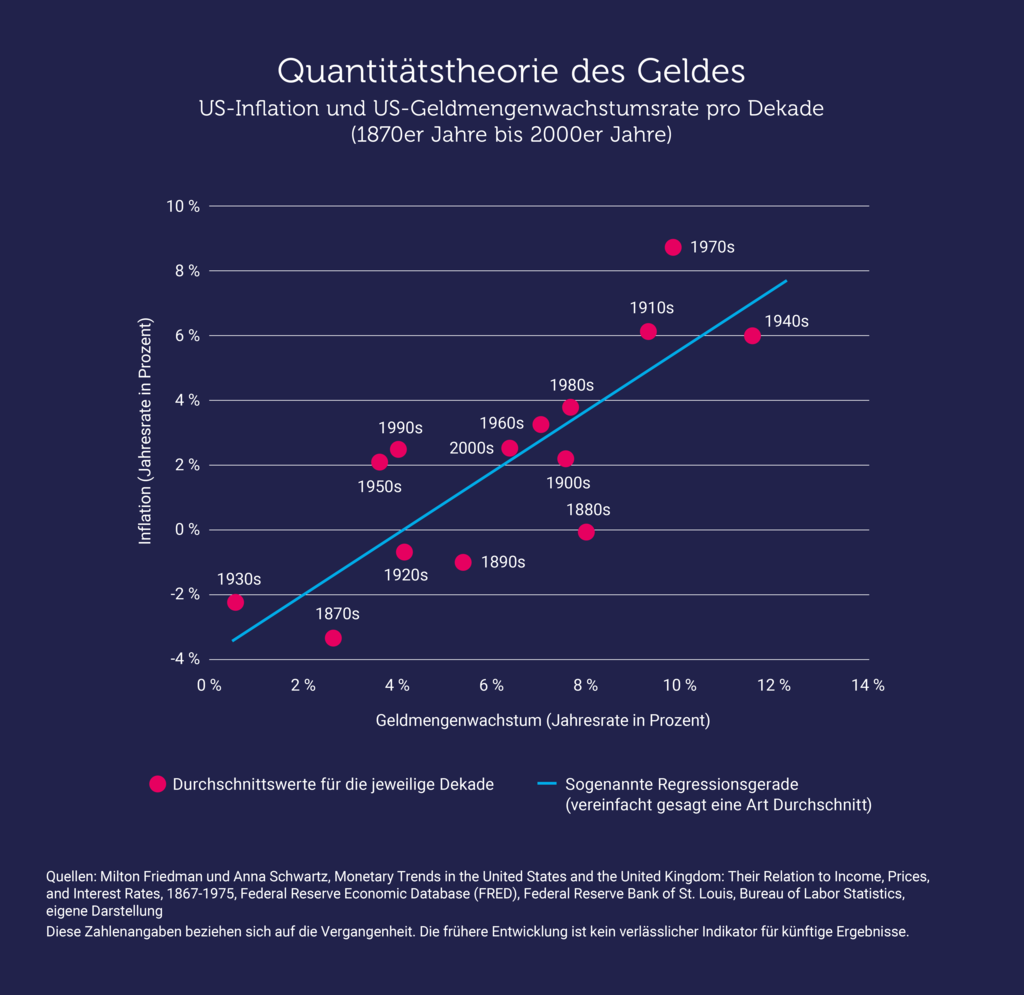
The big question, then, is whether this relationship still holds today, and whether we must therefore expect, in the coming years, a sharp, if not uncontrollable, devaluation of the euro, particularly in light of the money supply growing even further in the wake of the coronavirus crisis. To answer this question, it is first necessary to distinguish between relative and absolute price increases.
Distinguishing relative from absolute price increases
Relative price increases simply mean that a particular good or service becomes more expensive relative to another. This need not be accompanied by a rise in the general price level. In the coming months we will probably even see a good example of this: because of the coronavirus-related distancing rules, restaurants can use only about half of their actual capacity after reopening. The resulting supply shortage will likely lead to a corresponding rise in prices. This is by no means certain, however, because it may well be that we see an even sharper decline in demand out of fear of contracting COVID-19. In that case, despite reduced restaurant capacity, we would in fact be dealing with a surplus supply and could expect prices to fall accordingly. Should the prices for restaurant visits actually rise, however, while all other prices for goods and services remain essentially the same (or even fall), then we would be dealing merely with a relative price increase, namely that of restaurant visits compared with everything else.
Shifts in relative prices are a completely normal process in an economy. They are definitely not what is meant when people speak of general price increases, that is, of inflation. The term inflation always refers to an increase in the general price level, i.e. the increase of more or less all prices. But here, too, a distinction must be made as to whether these absolute price increases (inflation) are driven by the business cycle or are an expression of a loss of confidence in state institutions, particularly in the system of European central banks.
Cyclically driven inflation
Cyclically driven changes in the general price level arise from a mismatch between an economy's so-called aggregate demand (consumption, investment, government spending and exports) and aggregate supply (gross domestic product and imports). If demand exceeds supply, this tends to push prices up (inflationary). If, on the other hand, supply exceeds demand, this dampens prices (deflationary). Since the introduction of the European common currency at the turn of the millennium, the ECB has succeeded in keeping inflation in Europe at a targeted level of around 2% or below.
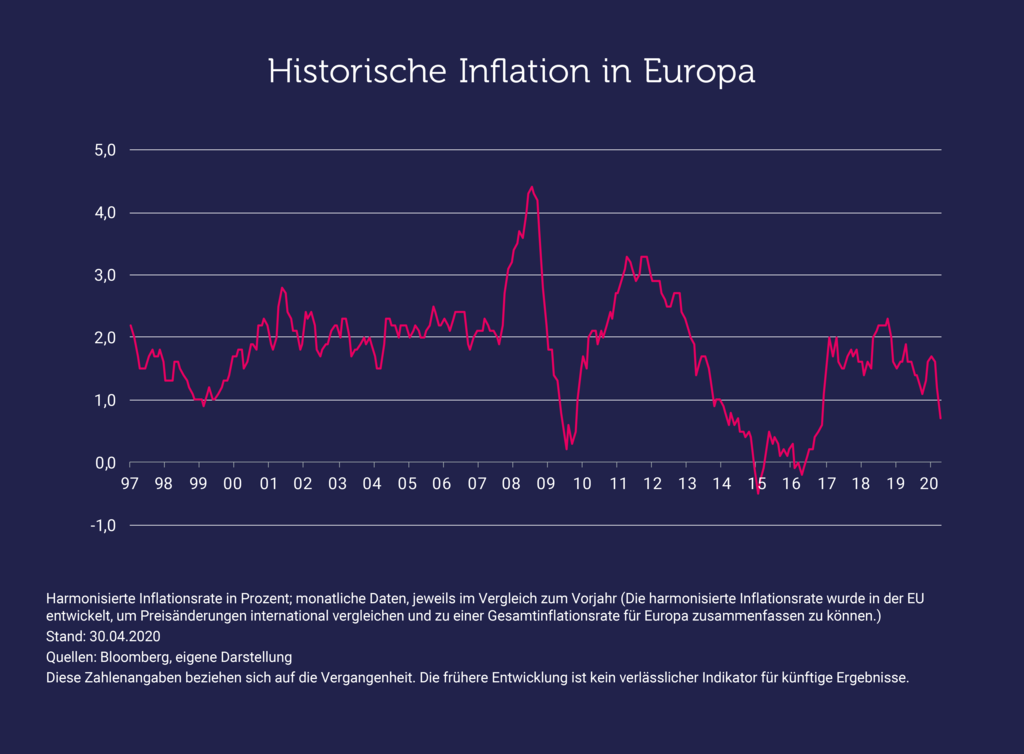
Whether the current crisis is more likely to give rise to inflationary or deflationary tendencies is still an open question. For unlike a "normal" cyclical downturn, in which demand typically weakens, we are currently dealing with a supply shock and a demand shock at the same time: the shutdown has pushed down both aggregate demand and aggregate supply. Which effect will now prevail remains to be seen. It is therefore by no means a foregone conclusion that the current crisis must lead to inflation, as many analysts assume. A cyclical deflation scenario (reduced demand, excess supply, falling prices) is just as plausible. But even if an excess of demand were to occur, resulting in rising inflation, this would be an entirely normal process without massively rising inflation rates, and it has nothing to do with the fears mentioned at the outset, let alone with a collapse of the euro currency system.
This brings us to the second and decidedly dangerous scenario of general price increases: the erosion of confidence in the integrity of national and European institutions, particularly the ECB.
Inflation due to a loss of confidence
A spreading loss of confidence in state institutions is the most striking and at the same time the least tangible cause of inflation. To decide whether this type of inflation actually poses a real danger in the current situation of sharp money supply expansion, it is quite helpful to take a closer look at the mechanism associated with such a loss of confidence.
Inflation expectations play a decisive role here. If broad sections of the population expect high, and possibly even accelerating, inflation (a reduction in the value of money), money loses one of its most important functions, namely serving as a store of value. Holdings of money in the domestic currency, and demand for any and all investments that pay interest and repayment in that currency, then decline dramatically. In the extreme case, when inflation rates reach double and triple digits, money then also loses its function as a generally accepted means of payment. People then even hoard everyday consumer goods, and under some circumstances an alternative medium of exchange may even become established, such as tobacco and cigarettes. The actual currency is then accepted as a means of payment only reluctantly, and only because the state compels it.
But does the danger described actually exist in the current situation? It is undisputed that both the scale of the government debt that has now accumulated and the size of the central bank's balance sheet (the latter being inflated in the course of the massive bond purchases) are cause for concern, and both will rise significantly further as a result of the various stabilization and support measures.
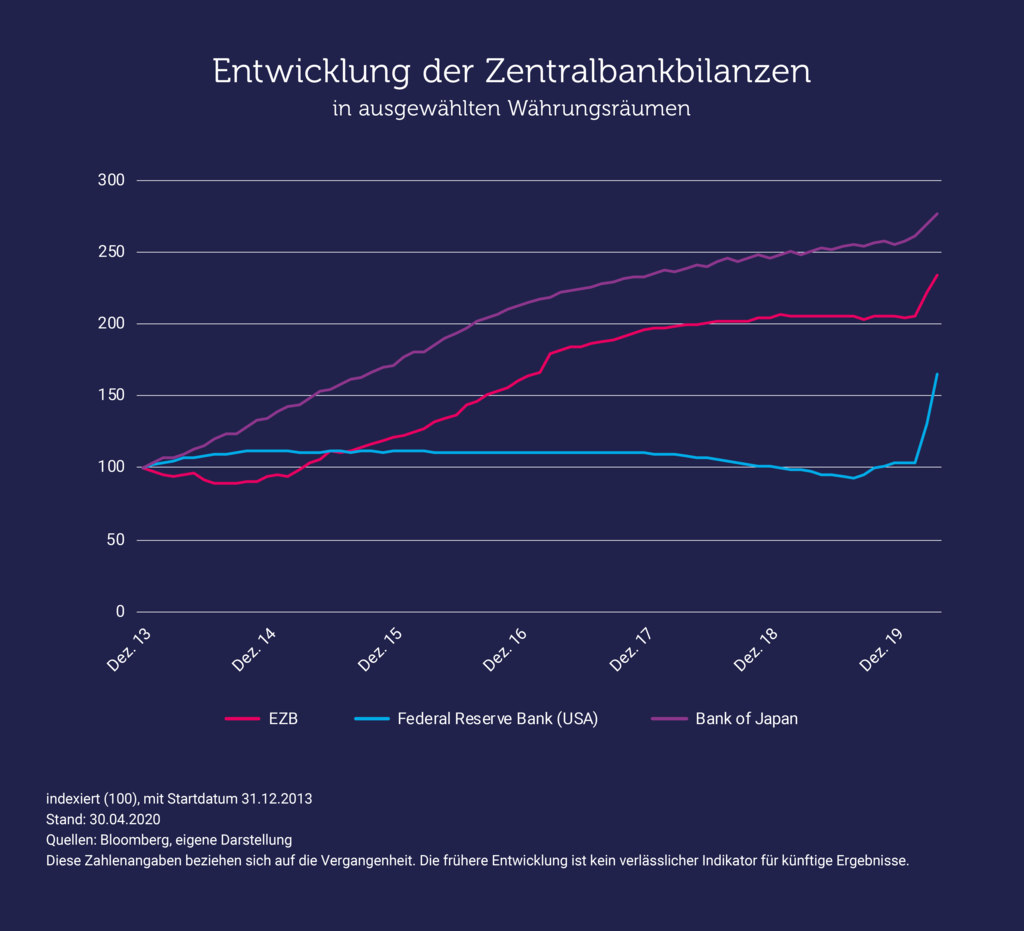
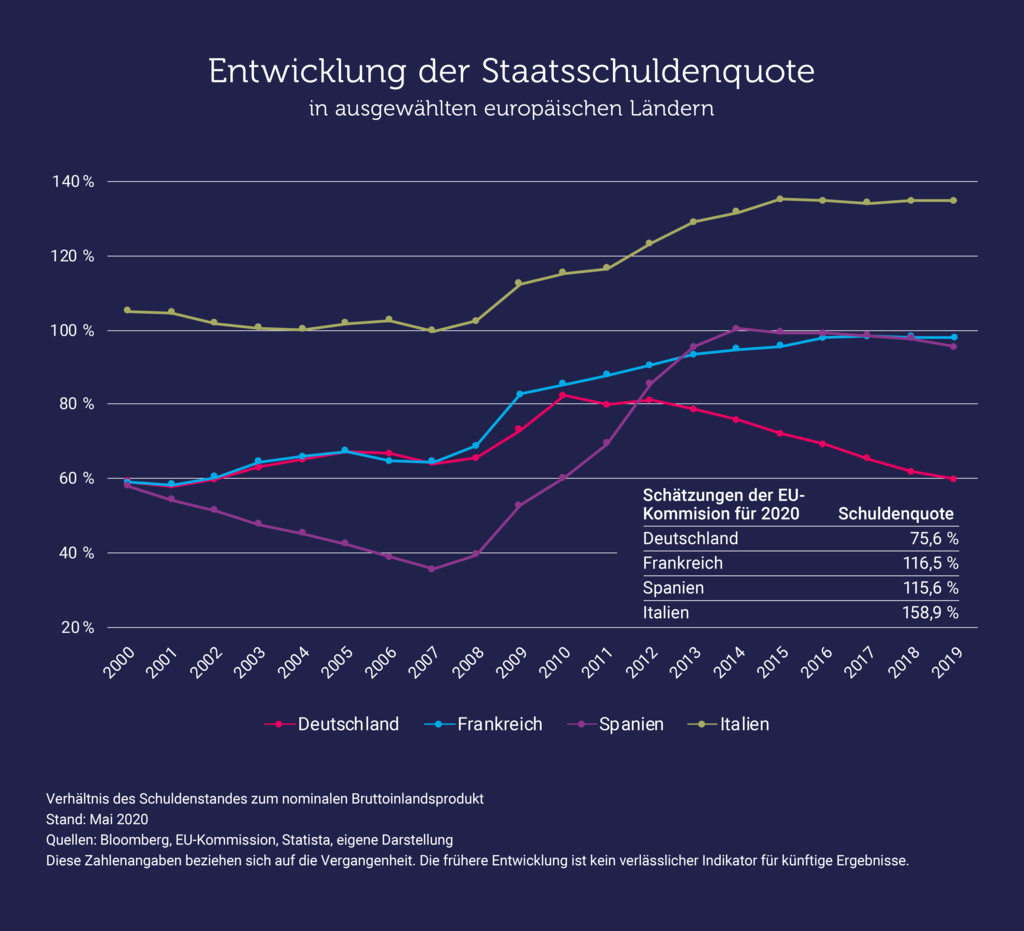
But are these developments really sufficient grounds to fear massive inflation, or even a collapse of the currency? We do not believe so.
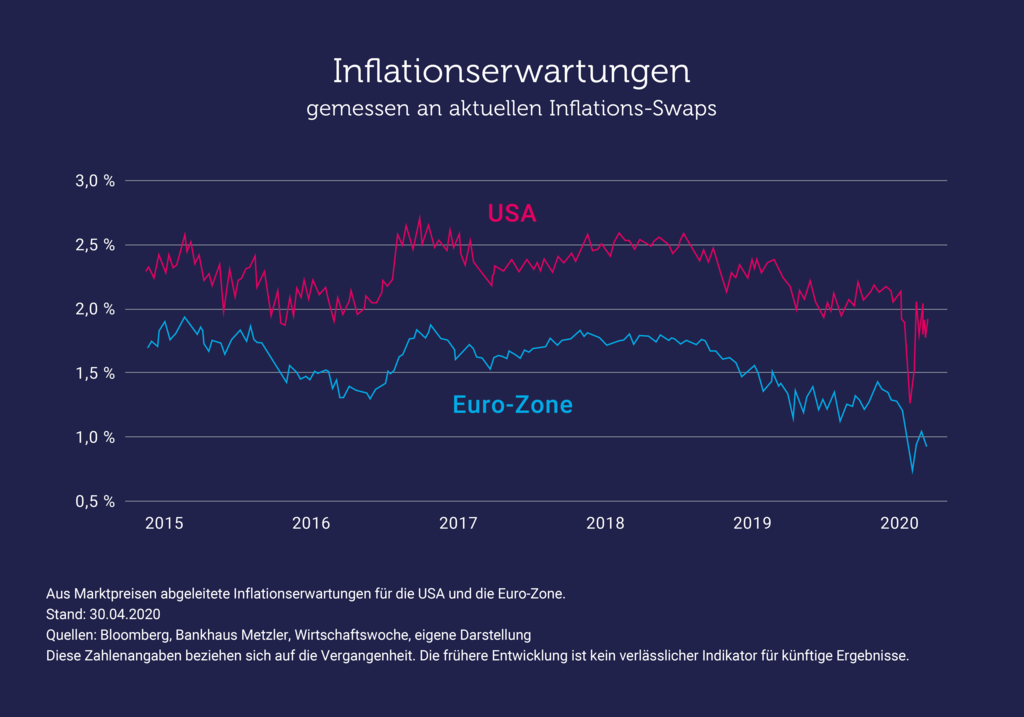
For example, the relevant market prices of so-called inflation swaps, which serve as a useful indicator, reveal no particular inflation fears.
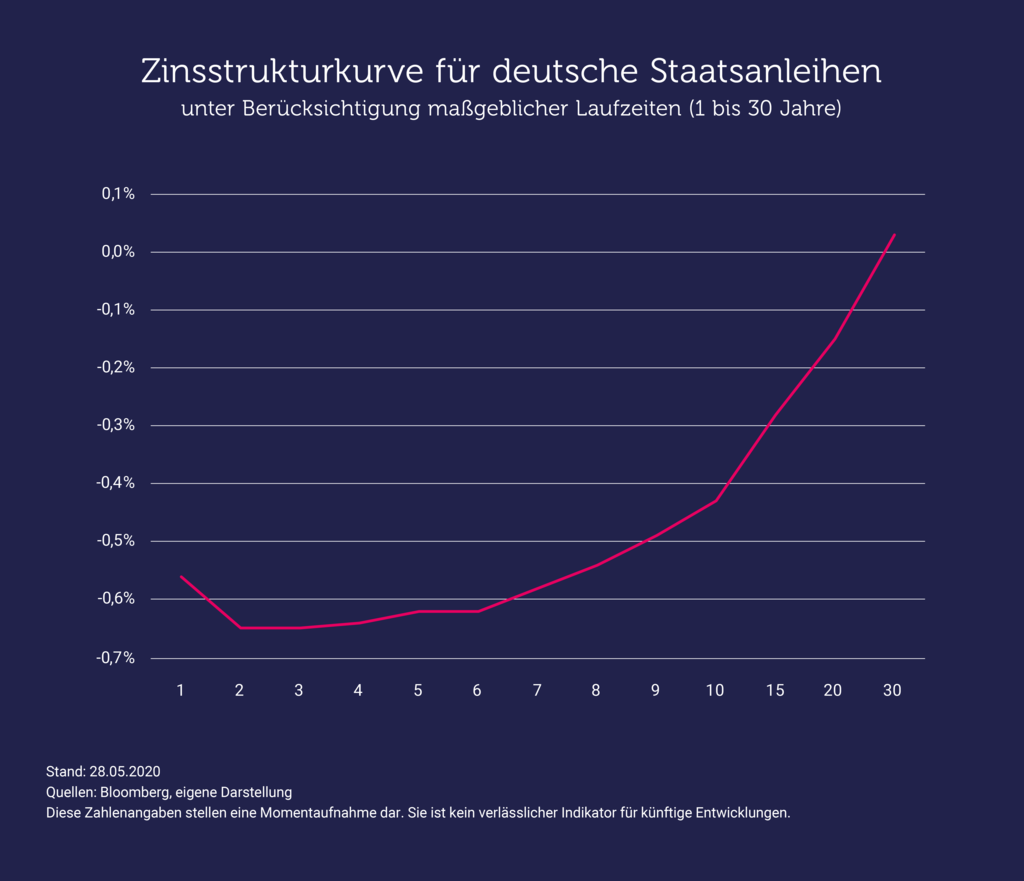
In addition, demand for euro-denominated investments is not declining either. While there are shifts in demand within the eurozone, bonds from the "safe havens", which include countries such as Germany, the Netherlands and Finland, remain sought-after investments, as reflected, among other things, in the still-negative German yields across virtually all remaining maturities. An investment environment dominated by fear of a currency collapse looks decidedly different. It would be marked by extremely high interest rates, because investors would only be willing to invest in such a high-risk currency if they were richly compensated on the interest side.
An equally good sign that confidence in the stability of the euro remains intact are the yield differences between inflation-indexed2 and "conventional" bonds, from which the market participants' inflation expectations can be read. Here, too, there have been no dramatic changes in recent weeks and months.
The debt burden is bearable, provided the consolidation course is continued after the crisis
Hyperinflations, up to and including currency reforms, have always been preceded by a loss of confidence in state institutions. No such loss is currently in sight, either in Germany, in Europe, or at the global level. On the contrary: "printed paper" issued by states alongside banknotes, i.e. government bonds, has in the current crisis even taken on the role of a safe anchor, a development that reflects precisely the opposite of a loss of confidence.
As already emphasized, this is the decisive point, for like money in all modern economies, the euro too is so-called "fiat money," meaning it was, in effect, artificially created and derives its value solely from confidence in the institution that issues the currency and, of course, from confidence in the strength and productivity of the economies behind it. And this confidence remains intact, as all the relevant indicators show.
There is, of course, no guarantee that this will always remain the case. Like any confidence, confidence in the stability of the euro can be put at risk. What will be decisive here is less how much additional money is put into circulation as a result of the coronavirus crisis and how much additional debt states take on as a result. Like most economists, we too are convinced that the measures taken were reasonable and sensible given the special nature of the crisis, even in their extraordinary scale.
The decisive point, we are convinced, will be whether states manage to persuade their citizens that the consolidation course (reducing the debt ratio), which had in fact been embarked upon quite successfully until the outbreak of the crisis, will be continued in "normal" post-coronavirus times. If that is assured, then even the current debt levels, and even the higher levels still to be expected, are no reason to fear the demise of the euro. It will weather this crisis, too.