Given the valuations of stocks connected to artificial intelligence (AI), it can sometimes make your head spin. Now fear of a bubble is spreading. How investors should deal with it.
The restaurant chain Kkanbu Chicken is hugely popular in Korea. But it made big headlines at the end of October not because of its especially crispy chicken, but because of a visit from three very special guests: Jensen Huang, CEO of Nvidia, Lee Jae-yong, chairman of Samsung Electronics, and Chung Eui-sun, chairman of the Hyundai Motor Group. The photo of the trio clinking beers together at a branch in Seoul travelled around the world.
Thanks to the AI boom, the Nvidia boss now enjoys popstar status. But it wasn't just the appearance itself that was surprising. It was also that, the next day, it triggered share-price jumps on the Seoul stock exchange for companies in the poultry-processing sector. Kkanbu Chicken itself isn't even publicly listed.
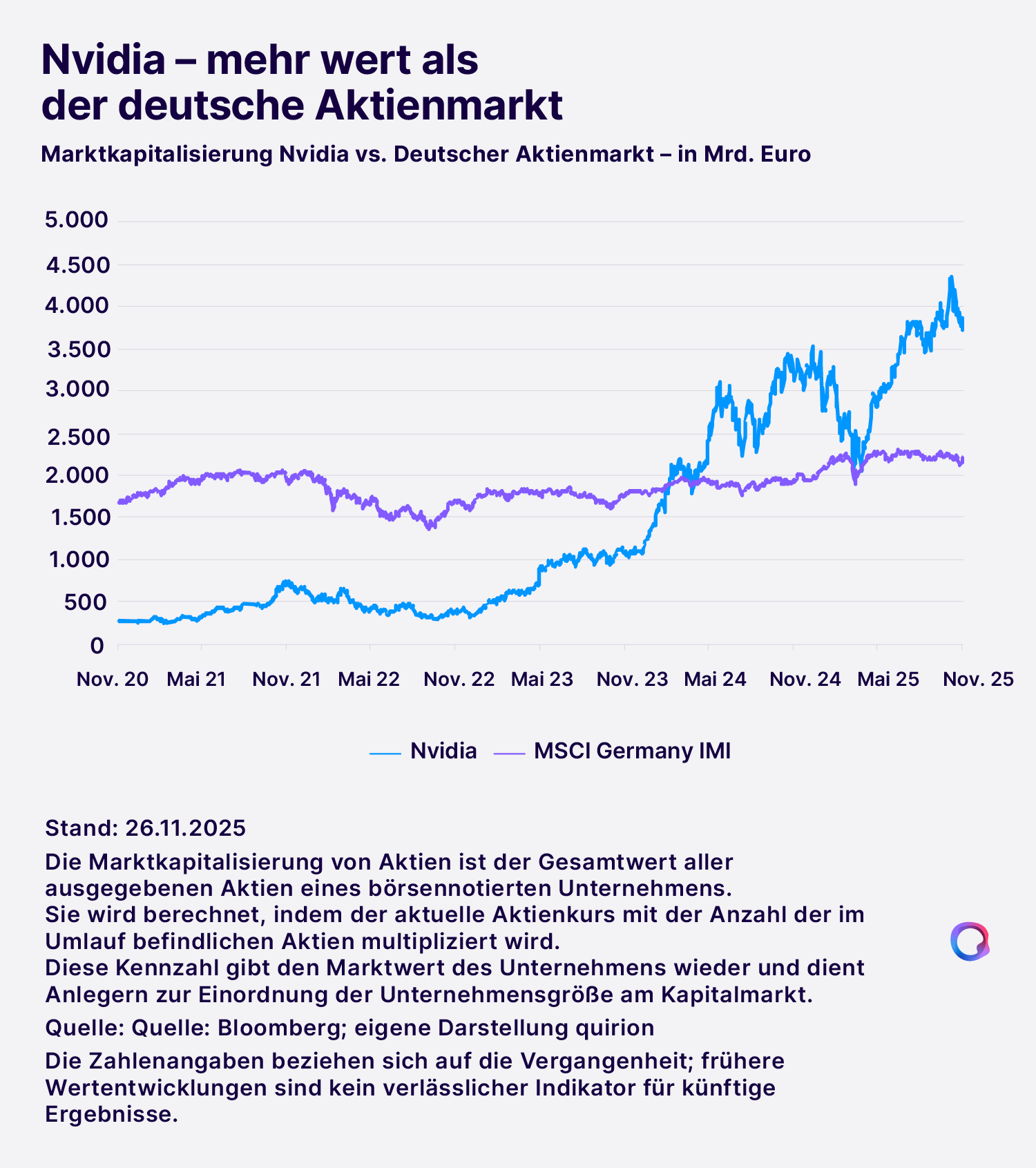
Excesses on the stock markets are not uncommon. And many people are right now asking themselves whether all the euphoria around AI stocks isn't completely overblown. In October, Nvidia briefly reached a valuation of 5 trillion dollars, the first company in the world to do so. For comparison: over the same period, the entire German stock market managed just around 3 trillion US dollars.
The high valuations of AI-related stocks and the trillion-dollar investments in AI infrastructure make many people uneasy. They fear it could turn out like the end of the 1990s, when the internet bubble burst. US Federal Reserve chair Jerome Powell has stayed calm so far: he doesn't believe there's a bubble, he said at a press conference in October. And he sees a key difference from the dotcom era in the fact that many AI companies can already point to considerable earnings. In November, Nvidia reported a 65 percent jump in profit to €31.9 billion for the third quarter, with a positive outlook for its future business.
Expect surprises
In recent years, there has already been frequent debate about whether tech companies are overvalued. “When people talk about a valuation being too high, it seems to be taken for granted that prices must soon fall,” observes Philipp Dobbert, head of asset management at quirion and at Quirin Privatbank. “But there's no method that would let you reliably determine which valuation is exactly right.” That, he says, can only ever be speculated about. “Prices reflect expectations about the future. Those can be met, exceeded or disappointed.”
Surprises are part of the markets. They can be negative or positive. In 2023 and 2024, for example, fear of a possible US recession was going around, among other things. The major economic slump failed to materialise. In both years, the S&P 500 managed a gain of over 20 percent. “No one had expected that beforehand,” Dobbert emphasises.
In the first quarter of 2025, US stocks initially showed weakness. Trump's tariff chaos caused great nervousness. As prices fell in March and April, you often heard the advice that it was better to avoid US stocks. Shortly afterwards, however, a months-long catch-up rally began that carried the market back to new record highs, until the debate about a possible speculative bubble now caused unease.
Whatever you do, no market timing
“The next crash is sure to come,” Dobbert stresses. It's just that no one knows exactly when it will happen or how long it will last. “In any case, you shouldn't try to hit an optimal moment to get out. In the vast majority of cases, that goes wrong.”
Suppose prices start crumbling and you get out. Perhaps they keep falling for a while and you feel vindicated. “The problem is getting back in. There's never a moment when all questions are settled and all risks eliminated,” Dobbert points out. “We've often seen a lot of return get missed because someone got back in far too late.”
Invest stress-free
How should investors deal with the uncertainty? “With the broadest possible diversified portfolio, in which you stay invested through all market phases,” says Dobbert. Over the long term, he says, the trend on the stock market points upwards. That's because stocks give you a stake in companies and therefore in the economy. And a market economy, in turn, is fundamentally geared towards growth.
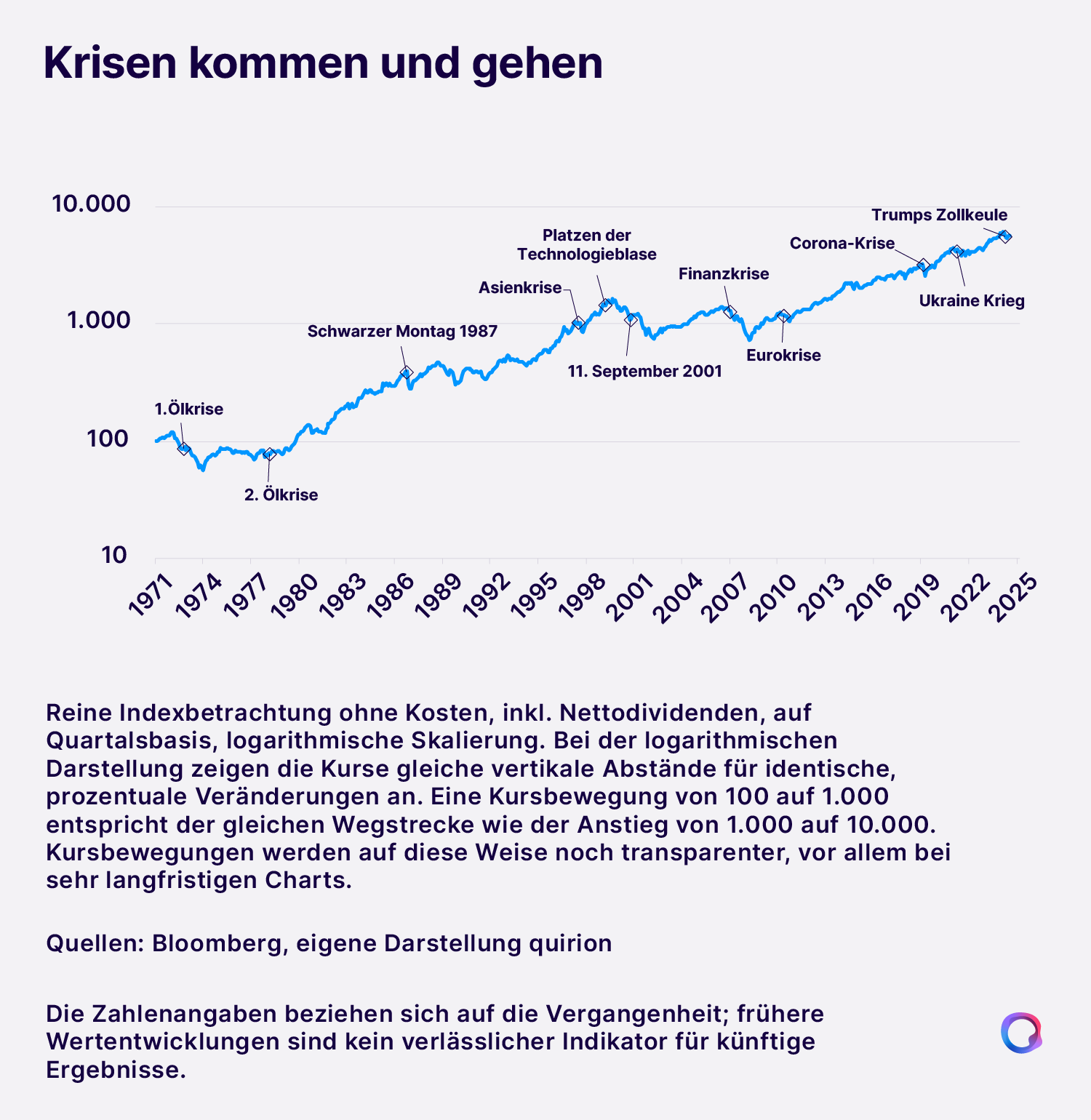
With the broadest possible diversification, you can seize the return opportunities of the stock markets without taking unnecessary risks. Because even though prices have no upper limit: individual companies come and go. A trending sector can lose its allure, an investment region can slide into a lengthy crisis. “Risks like these are best minimised through diversification,” Dobbert observes. “With a portfolio as broadly diversified as our global ETF portfolio, you can stay calm in any market situation.”
The whole world in your portfolio, as a savings plan too: more here.