Our investment strategy has a scientific foundation. It aims for the best possible balance of return opportunities and risks. That way, investors can stay calm in any market situation.
Emotions and investing are often hard to separate. But they don't make a good team. The euphoria when prices somewhere climb especially sharply - or the fear when a roller-coaster ride on the markets sows doubts about your own strategy: gut-feeling decisions all too often lead to bitter disappointments.
At quirion, the investment strategy is entirely free of emotions and speculation. To build wealth over the long term and systematically, it draws on scientific findings. "In capital market research, theory and empirical evidence mesh together in an almost exemplary way," explains Prof. Dr. Stefan May, Head of Investment Strategy and Product Development at quirion. "Yet only a few people in the wider public know that the findings gained this way make it quite clear what makes sense when it comes to investing."
Trust the market, not forecasts
One of the cornerstones of capital market research is the "efficient market hypothesis" - even if, at first, you might not necessarily associate the often frantic movement of prices and the frequently shifting opinions about trends with "efficiency." "But efficiency does not mean that experts can calculate future price developments in advance or somehow otherwise foresee them," May stresses. Instead, the assumption is that all available and price-relevant information is already reflected in current prices. "Exactly what will happen in the future remains unknown."
No one in the market has a crystal ball. "When investing, you should therefore orient yourself toward the long-term market return," May advises. "Attempts to beat it regularly go wrong." That applies both to the attempt to pick out only the best stocks from the broader market with a particular selection, and to the attempt to catch the optimal moment to get in or out.
Reliably beating the market - that doesn't work even for professionals. When it does succeed, it's a stroke of luck. A comparison published by S&P Global in March drives this point home once again. Among euro-denominated equity funds that invest worldwide, a full 91 percent performed worse in 2024 than a comparable stock market index. And in case you think that was an exception: over the past 10-year period, this applies to 97 percent.
Spread, spread, spread
Instead of selecting stocks, sectors, or countries based on particular expectations about the future, quirion relies on diversification. In doing so, the investment strategists orient themselves toward so-called return factors and market capitalization. "Ultimately, every stock has a set of characteristic features that decisively influence both its return opportunities and its risks," May notes. "Most of these risks can be rendered more or less harmless through sensible diversification." In academic terms, these are referred to as unsystematic risks. "What remains is systematic risk. Only that is appropriately rewarded, because it can't be filtered out through diversification."
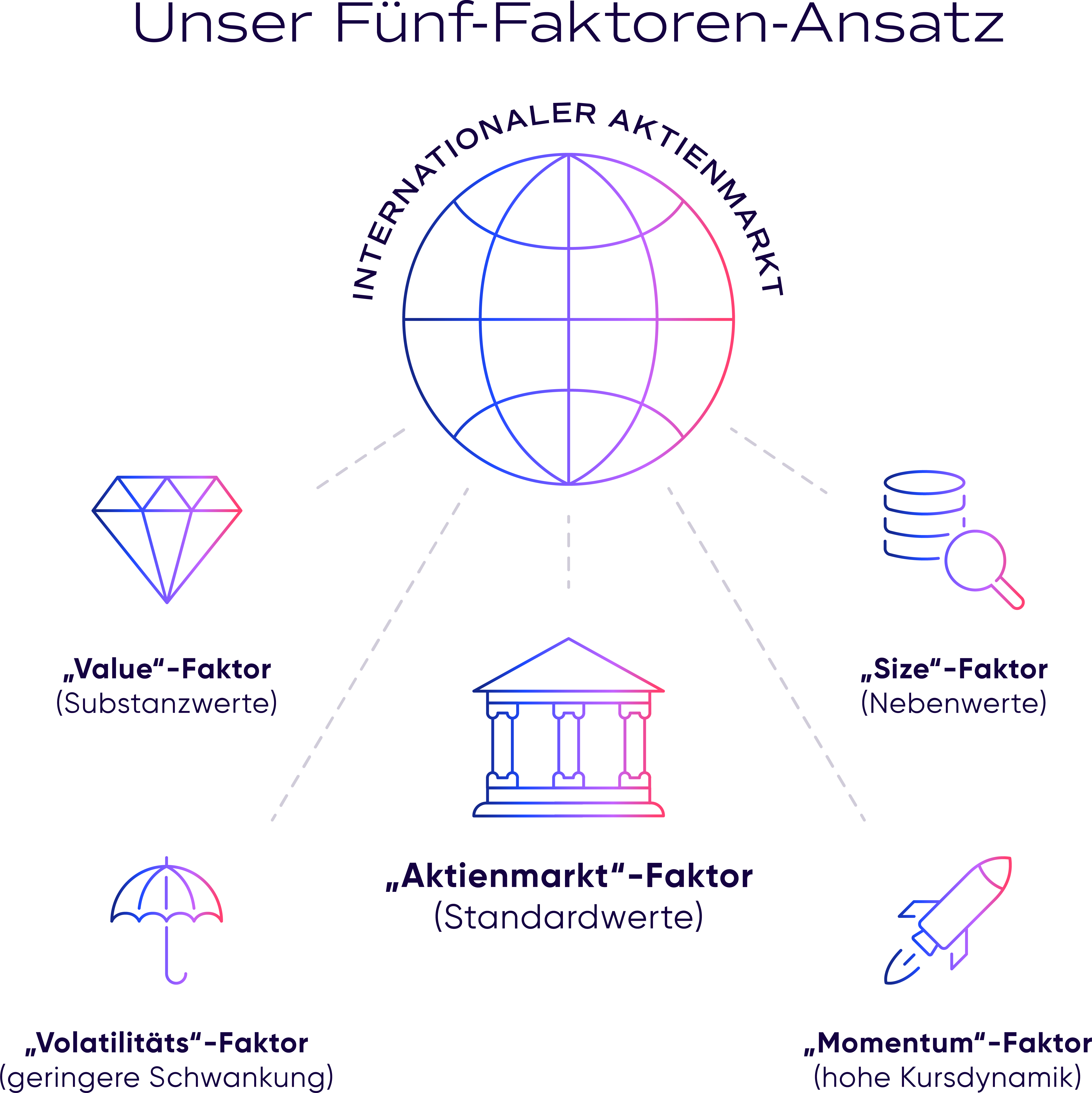
The goal is a so-called "efficient portfolio." In such a portfolio, risk is minimized within the relevant asset category. That category can be a pure equity portfolio, a mix of stocks and bonds, or a pure bond portfolio. It's always about achieving the most optimal possible balance of return opportunities and risks.
A world portfolio with perspective
On the equity side, quirion's global ETF portfolio currently contains around 8,000 stocks from more than 70 countries. "Through this broad setup, we increase the likelihood of benefiting from the average returns of the global stock market, which have so far always been positive over the long term," May is convinced. "At the same time, we reduce the impact of turbulence in individual sectors or regions."
With a portfolio like this, investors can stay calm in any market situation. And they should: "The investment strategy is designed for the long term, that is, to keep you invested across different market phases," May emphasizes. Even when it's sometimes emotionally hard to keep calm during turbulence: "A lack of investment discipline is a particularly common reason why, for many people, the gains in their own portfolio fall short of what would have been possible over the long term with the market return."
An assessment of the current market situation can be found here.