quirion is scientifically grounded and guided by facts, not forecasts. That makes it all the more interesting to take a look at those facts. How have global markets developed from a long-term perspective? Credit Suisse provides answers in its "Global Investment Returns Yearbook", newly published in February. Once a year, and in collaboration with professors from London Business School, the bank compiles the facts from almost 120 years of financial history, together with insightful background knowledge for every investor.
Equities beat bonds
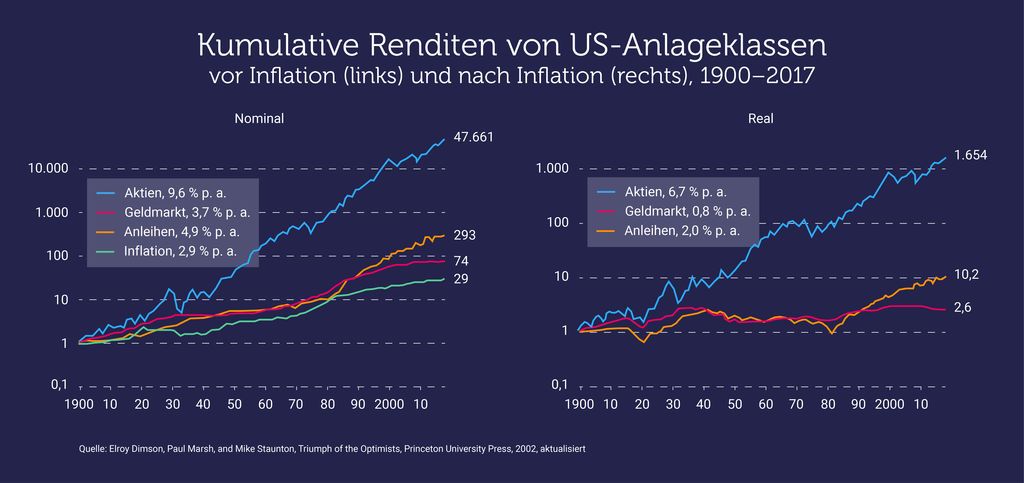
One of the most fascinating findings comes from comparing the returns of bonds and equities. On average, equity returns — using the USA as an example — outpace both short-term money-market investments (3.7 percent per year) and long-term bonds (4.9 percent per year) at 9.6 percent per year — a reward for the higher risk associated with investing in equities. Adjusted for inflation, it is even more striking: since the 1930s, money-market investments have delivered no real growth in wealth; at best, they have protected against inflation.
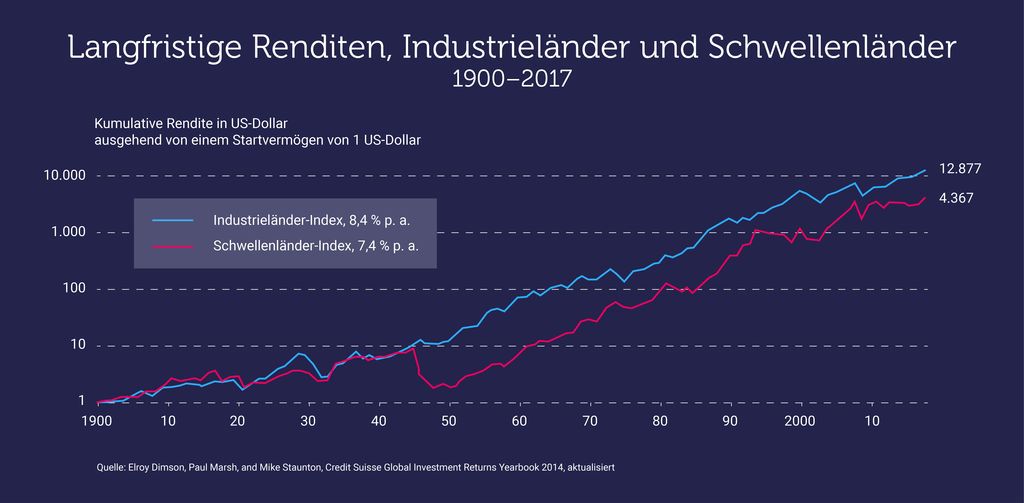
Looking at the equity market across all developed countries, the long-term return was 8.4 percent per year. From this long-term perspective, market crashes barely register. Emerging markets are a somewhat different story: they lost dramatically in the 1940s but have generated high returns ever since.
What does this mean for quirion? quirion never advises any of its investors to hold high equity allocations if they cannot or would rather not bear the risk that comes with them. But if you want to build wealth over the long term, there is hardly any way around investing in equities. quirion invests in low-cost ETFs and index funds and spreads investments worldwide across more than 70 countries and over 8,000 companies. This way, the attractive market return of equities reaches our clients as fully as possible, and we avoid unnecessary risks from speculating on individual companies. We classify emerging markets as risky, which is why they are only suitable as an admixture.
It all comes down to market weighting
It is also worth taking a look at market weighting. What immediately stands out when you compare the status quo of 1899 with 2017: back then, the USA was still relatively insignificant, and Great Britain was the great economic power. Germany, too, had a large equity market. Today the picture looks different: the USA is the dominant economic power, which is also reflected in the equity market.
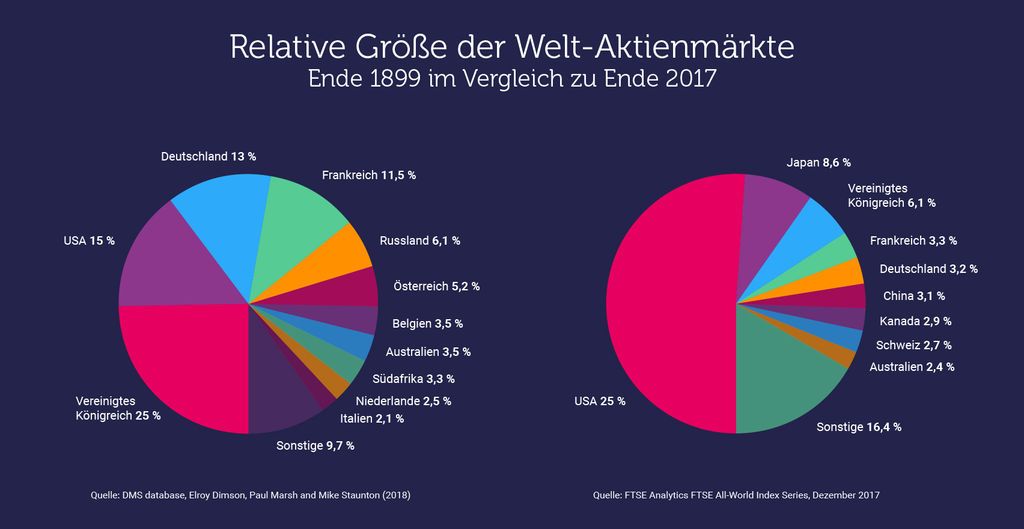
What does this mean for quirion? We rely on market weighting, meaning that countries are represented in our portfolio according to their share of the global equity market. When weightings shift between countries, our portfolios automatically follow suit. This keeps us broadly diversified at all times and prevents us, for example, from overweighting a country in decline.
Aim for worldwide diversification
What is often overlooked in such presentations is how returns behave during extreme events. Take Germany as an example: here, equity performance has been remarkably strong since the end of the Second World War — for instance 4,373 percent over the period from 1949 to 1959. It gets interesting when you look at the returns from the time before that. Equity markets in individual countries can, in the most absolute extreme case, lose 80 to 90 percent in a single year (for example in 1948: Germany: -91 percent for the year; Japan: -86). On the other hand, there are periods with extremely good returns: the world portfolio, for instance, generated a return of 185 percent between 1932 and 1936. Also interesting: the longest losing streak for equities in real terms — that is, after inflation — was 22 years for the world. This was the maximum price you had to risk for the excess return of equities. In individual countries, by contrast, that figure was as high as 55 years.
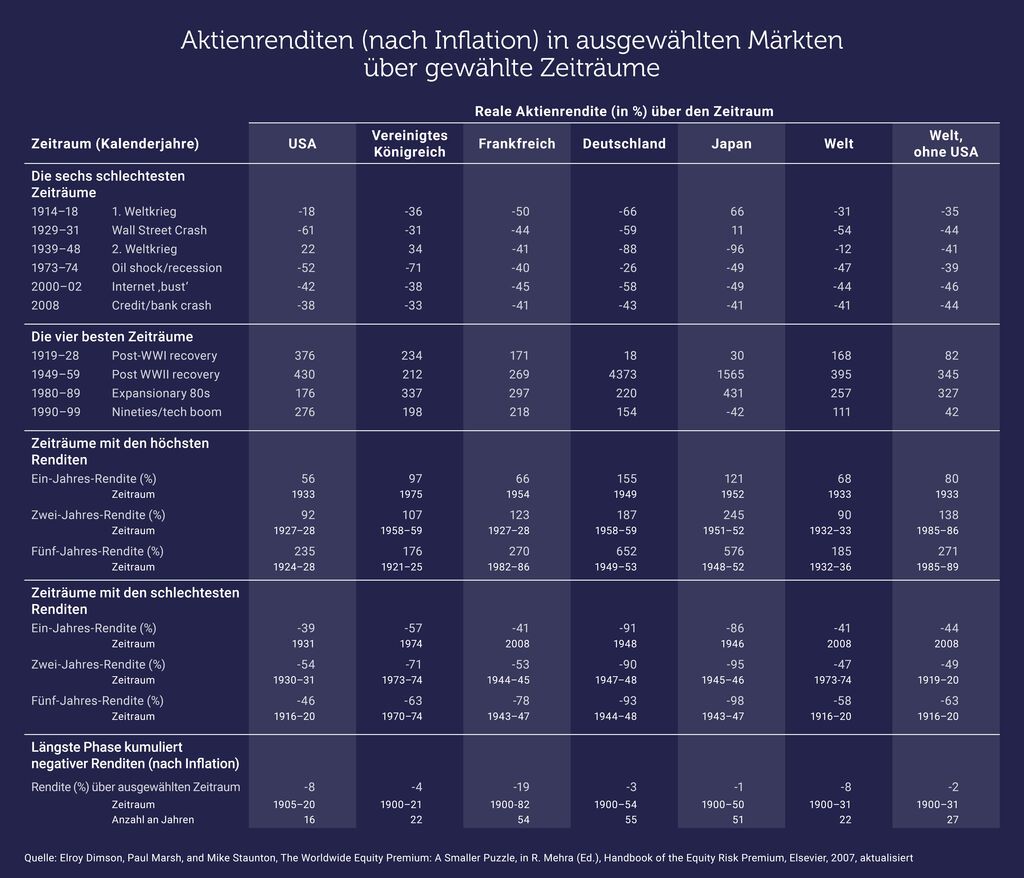
What does this mean for quirion? It shows that the intensity of fluctuations — and thus the loss potential — of national market indices is significantly higher than that of a globally diversified portfolio. The more international the portfolio, the smaller the fluctuations. That is why we rely on complete diversification across asset classes and countries, and advise against investing, for example, only in German equities.