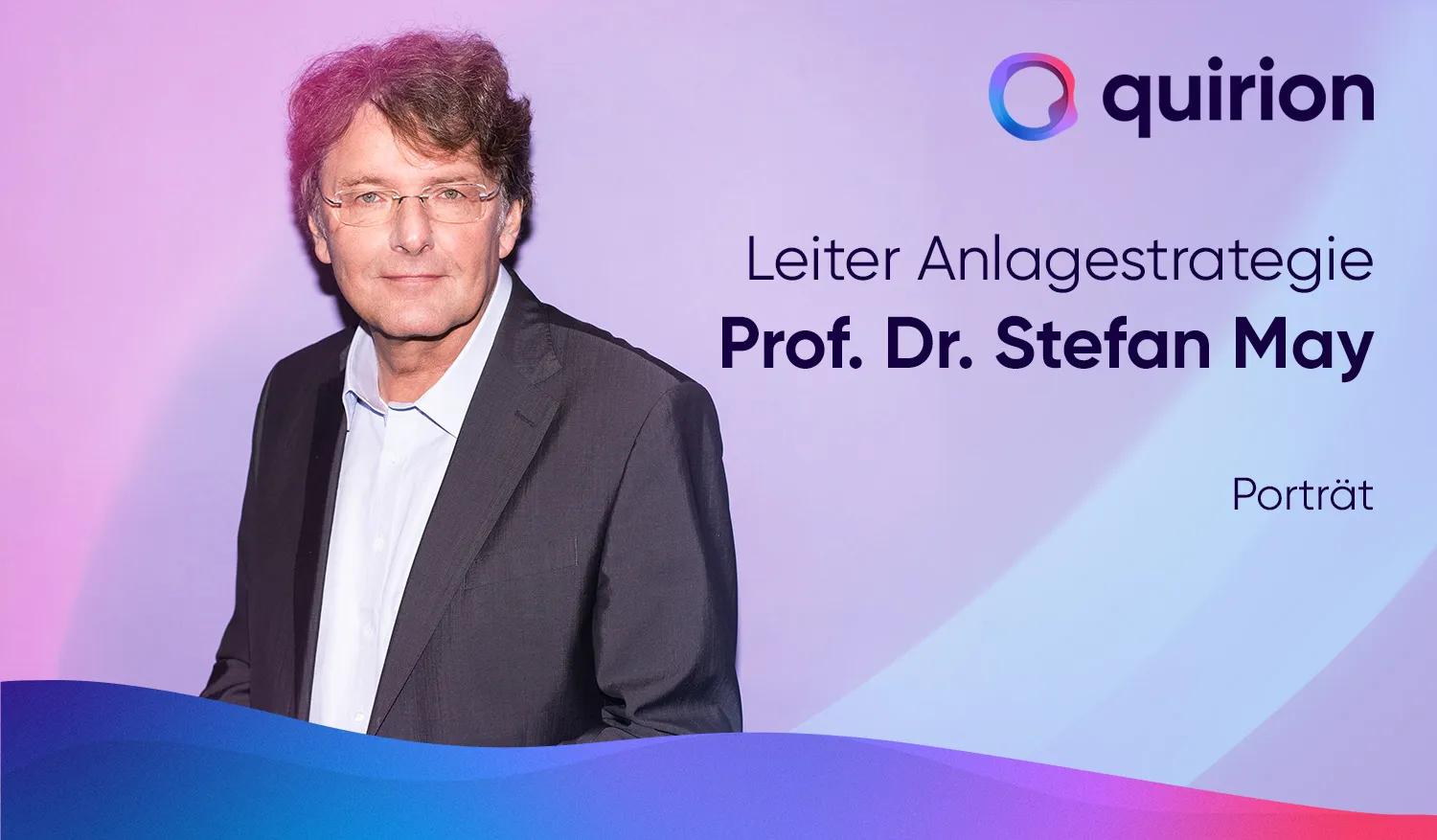
As a professor of banking, financial market analysis and portfolio management, Stefan May spent many years making the case for putting the findings of capital market research to work in investing. As head of investment strategy at Quirin Privatbank and at quirion, he continues to help translate that theory into practice to this day.
"There is nothing so practical as a good theory": this quote has been attributed to several authors, among them the social psychologist Kurt Lewin. Regardless of who first put it that way, Stefan May likes the saying best with a slight refinement: "There is nothing more relevant to practice than a good theory." In his view, this certainly holds true for portfolio theory. And that goes some way toward explaining May's career path. His heart belongs to science and to its connection with practice.
First a degree in economics, then a doctorate and a research assistantship at the University of Regensburg: an academic career seemed all but predestined. But then an offer from Hypo Capital Management drew him into the banking world, initially as an analyst. His responsibilities quickly grew. After four years he moved to Luxembourg for the Hypo Bank Group, building up a new business unit as head of portfolio management and asset management. Yet even during his time at Hypo, May remained connected to academia. On the side, he continued to teach regularly.
In 1996, May switched sides once again, answering the call to become a professor at what was then the still very young Fachhochschule Ingolstadt. He helped build up the university, which was later renamed Technische Hochschule, and even served as its vice president for two years. For over 25 years he was responsible for teaching banking, finance, financial market analysis and portfolio management. Now 67, he is retired with emeritus status.
Trusting the market
For May, capital market research is a field in which theory and empirical evidence dovetail in almost exemplary fashion. "Over the past 70 years, a certain canon of insights has taken shape that private investors, too, can benefit from," May notes. Among them: that you should not try to beat the market, and that you are better off spreading your investments as broadly as possible in order to reap the benefits of diversification. (link to the planned article on diversification)
May always kept such scientific insights firmly in mind. After his experiences in the banking world, however, he had for a time resigned himself to the fact that theoretical findings, however well supported by the evidence, left little mark on investment advice, especially in Germany. "I often had to listen to people say that theory was all well and good, but that in practice it was about making money."
The road to Quirin Privatbank
In 2013, at the invitation of Dimensional Fund Advisors, May gave a series of lectures. Dimensional had embraced a science-based investment approach early on. After one of these talks, May struck up a conversation with an employee of Quirin Privatbank. They discussed the bank's approach of independent advice, free of product commissions, and the fact that Quirin Privatbank, along with its digital asset management arm under the quirion brand, also wanted to build on scientific insights. "That electrified me," May says.
A little later, May visited Quirin Privatbank in Berlin, where he also met the bank's founder, Karl Matthäus Schmidt. Not long afterward, the university professor additionally took on the role of head of asset management at Quirin Privatbank and at quirion. In this capacity, he played a decisive part in shaping the investment strategy. "At the outset, it was mainly about putting the science-based investment approach into practice in ETF portfolios, and then conveying it both to the advisors and to the investors." No easy task in a financial world dominated by commission-driven product sales and headlines about the latest hot market trends.
Educating people as a life's mission
Anyone who speaks with May quickly senses that educating people about sensible investing is a genuine concern of his. Why does it still matter so much to him? "Because to this day, most banks take liberties in advising private investors that they would never dare take with institutional investors such as insurance companies."
What he means above all is that investors are all too often steered into overpriced products such as actively managed funds because of the lucrative commissions involved. "When those then deliver poor results, investing in the capital markets is often called into question altogether." But the fault lies not with the capital markets, he says, but with poor advice. This frustrates May in particular because, given the growing need for private retirement provision, he sees great social value in giving broader segments of the population a share in the return opportunities of the capital markets. "With our investment strategy and our efficient ETF portfolios, that is exactly the goal we pursue."
Keeping the bigger picture in view
Of course, May does not concern himself solely with capital market research and portfolio theory. He lives in the Steigerwald region on the Bavaria-Franconia border and loves to go for walks there with his two dogs. He enjoys listening to classical music, especially late Romantics such as Bruckner and Mahler. He appreciates literature and is particularly passionate about the philosophy of the natural sciences and mathematics, which brings him back once again to a certain connection between theory and its practical effects: "What fascinates me most is how our views of the world have changed with the advances in the natural sciences."
As an emeritus professor he is not currently teaching any courses, though he does not rule it out for the future. Right now he is focused on his work at Quirin Privatbank and at quirion. "I didn't have any grand career plan at the start of my studies," May says, looking back. At first, he had been undecided about whether to study business administration or economics. In the end, what tipped the scales was that economics touches more strongly on social and political themes. "Topics that are about the bigger connections have always drawn me in," May emphasizes. Whether it's natural science, economics or portfolio theory: "When people seriously engage with scientific insights, it can take them a great deal further in life."