Relying on your own intuition when investing can quickly lead you astray. Here is a look at four especially common mental errors. And what you can do to avoid them.
Sometimes you seem to see things perfectly clearly. And then it happens. A slightly different perspective reveals that everything is quite different. It’s like optical illusions — take the famous Müller-Lyer illusion. The phenomenon: a straight line appears to be of very different lengths depending on whether the arrows at its ends point inward or outward. Even though the lines are actually the same length. You can only resist this perceptual error with some effort. You have to draw in guide lines to show yourself what is really the case.

So-called cognitive biases work in much the same way. People intuitively have certain behavioral tendencies, some of them deeply anchored in the brain. And these also influence decisions when investing. Usually with painful consequences.
1) „Now I need to rethink everything.“
People, for example, generally tend to regard current information or events as especially important. At any rate, as more relevant than things that happened longer ago. In behavioral finance, the behavior-oriented theory of financial markets, this phenomenon is called „recency bias“. Anyone who invests money in the capital markets feels this bias toward the here and now especially during larger price movements.
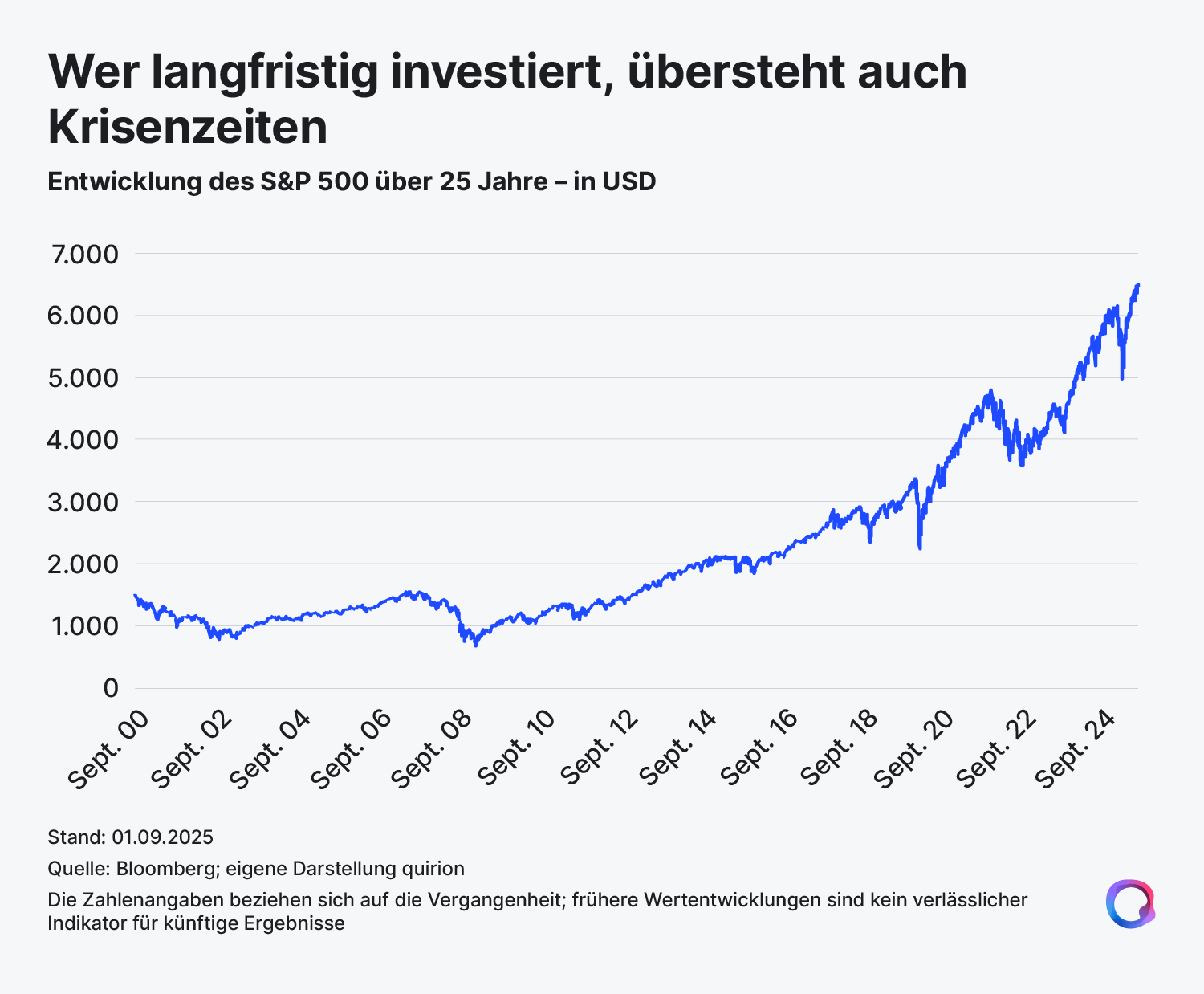
The phenomenon could be observed nicely again this year. After what felt like an eternity in which the US markets outshone other regions, things did not go quite so smoothly there in the first four months. The uproar over Trump’s tariffs, a slight bout of weakness in the dollar — and investing in the American stock market was already being called into question across the board.
Our tip: In the stock markets, a long-term perspective helps you put developments into better context.
2) „I can’t afford to miss this.“
Closely linked to „recency bias“ is the hunt for the next high-flyer. Because somewhere, prices are always rising particularly sharply right now. During the coronavirus crisis, for example, that was true of the biotech company BioNTech. In the summer of 2021, the media were falling over themselves with enthusiasm. And they fueled the fear of missing out. The stock rose to over €300. In early September 2025 it was trading below €90. „Only“ around four years lie in between. But by now the headlines feel like they are from another era.

Today, other stocks are supposedly a „money-printing machine“. There are always some. Someone always „knows“ what you „must“ bet on right now.
Our tip: The path to your investment goals runs through a consistent strategy. If that strategy is set up correctly, you can spare yourself a great deal of excitement and disappointment.
3) „I knew it.“
People not only tend to overestimate current trends. They also tend, in hindsight, to classify developments as far more predictable than they actually were. Psychology calls this „hindsight bias“. It refers to remarks along the lines of: „It was obvious this market would go through the roof.“ Sometimes you say that to yourself. Sometimes you hear it from others.
Anyone who knew how things were bound to turn out also feels confident about predicting the future. And that’s when it gets really risky. Because individual developments in the financial markets can never be reliably forecast.
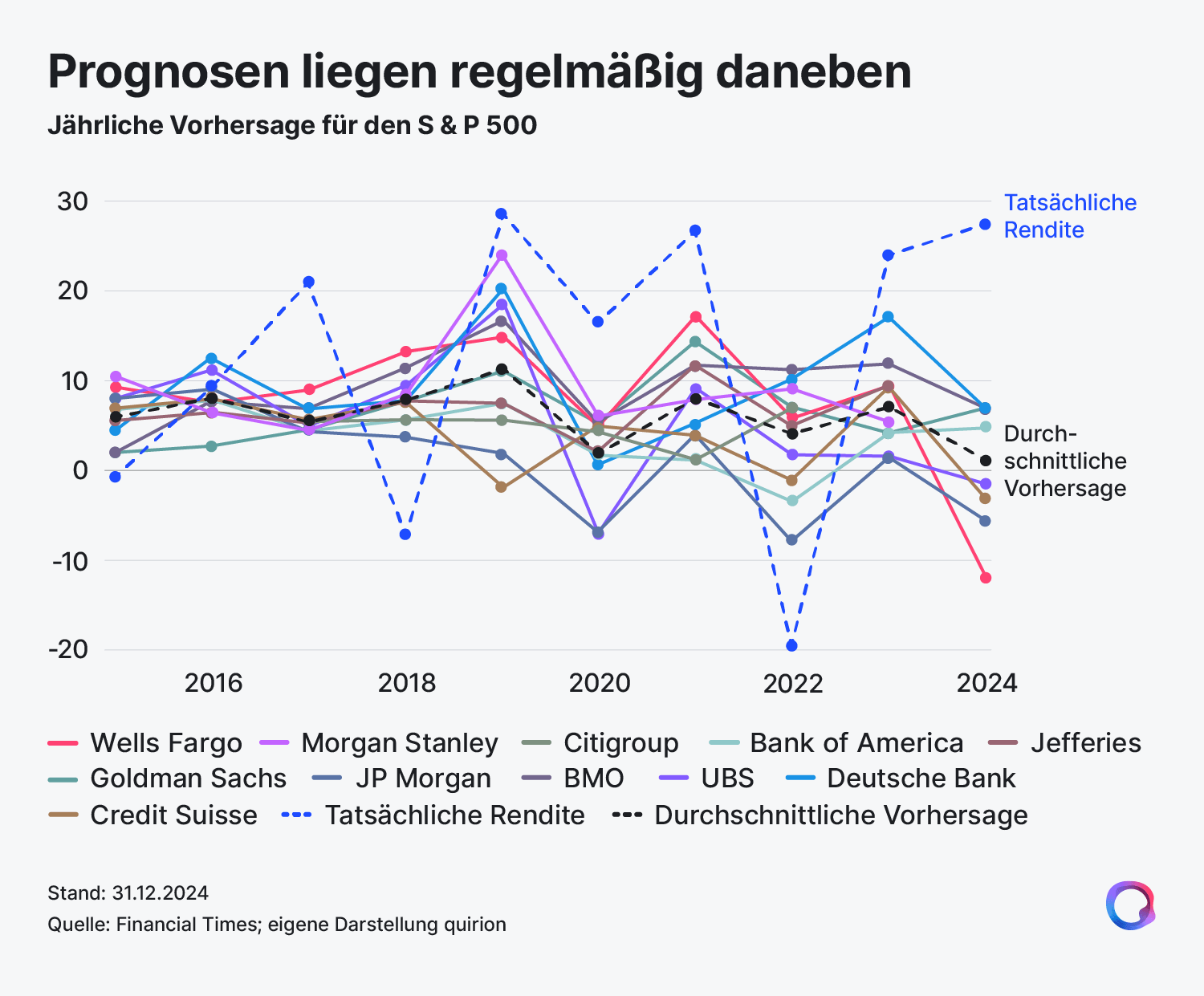
Our tip: Distrust all forecasts when it comes to investing. They are no solid foundation for an investment strategy.
4) „I only invest in the best.“
Rankings are very popular. For instance, when searching for investment products such as traditional actively managed funds. Rankings seem to show at a glance where it’s worth investing. But be careful: relying on such rankings rests on two misconceptions at once.
The first misconception is tied to the tendency to trust experts more or less „blindly“ („authority bias“). Investment experts don’t have a crystal ball either. They cannot know in advance which market segments and individual stocks will excel in the future. Yet that is exactly what they would need to gauge in order to systematically beat the broader market through active fund management. That only a few succeed at this is shown time and again by studies. A study by S&P Global from March demonstrated this, among other things, for euro-denominated, globally investing equity funds: in 2024, 91 percent of them performed worse than a comparable stock index. Over the 10-year period, that was even true of 97 percent.
The second misconception is linked to what is known as „extrapolation bias“. People tend to expect the past to continue and to project it into the future. But past successes in the world of funds usually don’t last long. The funds at the top change constantly — another sign that the investment success of active strategies has more to do with luck than with skill.
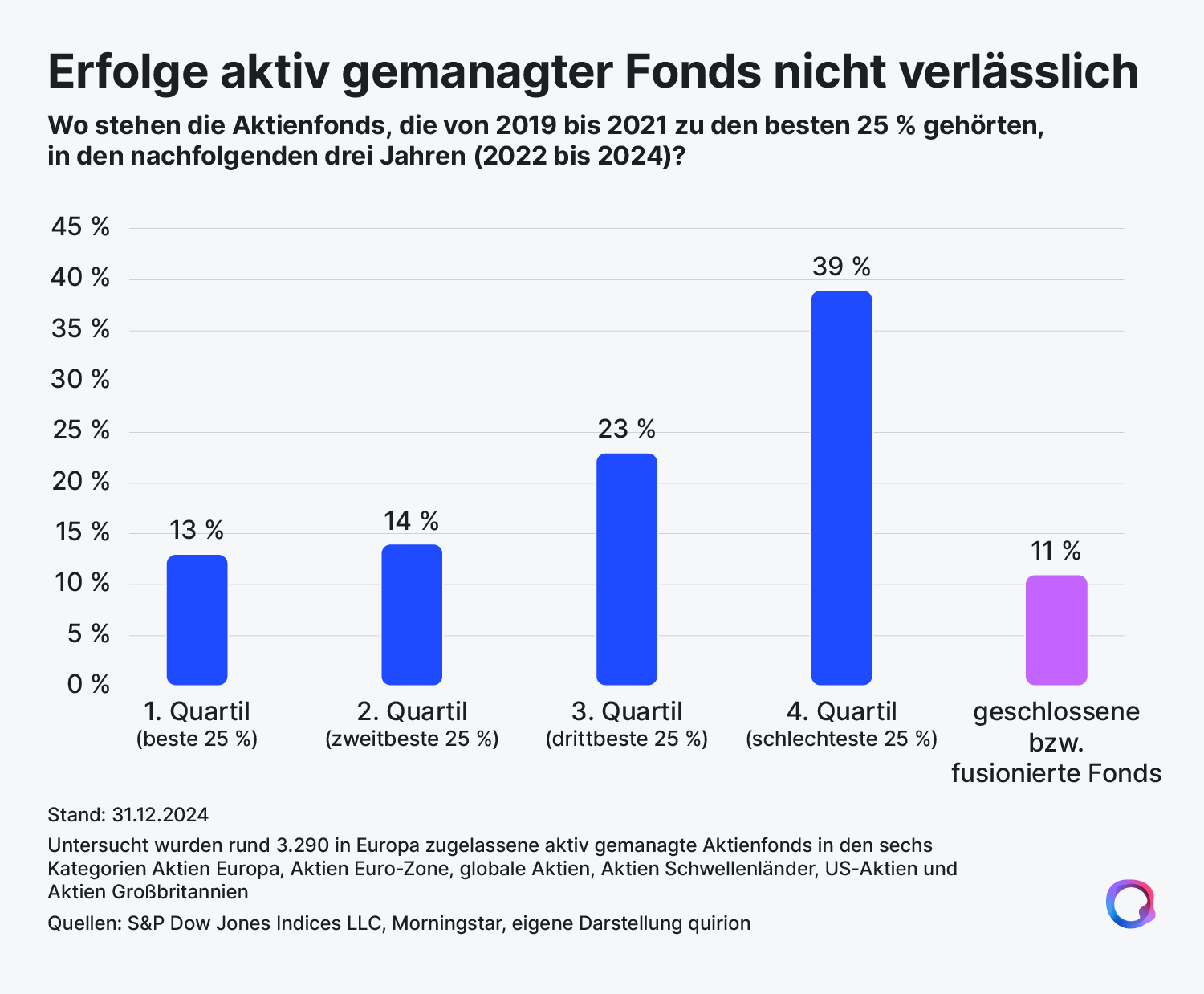
Our tip: You should not bet on strategies that try to beat the market. Better to „join forces“ with the markets instead. That means spreading your portfolio as broadly as possible.
Conclusion:
What counts for your investment success is a long-term perspective. And a consistent investment strategy. That strategy should do without forecasts and active security selection. Which strategy is right for you specifically depends on your goals.
We’d be happy to make you an investment proposal that matches your goals.