We are currently living through extremely turbulent times marked by great uncertainty. The capital markets are in an extremely emotional mood, set against economic consequences that will, without doubt, be overcome sooner or later. In times like these, though, both investors and investment professionals themselves are subject to large emotional swings, and in this atmosphere it is not easy for any of us to convey calm and composure. So how can it work nonetheless? Remind yourself of your investment horizon and of the share that equities sensibly make up in your overall wealth, and of how these aspects still fit your strategic asset allocation.
Every crisis has its own character, and it is impossible to foresee the exact course it will take. At present there are, in quick succession – most recently yesterday – individual trading days on the (stock) markets that must be described, even from a longer-term perspective, as decidedly negative, indeed panic-driven. Don't let yourself be drawn in by this. The existence of the market-economy system is not in question. It is therefore certain that this crisis, too, will come to an end and that, by the nature of the system, a vigorous recovery will follow as soon as the situation returns to normal.
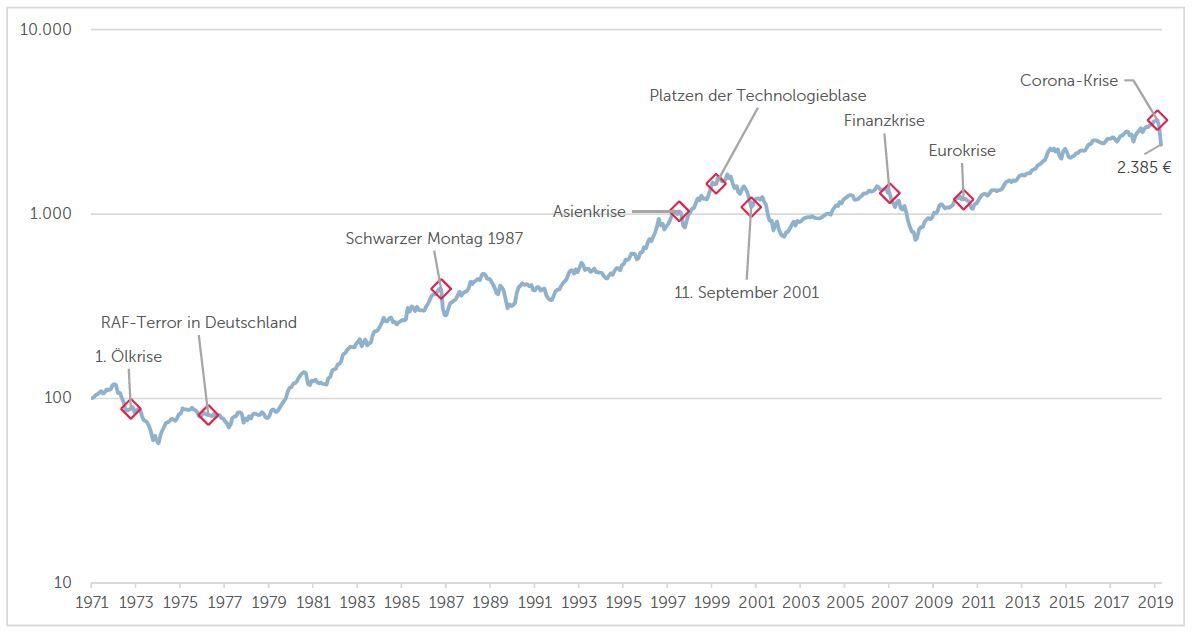
Of course we can understand that you are worried. Your assets have been through a rapid and steep decline over the past few days. Despite all of this, in the interest of your long-term investment success, we recommend that you sit out the risk. This is nerve-racking, but in all situations of this kind it has always been the right thing to do. In the end, the coronavirus will be one episode in the eventful history of the financial markets. The graph below illustrates just how episodic momentous events are.
Markets reward discipline
Growth in value of €100 over a good 48 years – MSCI World Index (31 December 1971 to 12 March 2020)
Sources: Bloomberg, own illustration
Index only, excluding costs, including net dividends, on a monthly basis, logarithmic scaling
These figures relate to the past. Past performance is not a reliable indicator of future results.