The markets' reaction to the Iran war once again shows just how quickly prices can change direction. Even if prices fluctuate more sharply for a while during such crises, the principles of long-term investing don't change as a result.
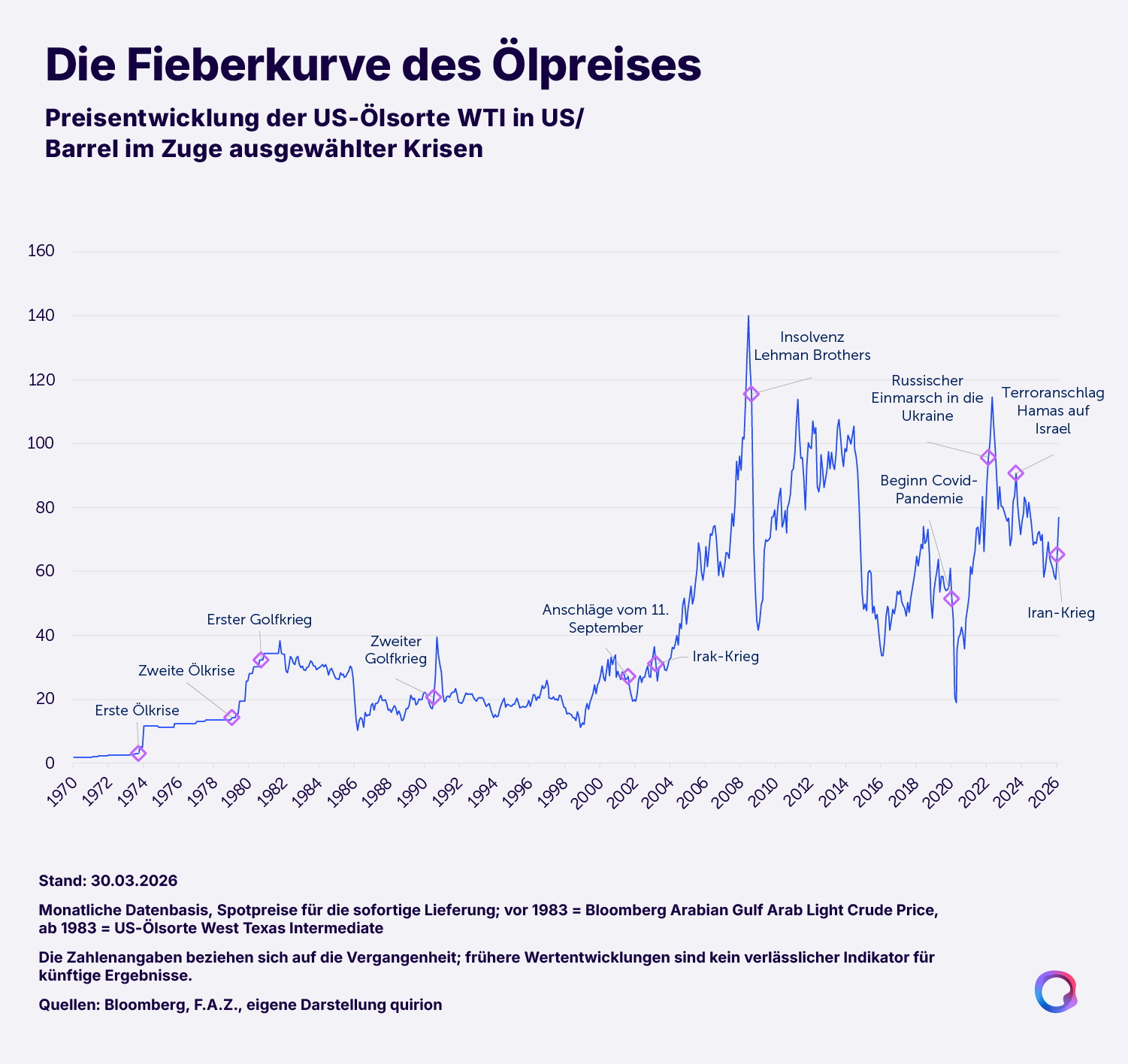
The pattern is already familiar: at the start of April, massive threats from US President Donald Trump against Iran sent oil and gas prices soaring. Then, shortly before the extended ultimatum expired, came the all-clear for now: the news of a 14-day ceasefire sent oil and gas prices tumbling again and lifted share prices. The DAX, for example, gained more than five percent within a single day.
How long the truce will hold, and whether the peace negotiations will come to a positive outcome, is uncertain. Shortly after the reports of the ceasefire, doubts quickly resurfaced that the conflict would now be resolved swiftly.
Every escalation stokes energy prices
Ever since the Iran war broke out at the end of February, attacks and threats against energy infrastructure in the Middle East have been the focus of the markets. The Strait of Hormuz above all: it is through this narrow waterway that Saudi Arabia, Iran, the United Arab Emirates, Kuwait and Iraq export most of their crude oil. In addition, Qatar, one of the world's largest exporters of liquefied natural gas (LNG), also mainly uses this route. There are hardly any alternatives.
A normalisation of shipping traffic will not happen overnight even in the best case, but will instead drag on for several weeks or even months. For one thing, because hundreds of ships are backed up in front of the strait and passage remains dangerous due to sea mines. For another, because the production infrastructure in the Gulf states has been partly impaired by war damage.
The main buyers of the oil and gas transported through the Strait of Hormuz are, admittedly, countries in Asia. But the effects are nonetheless felt worldwide. Every escalation of the conflict repeatedly sends world-market prices for oil and gas jumping. The international equity markets, in turn, react very sensitively to such movements. Should the price increases prove stubborn and push up inflation noticeably, that would slow the economy.
Don't let yourself be pressured into acting
When prices are moving more sharply, you often feel a certain pressure to act as an investor: do I need to react? And how? The uncertainty is amplified by the media's constant "barrage". The Iran war wasn't even 24 hours old before speculation was already circulating about which shares would suffer particularly badly from the conflict and which would benefit. As always happens in situations like these.
Whether in crises, in calm market phases, or when prices are rising sharply: a strategy should be set up at all times so that return opportunities and risks are in the best possible balance. Because no one can see into the future and reliably predict short- or medium-term developments – no expert can either.
One strategy for all eventualities
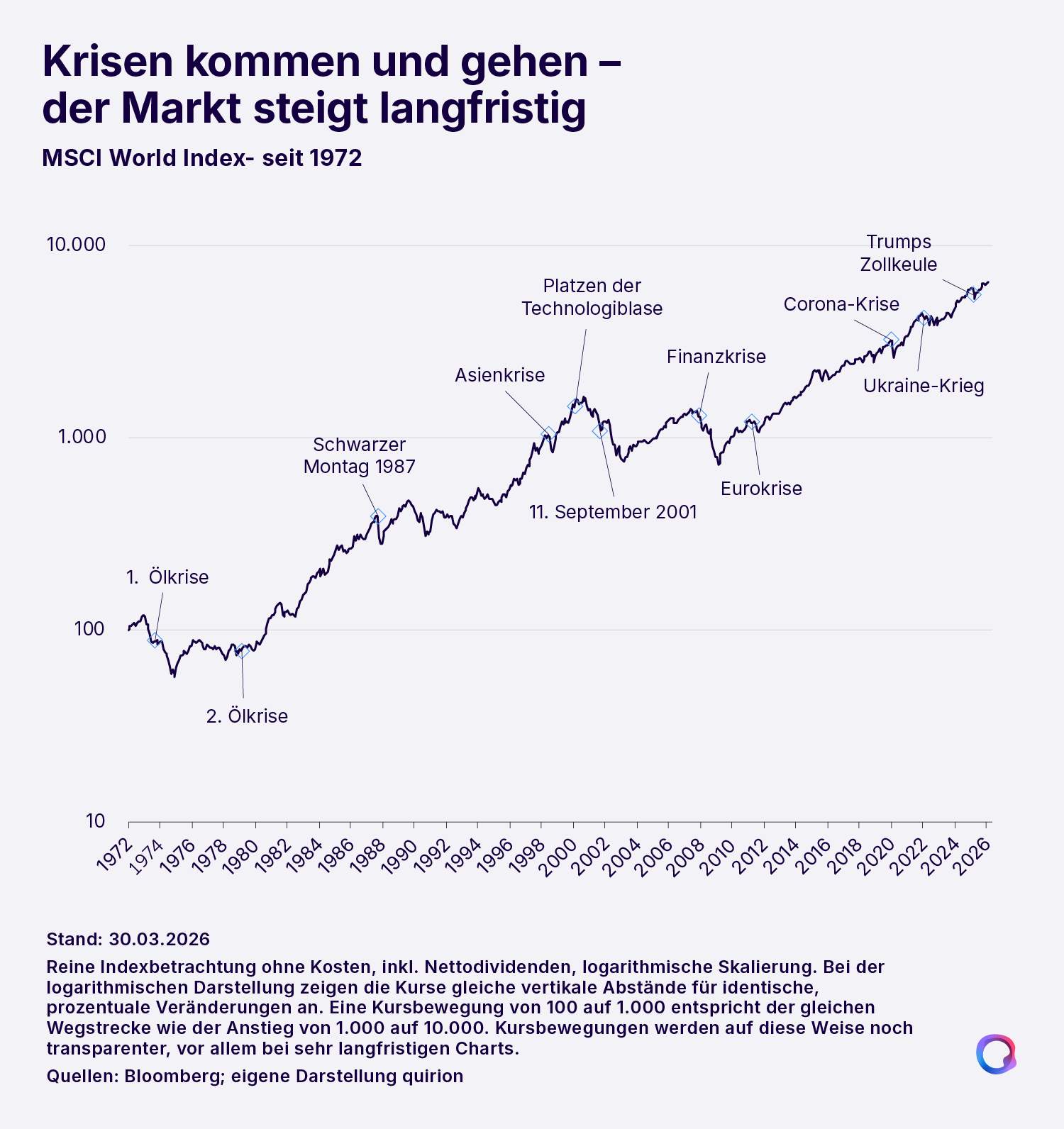
Investing in the equity markets should be geared to the long term. Because over the long term, the equity markets move upwards. This is due to the fundamental link with the global economy, which is inherently geared towards growth. The recent developments haven't changed anything about that.
Crises happen time and again. It's just that no one knows exactly when, or how long these phases will then last. What we do know, though: trying to hit the perfect moment to get in and out goes wrong in the vast majority of cases. Because you only ever know the perfect moment in hindsight. Anyone who exits the market in a hurry may turn a temporary dip in their portfolio into a real loss. And when the markets turn upwards again, the question is: when do you trust the trend and get back in? This is where most people fail. Return opportunities are quickly missed.
Those who deliberately steer clear of certain sectors or regions in such situations and give others a higher weighting also take on unnecessarily high risks. It's not only the general market trend that can shift quickly on the stock exchanges – so can the favourites. That's why it's advisable to keep your portfolio as broadly based as possible at all times.
Our global ETF portfolio is diversified according to scientific criteria. This is intended to ensure the best possible balance between return opportunities and risks. With a portfolio like this, investors don't get drawn into reckless speculation. And they can stay calm in any market situation. Including the current one: while many major stock indices were showing a net loss from the start of the year deep into March, our equity portfolio was still slightly up over the same period (figures as of 30 March 2026 in each case).
More about building wealth with quirion can be found here.