
Earning a stable side income with dividends, or reliably picking attractive stocks using metrics like the dividend yield: that sounds too good to be true. And it is.
“Collect high dividends right away with these stocks,” “The best dividend stocks of 2026: cash in your account all year long”: dividends are a big topic again right now, as always around this time. From roughly March into May, most companies in Germany hold their annual general meetings. Afterwards, they pay out the dividends.
Dividends can indeed be an attractive source of income. Coverage of stocks with high payouts, or of special dividend strategies, however, often leads to false conclusions. And to investors taking on unnecessary risks.
The dream of “passive income”
For some, the prospect of a payout sounds more tangible than the more or less vague hope of future price gains. Yet dividends don’t simply come “on top” of price gains. Dividends give you a share in a company’s profits. The payout reduces the company’s value. That’s why the share price usually falls by roughly the dividend amount around the payout date.
What’s more: yes, there are companies that pay dividends regularly over decades. Even so, there’s never any guarantee that this will stay that way. Companies can cut dividends at any time or drop them entirely. Sometimes companies pay high dividends even when their earnings situation is deteriorating. But that eats into their economic substance – bad for the share price and thus for the return prospects of their shareholders.
The dividend yield: a deceptive metric
Dividends therefore don’t necessarily say anything about the quality of a stock. That applies not only to their absolute size, but also to metrics like the dividend yield, which some use as a criterion for selecting stocks. The dividend yield relates the payout to the current share price. Here’s a worked example:
- Company A pays out a dividend of €5 per share. The share price is €500. That gives a dividend yield of 1% (calculation: 5 / 500 × 100).
- Company B pays a dividend of €2. The share price is €100. That gives a dividend yield of 2% (calculation: 2 / 100 × 100).
So in terms of the dividend amount, Company A is far ahead. In terms of the dividend yield, it’s Company B. At first, that sounds as if you’ve discovered something interesting. Yet neither figure says anything about the stocks’ future earnings potential. The comparison is merely a backward-looking snapshot.
You could now look at how Company B’s dividend yield has developed. But that’s not much more meaningful. The dividend yield rises when the dividend is increased. But also when the share price falls while the dividend stays the same.
More successful with dividend strategies?
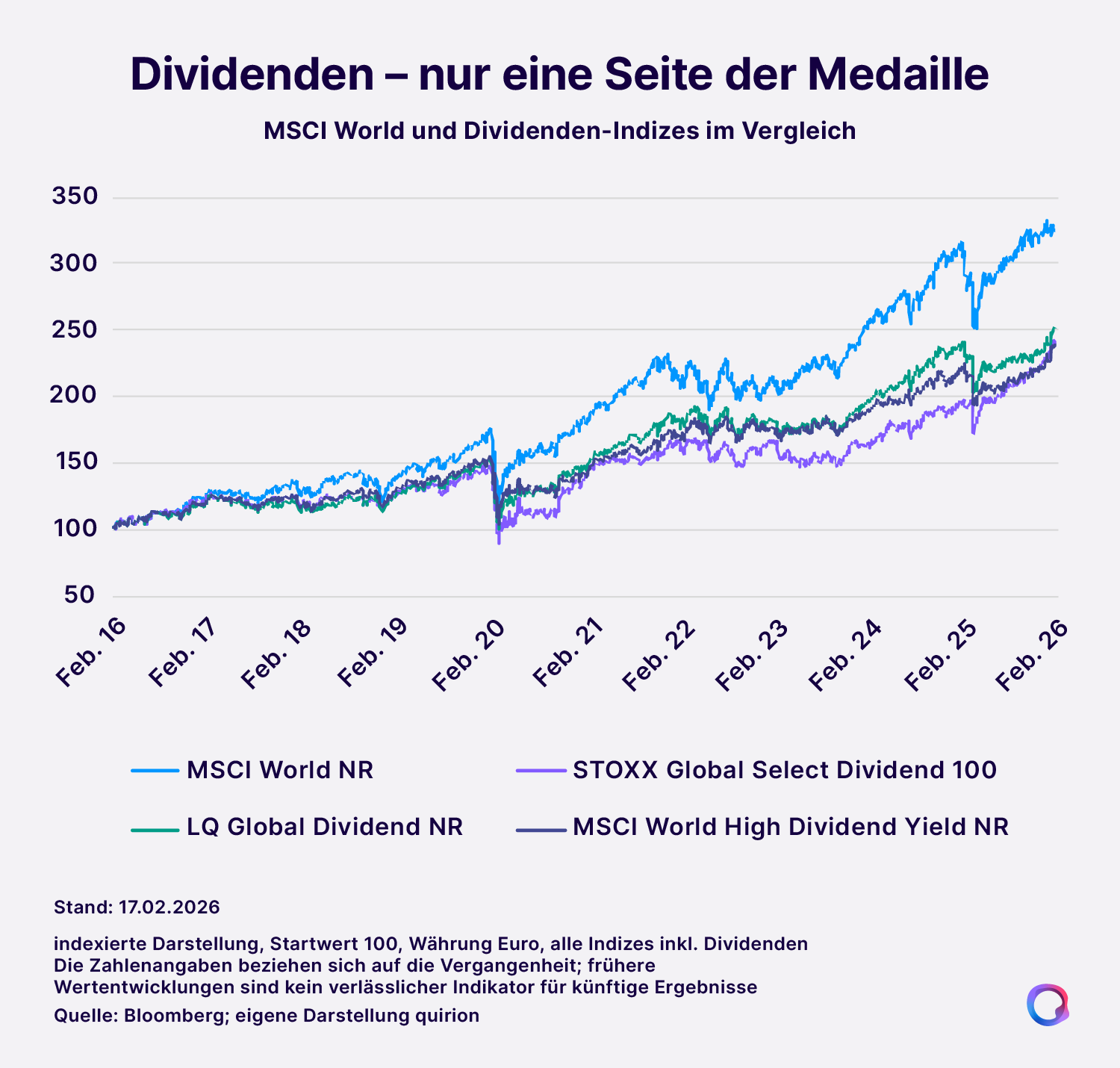
Searching for the most promising stocks possible in order to make investment success more likely – understandable as the wish is, it keeps leading onto thin ice. A comparison of dividend indices with the MSCI World shows: selecting on the basis of dividends and dividend yields generally provides no edge over the broader market.
At least in part, this can be traced back to the differing dividend policies across individual sectors. Traditionally, for example, firms from the utilities and telecommunications sectors report comparatively high dividend yields, whereas growth stocks from the technology sector tend to report low ones. Yet it’s precisely the latter that have delivered outstanding performance in recent years.
The MSCI World and dividend indices compared
The fundamental problem with “filters”
Some do admit that criteria like the dividend amount or the dividend yield aren’t enough for selecting stocks. Even so, they’re convinced that you just have to combine such metrics with others in order to filter attractive stocks out of the crowd. The problem: the more filters you use, the fewer companies remain eligible for investment. And that, in turn, increases the risks.
Financial market research has shown again and again that market developments cannot be reliably predicted. Beating the broad market through a targeted selection of securities is pure luck – and thus far too risky. Instead of narrowing your selection, it makes far more sense to rely on the most systematic diversification possible. This way, you tap into the return opportunities of the equity markets without taking on unnecessary risks.
You want to build wealth systematically: learn more here.