In many stock indices, the heavyweights are dominating especially strongly right now. Take the S&P 500, for example: this year the 10 top stocks have at times already reached a weight of around 40 percent. We look at what this means for your investment strategy.
Around 23 trillion US dollars: that was the market value the ten largest US stocks tipped the scales at in August. Add up all the stocks listed in the European Union, and at that time you arrived at a mere 12.8 trillion US dollars. The US chip designer Nvidia alone, at 4.2 trillion US dollars, was valued considerably higher than the entire German market (3.0 trillion US dollars).
Some speak of a dangerous imbalance, others of a "new normal". In 2015, the weight of the ten top stocks in the American S&P 500 stood at about 17 percent. In August of this year, it was around 40 percent. And the top ten have for some time consisted almost exclusively of large tech stocks.
The US heavyweights also dominate the MSCI World: the ten top stocks - all of them from the US - contribute a good quarter of the market weight of this index, which contains a full 1,320 stocks. But a concentration trend can be observed even in indices without US names. In the DAX, for example. With its 40 constituents, it is admittedly already very focused. Yet the fact that the five top stocks tip the scales at almost as much as the other 35 last occurred back in 2000.
"The fact that individual stocks or sectors dominate stock indices is nothing unusual," observes Philipp Dobbert, head of asset management at quirion and Quirin Privatbank. "What is indeed extraordinary, however, is the extent of the dominance, particularly in the US." The more concentrated an index is, he says, the more vulnerable it becomes to bad news among the heavyweights. "That was evident in the crisis years of 2007 and 2008. Back then it was the banking sector that carried a particularly high weight."
Guided by market capitalisation
The market weight, known as market capitalisation, is determined by the number of a company's shares and the current share price. Most indices are guided by this. As a result, their performance tends to depend ever more heavily on the stocks that happen to be in high demand at the moment.
That the current top names in the S&P 500 are in high demand isn't plucked out of thin air. A look at profits shows this: in the 12 months to the end of August, they contributed around 33 percent to the total profits of the companies listed in this index.
But on the stock market it isn't the past that counts, it's the future. And whether these companies will meet the ambitious expectations reflected in their high valuations is anything but certain. Some therefore recommend ETFs on indices that don't weight their constituents by market capitalisation but instead weight them all equally ("equal weight"). The bet: if the prices of these hotly traded stocks eventually fall, such ETFs would be hit far less hard.
"For me, this advice is a prime example of throwing out the baby with the bathwater," Dobbert observes. "Because the various stocks in a market contribute to the overall return to very different degrees. An equal-weighted index ignores that." So anyone who weights all the stocks in a market equally cuts off a great deal of return potential.
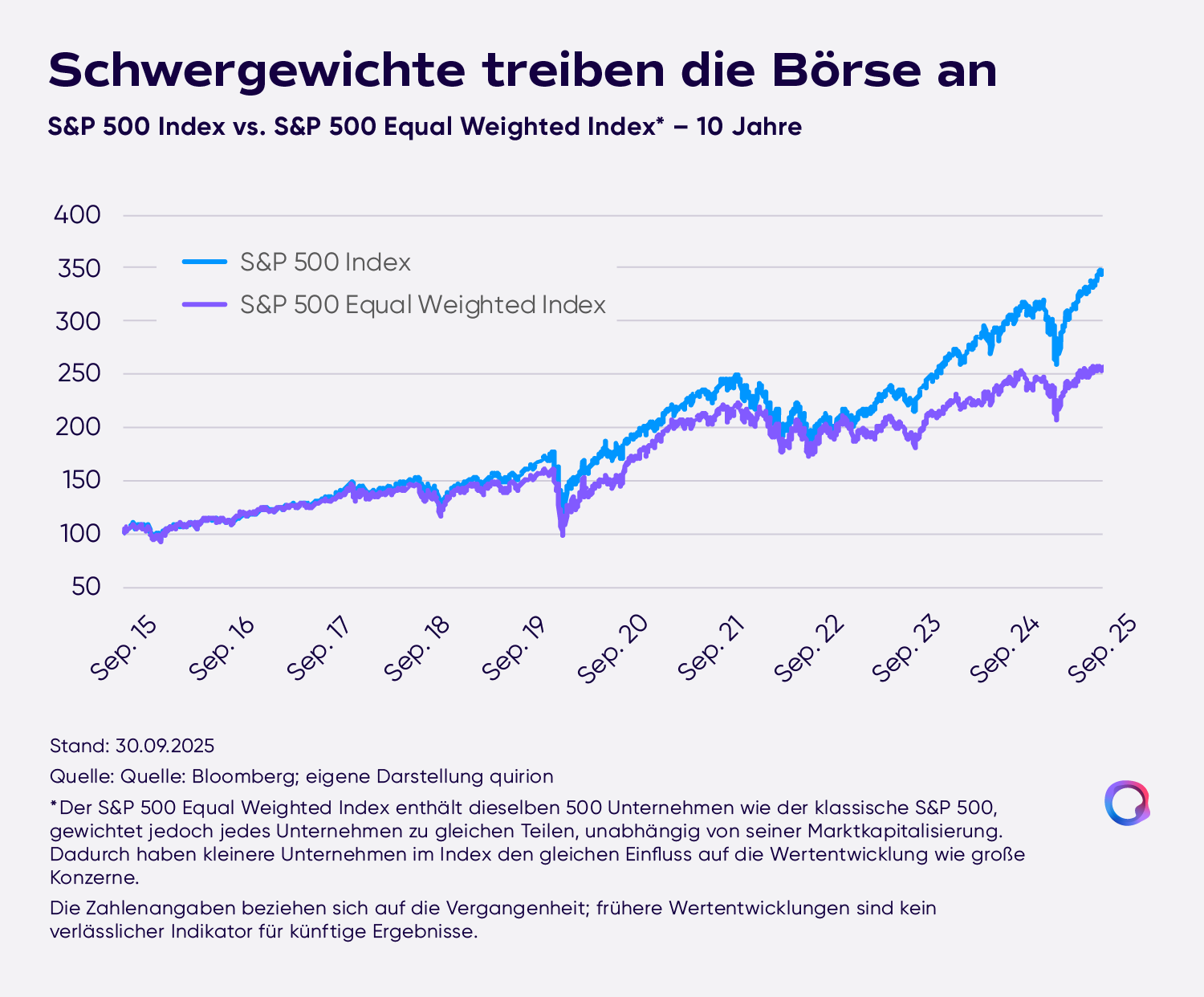
A few stocks make the performance
In a study published in 2020, US economist Hendrik Bessembinder analysed the performance of US stocks between 1926 and 2019. He found that of the 26,168 companies listed since 1926, "only" 11,036 increased their shareholders' wealth. And just 83 companies were responsible for half of the total wealth created in the US equity market over this period. The fact that a few stocks drive performance isn't confined to the US: in a study published in 2023, Bessembinder came to the conclusion that between 1990 and 2020, the entire net wealth creation on the global equity markets was ultimately attributable to a mere 2.4 percent of companies.
So individual stocks account for the lion's share of the positive performance on the equity markets. The problem: "You can't know in advance which stocks these will be in future." Even if you may believe you have some kind of hunch. Or you trust in experts. "The fact is: anyone who tries to improve their returns by selecting stocks or by deliberate weighting always takes on greater risks." Because in doing so, you make yourself dependent on forecasts. "Whether you're right is a matter of luck."
Harnessing the market's collective intelligence
A sound investment strategy doesn't speculate. Neither about "fair valuations" nor about the prospects for individual stocks, sectors or countries. "The smartest thing is to not try to be cleverer than the market," Dobbert emphasises. "As an asset class, equities offer outstanding return potential, and with appropriate diversification of the portfolio I harness it without taking on unnecessary risks."
When it comes to spreading risk - so-called diversification - there are various methods. The principle: anyone who invests in just one or a few stocks makes themselves dependent on the success or failure of individual companies. The larger the number of securities, the smaller the impact of movements in individual stocks on the investment result. With sophisticated diversification based on scientific criteria, however, it isn't just about the number of stocks. "We take a total of five return factors into account," Dobbert explains. "We combine them so as to mirror the long-term return of the global equity market as precisely as possible."
The global quirion portfolio holds stakes, via ETFs, in around 8,000 stocks from more than 70 countries. Unlike the popular MSCI World, the global ETF portfolio from quirion therefore also includes, among other things, stocks of smaller companies and from emerging markets. In the MSCI World, the US share stood at over 70 percent at the end of August. In the equity component of quirion's global ETF portfolio, by contrast, US stocks carry a weight of around 46 percent. The top ten there account for just 11 percent.
"In the global ETF portfolio, we want to achieve the best possible balance of return potential and risk," Dobbert emphasises. "That means we neither forgo attractive return potential nor take on unnecessary risks."
How you can build wealth with us over the long term you can learn here.