
Whether in France, the US or Germany: many countries are pushing ever larger mountains of debt ahead of them. It is a topic being followed closely right now, especially on the bond markets. We take a look at how things are developing and at the two segments of our bond portfolio.
A government crisis in France: this seems to be gradually becoming the “normal state of affairs”. On 9 September, Sébastien Lecornu became French prime minister – already the fifth since the start of 2024. On 6 October, he resigned again. Only to be reappointed on 10 October. At the heart of the political turmoil are, time and again, reforms aimed at easing the strain on public finances, above all a major pension reform. That has now been suspended for the time being.
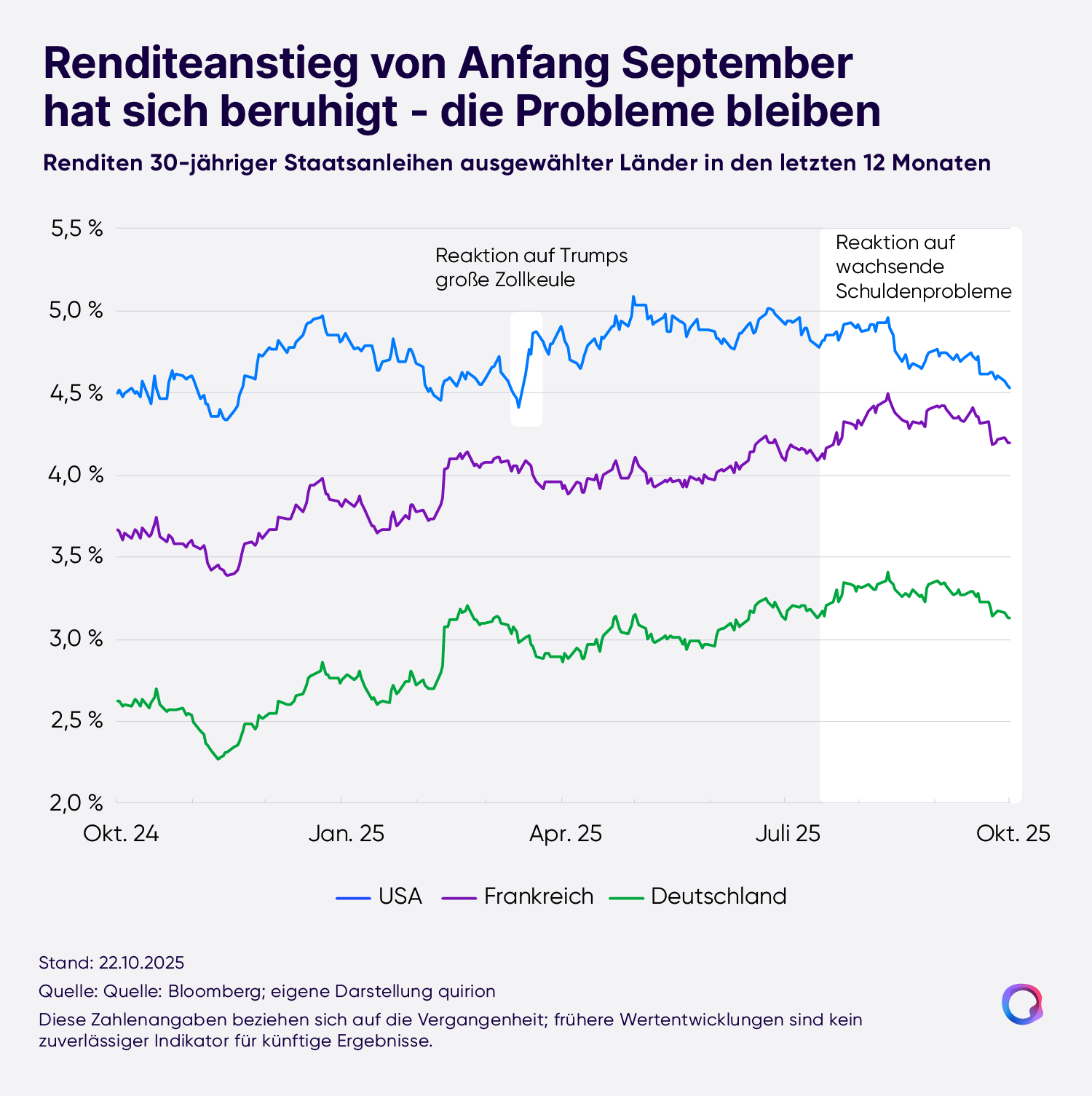
The topic has also kept the bond markets busy. Rating agencies downgraded France's creditworthiness. The European Union's second-largest economy is pushing a growing mountain of debt ahead of it: government debt adds up to around €3.3 trillion. Measured against gross domestic product, the debt ratio in 2024, at 113 percent, was almost twice as high as Germany's (62 percent).
Government debt is growing
It is not only in France that the debt issue is moving the bond markets. The US debt ratio is even higher than France's. At the end of 2024 it stood at over 120 percent. And with Donald Trump's “Big Beautiful Bill”, government spending is set to rise further still. This led to phases of price losses on US government bonds.
In Germany, too, the debt burden is growing. Not least because of the federal government's financial package worth hundreds of billions of euros, agreed in March. The enormous planned investments in defence and infrastructure are to be financed above all through longer-dated German government bonds. It can be assumed that there will be enough buyers. But the question is at what price. Germany is expected to have to pay higher interest. As a result, bond prices fell – or, put another way, yields rose. The one is always the flip side of the other.
Don't let yourself get rattled
“Are the US heading for a sovereign default?”, “Is the next euro crisis brewing in France?”: a mix of politically charged developments, rating downgrades and price swings naturally provides plenty of material for dramatic headlines. But investors shouldn't let themselves be rattled by them.
In any case, the hope that key interest rates in the US will keep falling has quickly given US Treasury prices a fresh boost. There can be no talk of a looming sovereign default. The US rating remains close to the best possible grade at S&P, Moody's and Fitch.
France's credit rating is weaker than that of the US. It nonetheless remains at a solid level with all three major agencies. Auctions of French government bonds went smoothly right into October. France does have to offer higher interest on new bonds. But these are evidently attracting buyers. There is also no sign so far of the euro weakening. On the contrary: against the dollar it has shown itself to be quite strong this year.
Broad diversification in the bond portfolio
Even so, investors should not neglect the risks with bonds either. It is therefore advisable to invest in a broadly diversified way. Accordingly, our ETF portfolio is highly diversified across the various bond segments.
Bonds from France and the US play a genuinely significant role in it – above all in our risk-reducing bond segment. Its main aim is to cushion the fluctuations of the respective equity component in the portfolio. The background: prices of government bonds with high credit quality usually fluctuate far less strongly than the prices of equities. That still holds true today. What's more, in the past such bonds have often been especially sought after precisely during weak phases on the equity markets.
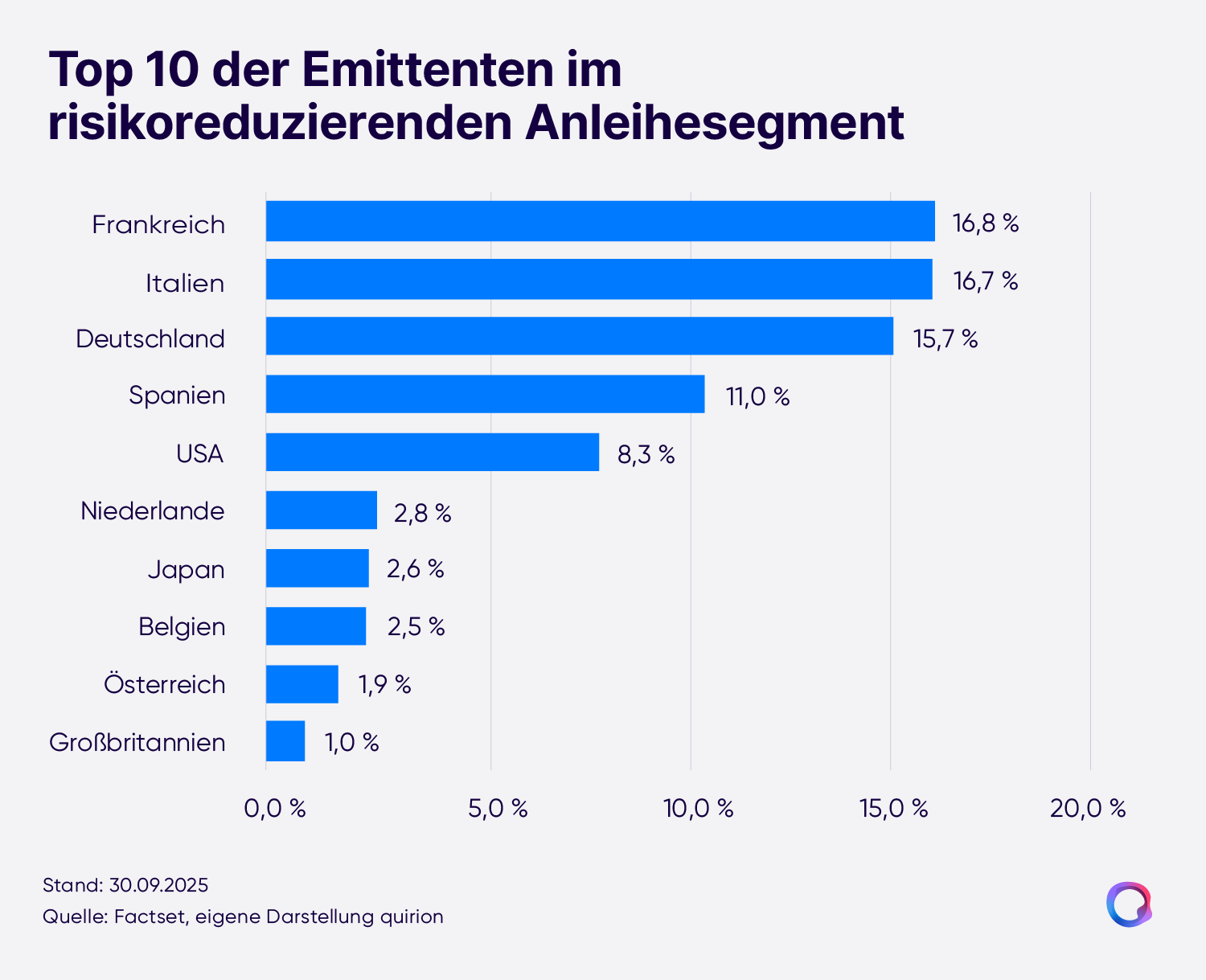
To avoid currency risks, the focus in our risk-reducing bond segment is on government bonds from Europe. Bonds from other currency areas, such as US Treasuries, are hedged against currency risks. This building block is allocated to the portfolios in line with the respective equity component. After all, it is that component's fluctuations that are meant to be cushioned.
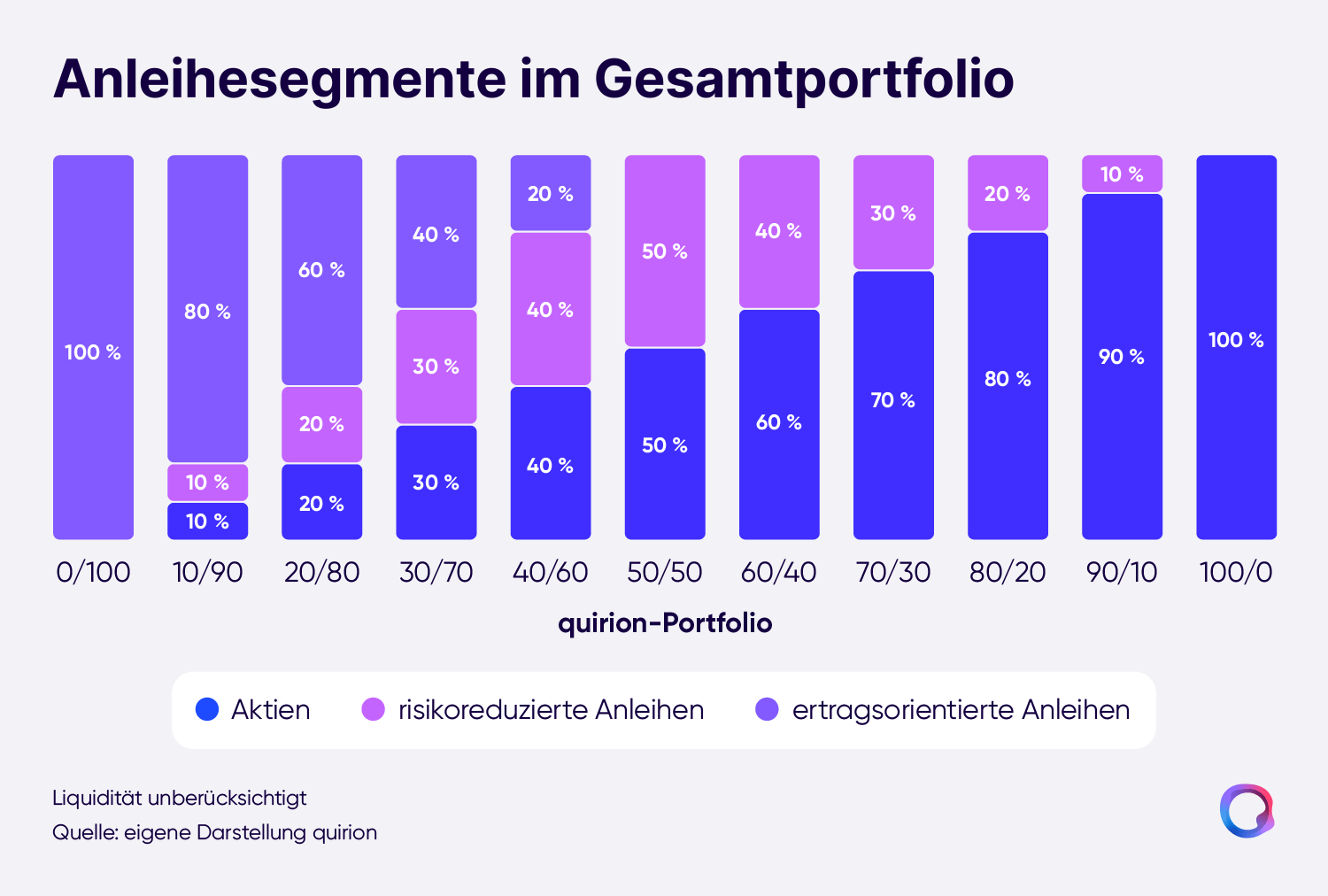
The income-oriented bond segment rounds out the portfolio for those who have an equity component of less than 50 percent. This segment consists above all of corporate bonds. The focus is currently on bonds from the financial sector, at over 40 percent. Government bonds make up only around 20 percent.
Corporate bonds tend to move more in step with the equity markets, so they are not as well suited to serving as a risk buffer. But by including them, investors with a lower risk tolerance nonetheless share a little more strongly in the value created by the corporate sector. In doing so, the segment's mix is geared entirely towards the best possible risk-return ratio.
You can find out more about the two bond segments here.