As part of the regular rebalancing in the global ETF portfolio, this time there's a bigger change on the bond side: an additional building block opens up extra return opportunities for investors with higher bond allocations. Philipp Dobbert, Head of our Wealth Management, explains the background.
Something is moving on the bond side of quirion's global ETF portfolio. In future, there won't be just one bond building block, but two. What's behind this?
Our goal has always been to pursue returns at an acceptable level of risk. On the bond market, though, for more than a decade the rule was: if you wanted attractive return opportunities, you had to accept disproportionately high risks. That has changed by now. And we want to make use of that to offer additional return opportunities to investors with bond allocations of 60 percent or more.
The upward turn in interest rates is already some way behind us now. Key interest rates are slowly coming down again ...
This isn't about suddenly betting on interest rate trends now. We work forecast-free, including with bonds, so our considerations are strategic in nature. The fundamentally changed interest rate landscape - and with it the framework conditions for the bond markets - simply opens up entirely new possibilities for these considerations. Beyond pure risk reduction as a complement to our equity exposure, it's now possible to sensibly make use of return opportunities in bonds again. That's why, over the past few months, we took a completely open-ended look at all the possible segments of the bond markets and examined how they performed over various time horizons.
What's changing?
From a bird's-eye view, not all that much. Because the following still holds true: over the long term, the world's stock markets offer higher average return opportunities than the bond markets. That's why, in the global ETF portfolio, stocks remain the main source of returns. Bonds serve above all to cushion the risks of the equity component.
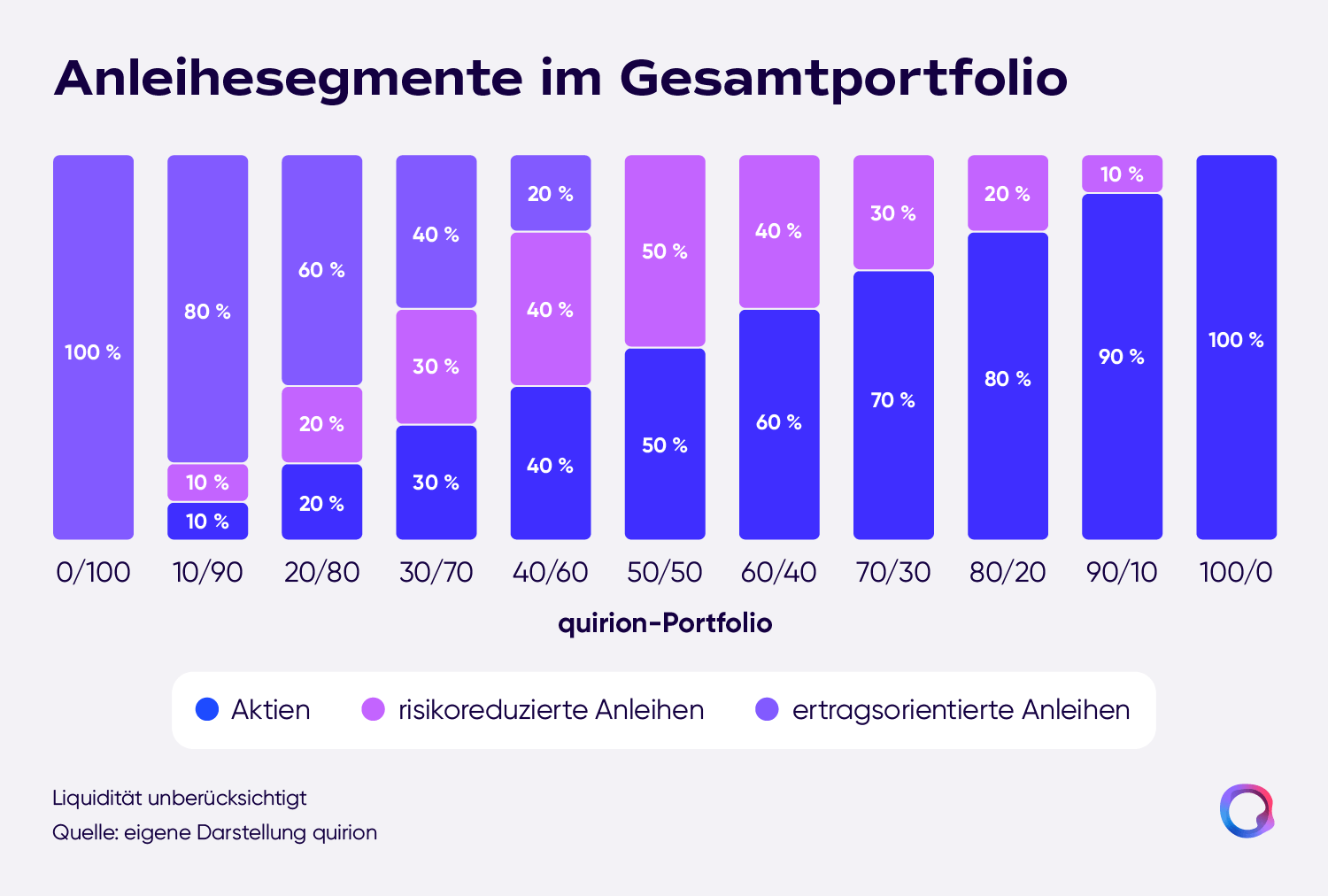
The new framework conditions in interest rates I mentioned now allow us to take a somewhat more nuanced approach with bonds and to split the bond component in two. One of our bond building blocks is geared even more closely than before toward reducing the risk of the equity portion. The second building block has the task of offering, in its own right, the most attractive possible balance of risk and return - in other words, to deliberately make use of the bond market's return opportunities.
And who gets which building block now?
The return-oriented bond building block in its pure form is used at a bond allocation of 100 percent. From an equity allocation of 50 percent - that is, when the majority is invested in stocks - only the risk-reducing bond building block is used. Between 10 and 40 percent equity allocation, the two bond building blocks are combined. In this case, the risk-reducing portion always forms the exact counterweight to the respective equity share. Suppose you have an equity share of 10 percent within the global ETF portfolio. Then the share of the risk-reducing building block is also 10 percent, and the return-oriented bond building block is 80 percent.
So how exactly do the two building blocks differ?
The return-oriented one is much more heavily geared toward corporate bonds. Their share there is 80 percent. In the risk-reducing part, it's just 17 percent. Corporate bonds offer a more attractive risk-return profile. On top of that, this lets us give clients with a lower tolerance for fluctuations - and therefore lower equity allocations - a greater share in the value created by the corporate sector. Corporate bonds, however, tend to move more in lockstep with the stock markets. That makes them less well suited as a risk buffer.
In the stabilizing building block, then, the mirror image applies: more than 80 percent is in government bonds, which are better suited as a risk buffer against stocks. These also have longer maturities, since this bond segment is often used as a "safe haven" during stock market turbulence. As a result, their prices usually move up when there's a slump on the stock markets. So they're a good counterweight.
Do the changes have any impact on the product costs?
The costs remain essentially constant. Depending on the strategy, there are tiny changes in the third or fourth decimal place, either down or up. As usual, we also took great care to ensure that the ETFs track their segment as efficiently as possible.
From bonds to stocks: are there adjustments on this side too?
We didn't swap out any ETFs there. We only very slightly adjusted the weightings for the emerging markets, so that the portfolio matches our target values for the various return factors even more closely. All these changes are implemented at the same time as the regular rebalancing.
What's the background to this rebalancing?
Prices are constantly on the move. As a result, the weightings between the securities in portfolios are also constantly shifting. But this causes the portfolio to drift away from its intended risk profile. To prevent that, we use rebalancing to offset the effects of value fluctuations - so that the weightings are right again and the risk matches the investors.
More about the individual ETFs in the global ETF portfolio can be found here.