High energy costs are fueling inflation in Germany even further. The economic mood is growing gloomier and gloomier – in Europe, but also in the US. The start of autumn on the markets was correspondingly stormy. Here’s what that means for your investment strategy.
War in Ukraine, rising energy prices, high inflation: none of these problems had disappeared over the summer. And yet prices recovered sharply at times. Then, however, they turned more steeply downward again. The reasons are quickly found. In Europe, it is above all the fear of energy shortages in winter that is unsettling companies and consumers. “Germany in particular has many energy-intensive industries – just think of the chemical or the automotive sector,” observes Philipp Dobbert, chief economist at quirion. If further shortages and price increases occur, considerable economic effects are to be feared.
A fright, but not without end
Largely because of energy costs, Germany’s inflation rate rose again markedly in September, reaching 10% according to a preliminary estimate. The expiry of the fuel discount and the €9 ticket also contributed to the inflation surge, as did higher food prices. For consumers and the economy alike, this is not good news.
Economist Dobbert sees it no differently. When it comes to investing, however, what matters is the long-term perspective – even if, in difficult times, it can quickly slip out of view. “Sometimes it’s portrayed as a foregone conclusion that, over the medium to long term, energy will keep running into shortages and price increases.” Even if solutions for overcoming this crisis are “not lying around in the street,” he is convinced that the economic cycle will, sooner or later, adapt to a changed geopolitical situation. “Prices have a steering function. A change in the behavior of market participants brought about by higher energy prices can also help overcome this crisis – whether by opening up new energy sources or through more efficient consumption.”
A recent study by the Institute of Energy Economics at the University of Cologne (EWI) fits this view. The EWI has calculated that if EU gas demand falls by 20% by 2030 compared with 2021 levels, wholesale prices could return to their 2018 level. According to the EWI, this holds regardless of whether gas trade with Russia is restricted or not.
Pressure on the euro
For the time being, however, high energy costs and inflation rates remain one of the dominant themes for the economy and the markets. The strength of the US dollar against the euro is fueling inflation on top of that, because many commodities are traded in US dollars. Italy’s parliamentary election in September put further pressure on the euro. The concern: with the election outcome, the voice of the euro skeptics gains weight. The campaign promises, which included massive tax cuts, could also burden the Italian budget. “But we first have to wait and see which announcements were campaign tactics and which are actually implemented,” notes Dobbert. “In any case, the ECB has enough instruments to stabilize the euro if needed. So it comes down primarily to the political decisions.”
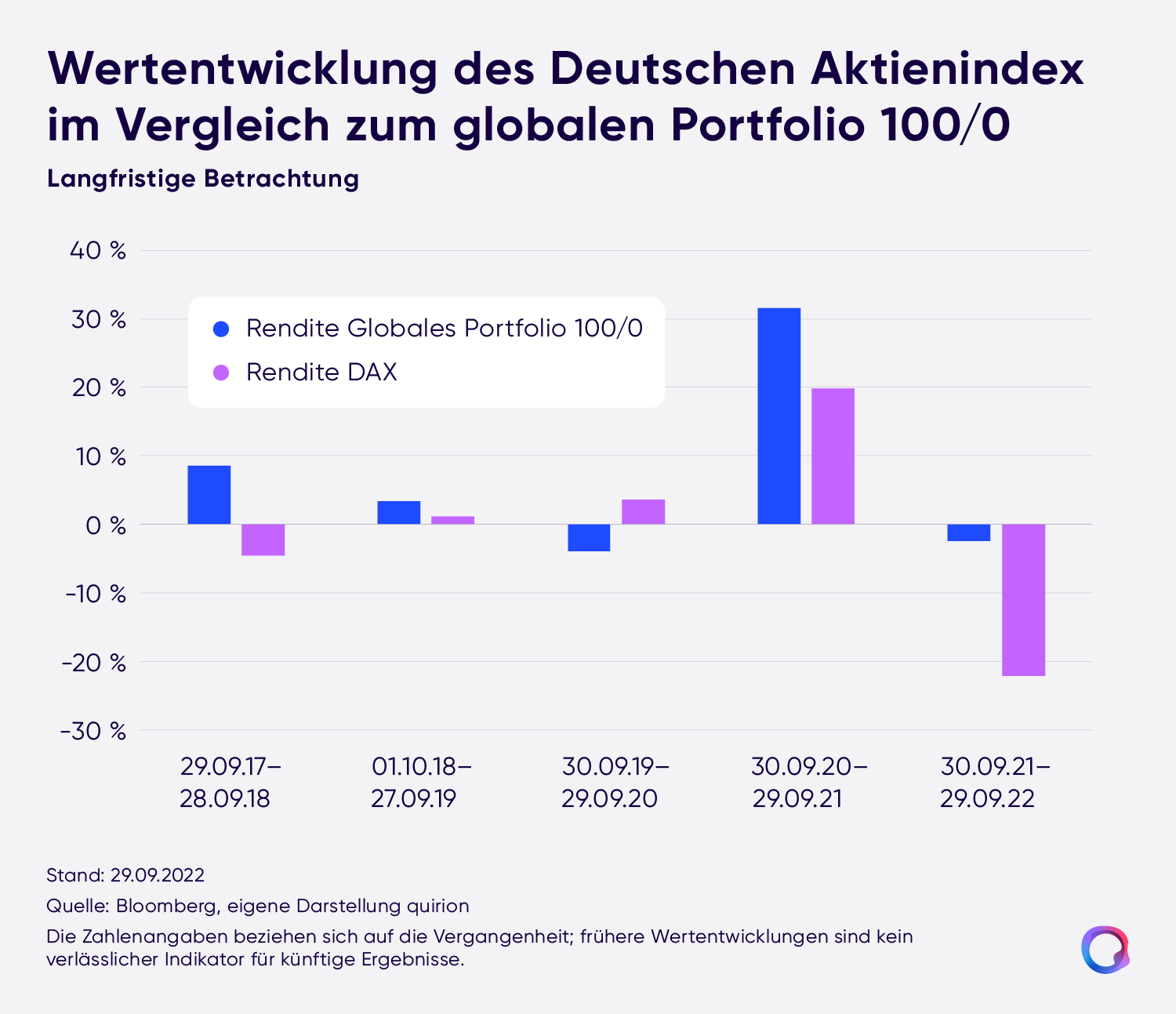
The currently weaker euro, just like the energy crisis, has a negative impact on European equity markets. The effects on quirion’s portfolios, however, are limited. German stocks, for example, carry a relatively low weight. “This reveals an advantage of an investment strategy aligned with the global equity market,” Dobbert emphasizes. Dollar strength therefore makes a positive contribution to performance.
The US economy shows signs of braking
In the US market – which plays a larger role in quirion’s equity portfolio because of its alignment with global market capitalization – energy shortages are less of an issue. What is discussed more there is the impact of central bank policy on the economy. In September, the Fed raised the key interest rate by another 75 basis points and signaled further steps. Market observers read the dynamic rate hikes, as well as the statements by Fed Chair Jerome Powell, as a sign that he will accept an economic downturn if necessary in order to rein in inflation.
Dobbert believes so too. The pressure to act is even greater in the US than in Europe. “The core inflation rate excluding energy and food is already much higher there, so in the US the price increases show up across far more goods and services.” The Fed reacted very late, he says, and is now forced to act. “The key objective is to keep inflation expectations under control – so that consumers and the economy don’t settle in for permanently high inflation rates.” The Fed will probably achieve this goal, he says, at the cost of a downturn. “Gross domestic product in the US has already fallen for two consecutive quarters, which by the European definition means the US is technically already in a recession.”
The dynamic key-rate hikes also have a considerable impact on the bond market. In anticipation of new bonds with more attractive yields, older bonds are being sold off heavily at times. This leads to atypically sharp price declines. “While the moves on the equity market have so far stayed within this asset class’s historical range of fluctuation, for comparable moves in bonds you have to look back a good 40 years,” Dobbert notes.
Staying the course with your investment strategy
What does this mean for investors? Do they now have to brace for a “new reckoning” – that is, for more modest returns on equities and a new role for bonds in their portfolio? “We’ve always stressed that the equity market won’t deliver dream returns like those of 2021 every year,” Dobbert explains. “What counts is the long-term average – which, realistically, I can only achieve as an investor if I stay invested for the long haul.” There are numerous scientific empirical studies, he says, that demonstrate again and again: “Trying to be invested only during the best market phases does not succeed reliably and, as a rule, results in significantly worse performance.”
Dobbert does not see a new role for bonds in the investment strategy. “The dynamic turn in interest rates after an era of zero rates is certainly a special event that brings turbulence with it.” But bonds still fluctuate far less than stocks and thus remain a means of stabilizing portfolios. For quirion’s portfolios, the economist also points to the reinvestment effect with bond ETFs: “When new bonds with more attractive yields come onto the market, as they are now, the proceeds from matured older bonds are automatically reinvested in these higher-yielding securities.”
With its strategic positioning unchanged, Dobbert sees quirion’s portfolios remaining well equipped – and not just for winter. “Beyond the day-to-day, it holds not least that a diversified equity portfolio systematically shares in the value creation of the economy and is thus also one of the most reliable forms of inflation protection,” Dobbert explains. If the price level rises, that will sooner or later be reflected in rising revenues and earnings – not for every single business, but for the broader market. “A globally oriented, long-term investment in the equity market is simply a timeless investment strategy.”