Whether the dollar is showing strength against the euro or the yen is currently weakening: currency fluctuations have a certain influence on an internationally diversified portfolio. A look at the effects on our global ETF portfolio.
The economy in the US continues to perform considerably better than in the eurozone. Interest rates in the US remain higher and are therefore more attractive to investors. On top of that, the interest rate gap widened somewhat after the ECB's rate cut in June. No wonder, then, that the euro lost a little value against the dollar.
Far more striking and pronounced on the currency markets right now, however, is the weakness of the Japanese yen - against the US dollar, but also against the euro. Admittedly, the Japanese stock market reached a new all-time high this year for the first time in 34 years. Yet the Japanese currency fell at the end of June to its weakest level since the mid-1980s.
Currency fluctuations like these also affect an internationally diversified equity portfolio such as quirion's global ETF portfolio. At first glance, though, the effects may be somewhat "counterintuitive." When you think about your own vacation, you're happy about a rising euro when traveling outside Europe. After all, you then get a bit more for your money. From an investment perspective, however, it's the opposite: if you hold US stocks in your portfolio and are therefore invested in the US dollar, a falling euro is more advantageous. The more the value of the euro falls against the US dollar, the more positive the performance contribution from the exchange rate movement turns out to be.
The dollar dominates
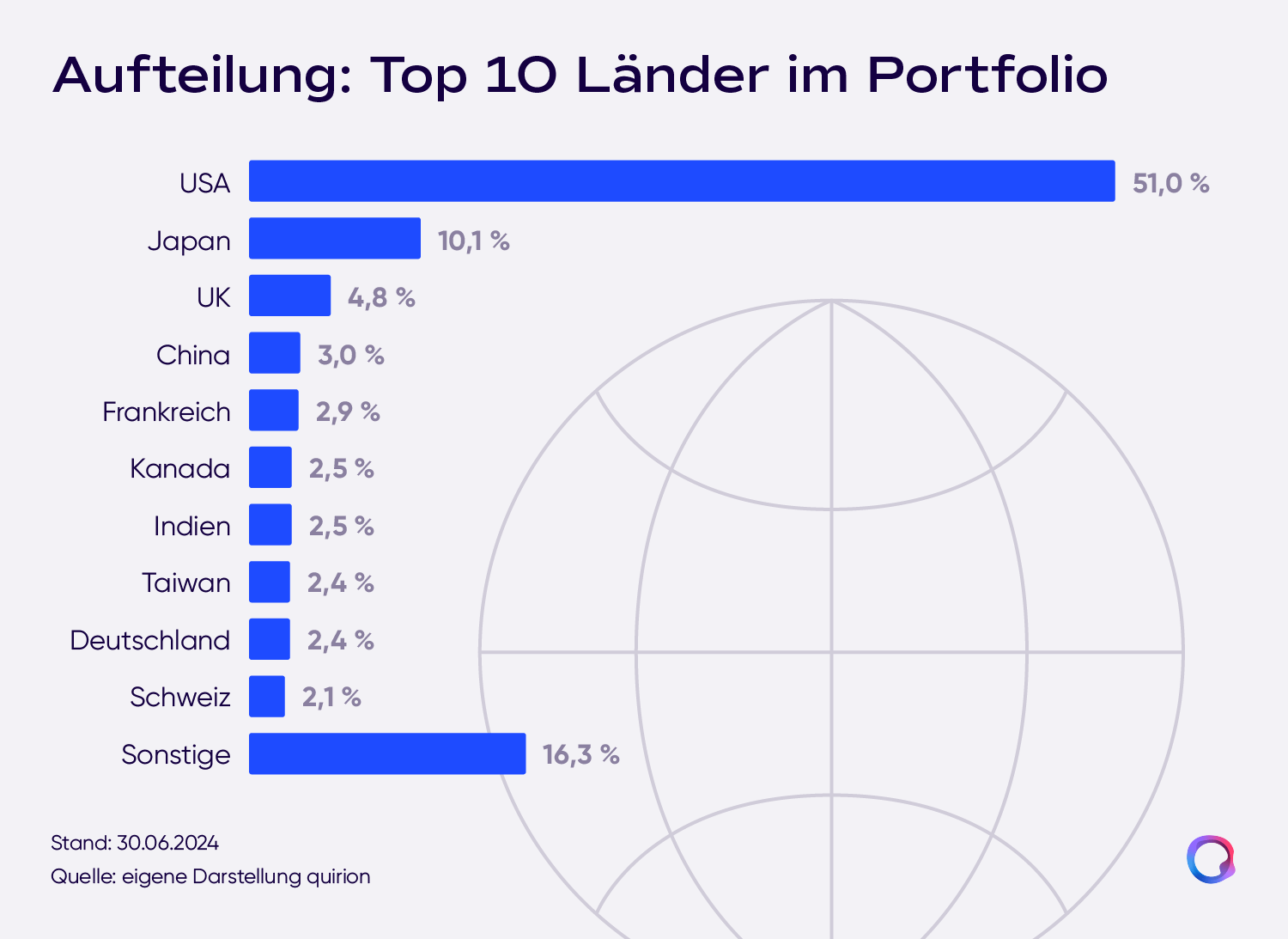
On the equity side, quirion's global ETF portfolio is heavily exposed to the dollar area. After all, the country weighting is based on market capitalization. And the US stock markets put all others in the shade. So for quirion's global ETF portfolio, the euro/US dollar currency pair is the most important exchange rate. Japan, and thus the yen, comes in second, though by a wide margin. The eurozone follows just behind and, in currency terms, accounts for a little less than 10 percent of the global portfolio.
"The impact of the current yen weakness on the performance of our equity portfolio as a whole is minimal," emphasizes Philipp Dobbert, Head of Asset Management at quirion and at Quirin Privatbank. "What's more, the effect of about -1 percent is more than offset by the strength of the dollar against the euro of about +1.5 percent."
To hedge or not?
In principle, there are of course ways to hedge portfolios against currency fluctuations. But "insurance" isn't free. Its price weighs on performance. So the question is whether hedging really pays off in the end.
"We don't hedge our equity portfolios against exchange rate fluctuations, because that would be far too expensive," notes Dobbert. The reason: no one knows how things will develop in the future. Neither the stock markets nor the currency markets. So you can't know in advance exactly when hedging would be advantageous. "You'd have to set it up permanently and bear the costs permanently." What's more: with hedging, you wouldn't have to stomach any currency losses, but you also wouldn't achieve any currency gains. Overall, the fluctuations in the portfolio would merely be somewhat smaller, because they'd be adjusted for the currency fluctuations. "And given the usual range of fluctuation for stocks, currency fluctuations barely make a difference," Dobbert explains.
Dobbert and his team take a different route with the bond portfolio than with equities. "We invest in bond ETFs that either contain only euro bonds or are hedged against currency movements." That's because of the role bonds play in quirion's investment strategy. "We deploy them specifically as a stabilizer." The fluctuations of bonds are generally much smaller than those of stocks - but also smaller than those of currencies. "Exchange rate movements would partly undo the stabilizing effect."