There is no return without risk. But not all investments are created equal: here is why you can feel you are in safe hands with quirion.
What software does risk management use? Are the fund's securities lent out? And how are such transactions collateralized? When it comes to which product providers and which ETFs are eligible for the portfolios, quirion wants to know every detail. "To compare it to buying a car: we don't just look at how the vehicles perform, but equally at how the manufacturer fits the parts together," explains Kai Hattwich, Lead Portfolio Manager at Quirin Privatbank and quirion.
Performance, in investing, is the return. It is the lever for building wealth. But anyone who wants returns has to accept certain risks in exchange. That is unavoidable. "That is why we work intensively to keep the risks as small as possible," Hattwich emphasizes.
Spreading the risk
This is already evident on the topic of price fluctuations. These, too, are unavoidable when investing in the capital markets. But with a special investment strategy based on scientific insights, price fluctuations can be dampened over the long term. An important role is played here by the very broad, global spreading of risk.
The most efficient route to broad diversification is through ETFs. Like all investment funds, these products are classified as segregated assets. This limits the risk should the ETF provider run into financial difficulties. The invested capital belongs to the investors, and no third party has access to it – not even an asset manager like quirion.
A rigorous filtering process for ETFs
Another pillar of quirion's risk management is the rigorous filtering process for product selection. It begins with the product provider itself. "We only consider ETFs from providers we regard as especially reliable," Hattwich stresses. What does the provider's product portfolio look like, and what about its technological infrastructure? Once a year, quirion gets an update on important details via an extensive questionnaire and legal documents. "Safety is the top priority here."
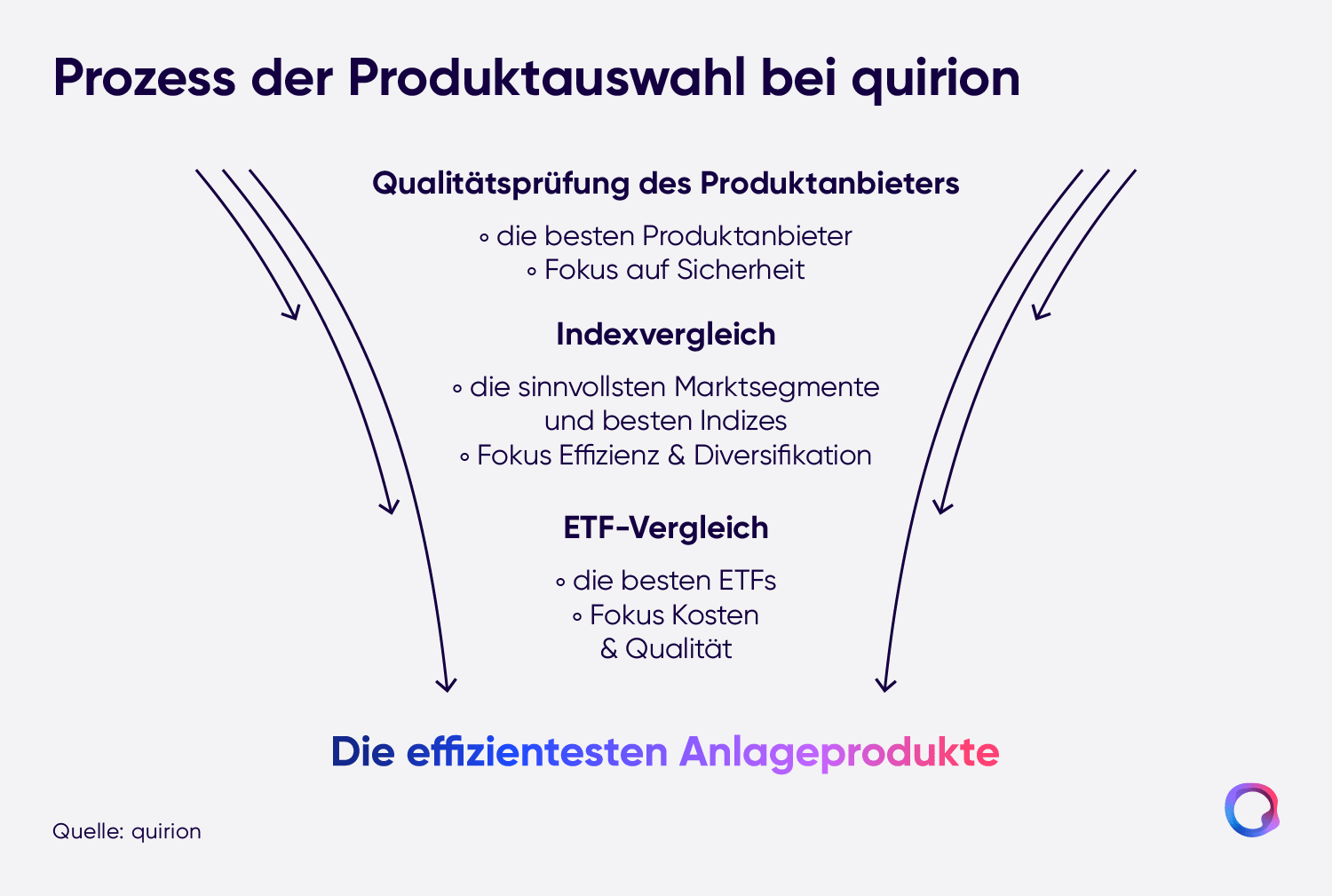
The review also takes into account the fact that ETFs replicate the performance of their underlying index in different ways. Some invest directly and hold the securities of their index in full or in part (physical ETFs). This type of replication can be very expensive for large indices, which weighs on performance. To stay competitive, providers of physical ETFs therefore often use securities lending: they lend other parties the ETF's securities for a limited period in exchange for a fee. This allows them to offset some of the costs. As collateral, they deposit other securities or cash. "The terms of such transactions differ from provider to provider. That is why we take a close look at their scope and the collateral."
Unlike physical ETFs, synthetic ones replicate performance indirectly, through a securities portfolio and a special swap transaction with a partner. Here too, Hattwich and his colleagues scrutinize the scope of such transactions as well as important details. "We want to know, for example, whether risk management sits with the ETF provider itself or is carried out by a neutral third party."
Even though quirion looks closely at such questions: the swap transactions are usually of such a small scope that, even in the worst case, they would barely be noticeable to investors. "We once calculated this for a number of ETFs. We arrived at a risk of around 0.1 to 0.2 percent of the portfolio value – and thus a magnitude that corresponds to ordinary price fluctuations over one to two days." So the risk arising from the replication method is very small compared with the risk of value fluctuations.
Safety with the clearing account
So quirion's clients can feel safe with the ETF portfolios – and not only with these. Since March, there has been interest on balances in the PLUS clearing account – currently 2.5 percent. There is no cap on the amount of deposits. The balances are held at Quirin Privatbank and are protected by law up to €100,000. In addition, Quirin Privatbank is a member of the voluntary deposit protection fund of the Association of German Banks (BdB). This means the money is protected, within certain limits, beyond the statutory framework.