In quirion's global portfolio, our investment strategists bring return opportunities and risk into the best possible balance. Why that matters and what role “factors” play in it.
Seeing the stock exchange as one big casino is a cliché that stubbornly persists. For some, this image triggers especially high return expectations; for others, it stirs up great fears about the risks. But investing has nothing to do with gambling – provided the investment strategy is set up accordingly.
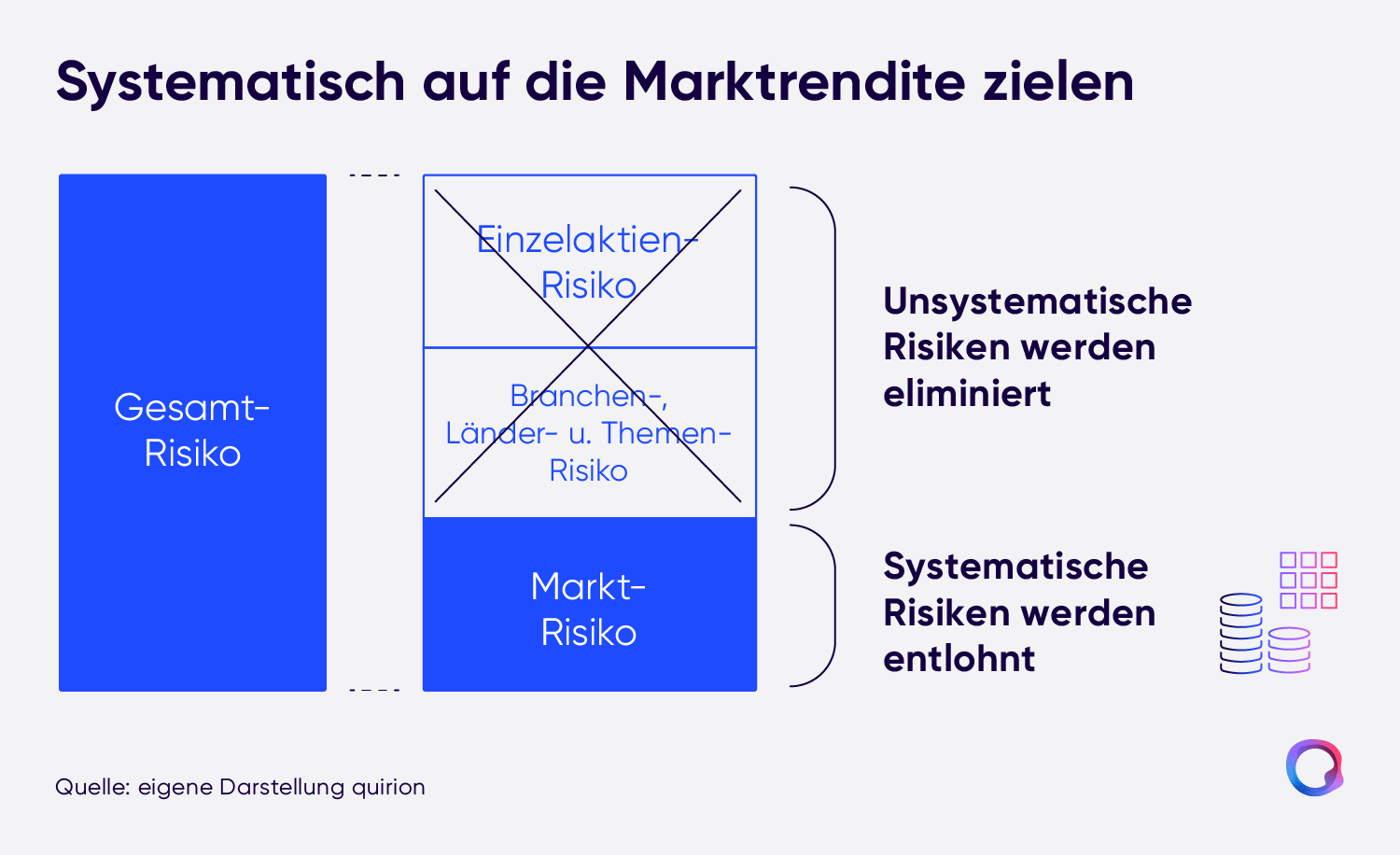
First of all: return is not pure chance, but the reward for the risks you take on. Return and risk are two sides of the same coin. That said, there are “good” and “bad” risks. The bad ones are the risks for which you can't expect an appropriate reward over the long term. In academic circles, they're called “unsystematic risks.”
Unsystematic risks relate to a single company, a specific sector, or a limited region. A company can drop out of the market, a sector can lose relevance, a region can slide into a political crisis. “Risks like these can be excluded to a certain extent through diversification, that is, broad spreading,” explains Kai Hattwich, Lead Portfolio Manager in the asset management arm of Quirin Privatbank, which quirion is also part of. “What then remains is systematic risk, which is rewarded by the market return.” Over the long term and on average, the stock markets have historically always risen.
Taking diversification to the extreme
If you want to spread your equity portfolio as broadly as possible, your investment strategy looks to the “global equity market.” That's also what quirion's global portfolio is geared toward. But replicating the “global equity market” isn't so simple. According to figures from the “World Federation of Exchanges,” there are currently around 59,400 stocks listed on the world's exchanges. The numbers are constantly changing. Trading all of them individually would be far too complicated and far too expensive. “So you have to take a detour,” Hattwich explains.
The basic idea: every single stock can be characterized by a set of typical features that decisively influence both its return opportunities and its risks. These include, for example, differences in company size, in valuations, or in price fluctuations. With the help of these and other features, the colorful diversity of all stocks can be meaningfully categorized. In technical jargon, these categories are then called “factors.”
Through detailed analyses, quirion has filtered out the five most important factors that best represent the return of the global equity market as appropriately as possible.
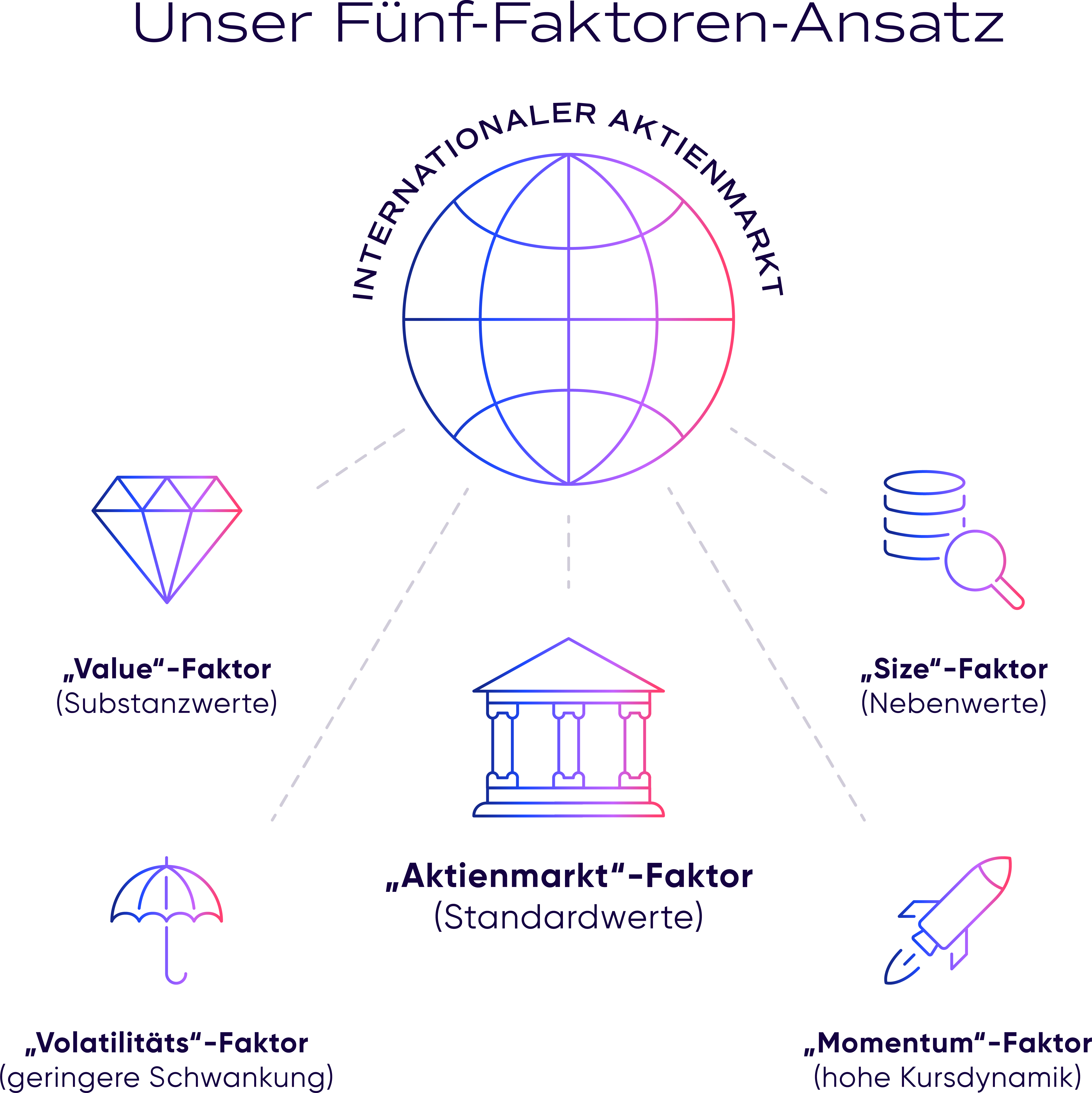
From factors to the portfolio
Identifying the factors is just one of many steps. It isn't enough merely to know them. They also have to be brought into a coherent relationship with one another within an investment strategy – and into the global portfolio via suitable products. The most suitable and most cost-effective route is through ETFs.
Apart from the “equity market” factor of large caps, however, there are no individual ETFs that bring factors into the portfolio in pure form.
For anyone now perhaps thinking of certain factor ETFs, for example for “value” or “momentum,” which do indeed exist on the market: whatever the ETFs' names, they always replicate several factors at once. Every stock in the ETF carries multiple features that shape its performance, and each ETF therefore contains several factors. quirion does use such specialized products too. But when putting them together, Hattwich and his colleagues have to pay close attention to whether the combination brings the intended weighting of each individual factor into the portfolios.
Bonds with a special role
In quirion's investment strategy, stocks are the primary source of return. With bonds, which are added depending on the investor's risk appetite, it's a different story. quirion's bond portfolio is also very broadly diversified, but it primarily plays the role of a risk buffer.
Here, too, two features can be identified in the global market for government and corporate bonds that make up its particular return and risk structure. “These are the factors of credit quality and maturity,” Hattwich explains. The lower a government's or company's credit quality, the more return investors have to be able to look forward to in order to take on the higher risk. The same applies to maturity: the longer it runs, the greater the risk and the return expectation usually are. Getting the right fine-tuning of credit qualities and maturities in the portfolio also matters, so that adding them cushions the fluctuations of the equity portfolio.
The plus for customers
Whether with stocks or bonds: “A systematic approach like the one we put into practice is something investors can't manage on their own,” Hattwich stresses. Even so, the cost of digital asset management at quirion remains, for example, well below the usual average costs of actively managed equity funds. And even if it's somewhat higher than for individual ETFs: “in return, you get a lot of convenience included – above all an investment strategy whose success doesn't depend on chance.”