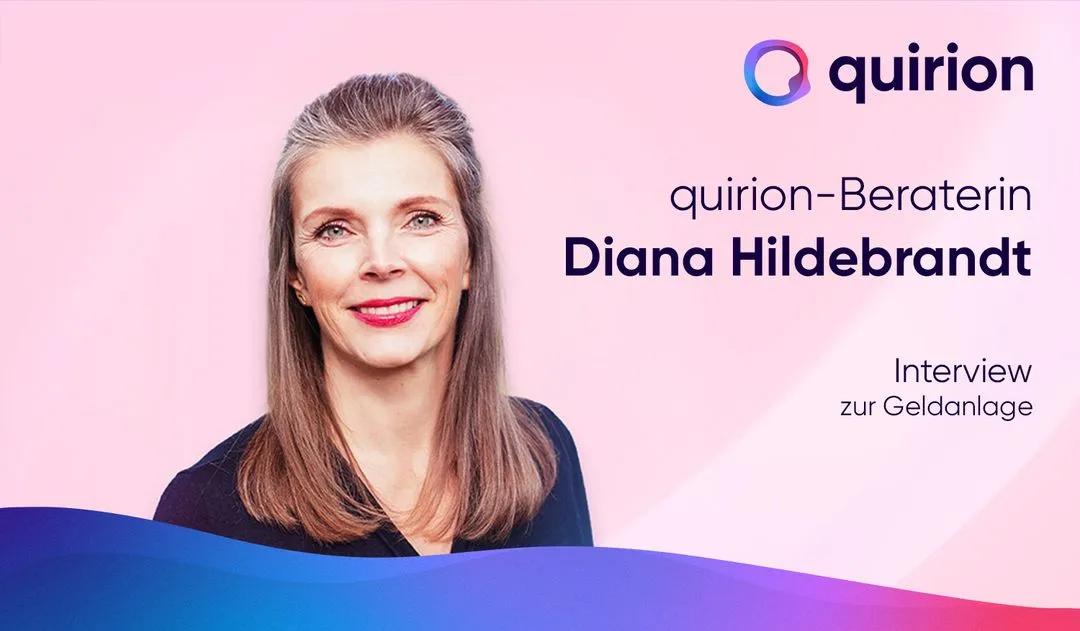
Diana Hildebrandt has been advising customers of Quirin Privatbank and quirion from Berlin since 2013. In this interview, the certified banking specialist explains how to take advantage of the current interest rate environment, build wealth over the long term, and avoid common investment mistakes.
After a long dry spell, interest rates are now at a lucrative level. If I want to make more of my money now, do I simply need to find the best interest rate offer?
That depends entirely on the time horizon you're planning for your investment. It's nice that there are finally interest rates again. We too offer customers attractive deals. Our new Cash Invest portfolio, for example, is a clever alternative to an instant-access savings account. But when it comes to investing, the first question isn't about the current interest rate level, it's about the investment horizon. Interest rate offers can be a sensible addition for money that needs to stay available in the short term.
And what if I want to invest over the medium to long term?
Then stocks offer far greater return potential. With a well-diversified equity portfolio, it has so far always been possible to achieve attractive returns over the long term – even though there are, of course, always fluctuations in the short term.
What does “well diversified” mean?
Spread as broadly as possible. With quirion's global ETF portfolio, for example, you have a stake in around 8,000 stocks from over 70 countries. Thanks to diversification across many companies, sectors, and regions, the balance between return opportunities and risk is far better than with investments in individual markets or stocks. The more selectively you pick securities, the greater the risk. Because then it's pure luck whether you're right. With a diversified equity portfolio, you participate in global economic growth – regardless of exactly where that growth is generated. Losses in individual sectors or regions can be cushioned well this way.
I can put together an ETF portfolio myself. Why should I use digital asset management?
Unless you happen to deal with investing for a living, digital asset management saves you a lot of time and effort. There are thousands of ETFs: professional asset management has completely different options for analysis and selection.
Besides, one product isn't enough. For optimal diversification on a scientific basis, a specific combination of ETFs has to be found. And that goes for different risk profiles and investment horizons, because a pure equity portfolio isn't right for everyone. We use bond ETFs to tailor the strategy to the customer's risk appetite where needed. On top of that: who, going it alone, actually does regular rebalancing?
What is that, and why is it important?
It's a way of compensating for changes in value. Over time, price movements also shift the weightings within a portfolio. If the prices of a position have risen especially over a certain period, it carries a heavier weighting than originally planned. As a result, the portfolio as a whole has a different risk profile. So that it doesn't gradually drift away from the strategy, we correct such deviations at least once a year. Profits are then taken regularly and reinvested in positions that have lost weight. Left to their own devices, investors usually don't carry out such a rebalancing.
What else should investors watch out for?
One important thing is timing structure: depending on the investment horizon, different strategies are advisable. Often, freely available money is put more or less entirely into interest rate products. But that way you miss out on a lot of return opportunities if you don't need to keep the money available at all times. Another common mistake is acting on gut feeling. If I've planned to invest money for five to six years in a well-diversified portfolio, I should stick with that – and not throw the plan overboard just because prices happen to be falling or rising.
When negative headlines dominate, people often let fear drive them to act. When the news is positive, that quickly flips into excessive euphoria. But method and discipline are decisive for investment success. Both, by the way, come far more easily when you have an advisor at your side. That way you're not so easily thrown off balance.
What do independent advisors do differently?
They aren't guided by product commissions. I used to often have an uneasy feeling when I had to recommend products to customers that didn't really suit them. Just so that the sales figures would add up at the end of the week. When I joined Quirin Privatbank in 2013, that changed fundamentally. Neither Quirin nor quirion profits from any product commissions. We have the freedom to focus exclusively on our customers' needs.