
In a nutshell.
- Calculating returns is simple – as long as only a single deposit is made into the portfolio.
- With several transactions in the portfolio – and that is the norm – it becomes complicated. A separate partial return then has to be calculated between each transaction.
- If you calculate "simply" even when there are several transactions, the result is often grossly wrong.
- The time-weighted return (TWR) measures the success of the investment strategy itself. Here the performance over the relevant period is measured, regardless of how much money was invested and when during that period. The TWR method is the one commonly used, including at quirion.
- Alternatively, you can calculate the money-weighted return (MWR). This additionally takes into account the amount of capital invested in each partial period. quirion displays this return as well.
How does quirion calculate returns? You might assume this question could be answered quickly and easily, but let us say this much up front: the answer is complicated, and calculating returns precisely is a science in its own right. What's more, there is no single "the" return: there are different methods for calculating returns.
- The simple return
- Calculating returns with several deposits and withdrawals
- Simple return with several deposits and withdrawals
- Calculating the time-weighted return
- Calculating the money-weighted return
- Total-assets return versus strategy return
- Accounting for costs
- Strategy opened before 1 January 2016
- Conclusion
The simple return
Let's start with the simplest case: suppose you invest €100,000. After one year, your assets are worth €97,000. What is your return? First we calculate the gain achieved:
Gain (or loss) [€] = current capital [€] – capital invested [€],
that is
€97,000 - €100,000 = -€3,000,
and we set the gain or loss in relation to the capital invested:

in our example, that is

The two formulas can now be combined into:

But what if deposits and withdrawals occur during the investment period? This is almost always the case, even if you personally do not order any payments: fund distributions and reinvestments, as well as tax and fee entries, also trigger changes in the invested capital. And now it gets complicated.
Calculating returns with several deposits and withdrawals
So let's expand our example. Say that after one year you decide to top up your portfolio by €10,000. Let's assume that after another year your assets stand at €116,000. It's getting hard to keep track, so we need a table.

We have already calculated the first two rows: in the first year, the return was -3%.
Simple return with several deposits and withdrawals
When we determine the return in the second year, we calculate it exactly as for the first year. In other words: you start the second year with assets of €107,000 and end it with €116,000, which gives a return of:

Things get interesting when we want to calculate the return over the entire investment period of two years. So what now?
Our return formula can be extended to

This formula even has a name: it is used to calculate the "simple return." Following this principle, we calculate your gain/loss and the return that we show you graphically in the "Asset development" tab, and as figures when you hover over it with your mouse.
In our example, this gives:

We expand our table accordingly:

This calculation is comparatively easy to carry out, but it is imprecise – and in many cases it does not even come close to producing a useful return figure. This is easy to see if we modify our example and withdraw €109,900 after two years. Our table then looks like this:

How did we calculate this? We relate the final assets, i.e. €6,100, to the total capital invested, i.e. €100: this yields a return of 6,000 percent.

The calculation is not forbidden, but the result is not very meaningful. That's because we have not correctly taken into account how much money was invested and when. Pretending that the gain was achieved with an investment of just €100 makes no sense. There are two ways to correct for this. First: calculating completely independently of deposits and withdrawals. Or second: the capital invested must be taken into account exactly at every point in time. The former method is called the "time-weighted return" (TWR); the second approach calculates the "money-weighted return" (MWR).
Calculating the time-weighted return (TWR)
When determining the time-weighted return, the returns of all partial periods are multiplied together without taking into account the respective capital employed. The corresponding formula is:

In our example, that is:

The result of 5.1 percent is close to the 5.5 percent determined earlier. However, the larger the deposits and withdrawals made in the portfolio in the meantime, the more the simple and the time-weighted return diverge from one another. The method is called time-weighted because a return counts more heavily the more periods it lasts. However, as soon as a capital measure takes place, a new period has to begin in order to be able to calculate with the method. At quirion, we break your investment period down into individual days, determine all the daily returns, and calculate your time-weighted overall return from those daily returns.
As you can see: unlike with the simple return, the amount invested plays no role in the formula. In that sense, the TWR return measures the success of a strategy, regardless of how and when money was invested in it. quirion primarily uses this method because it is the industry standard. Only in this way can returns be meaningfully compared between strategies.
In your login area, we show you the TWR return over your entire investment period. In the reporting in your postbox, however, you will also find the return per quarter or per year. To arrive at this, you have to find a hypothetical return that, applied in each period, produces the return actually achieved over the entire period under consideration. For example, an overall return spanning several years is converted into an annual return as follows:

Perhaps our example makes it clearer:

Rearranged, this gives

This figure is probably what people often mean when they talk about "the" return. Would you have thought that calculating it is so involved?
Calculating the money-weighted return (MWR)
As widespread as the TWR method is: in some cases the money-weighted return may also be of interest, because it explicitly takes into account when and how much money you had invested in a strategy. After all, it obviously makes a difference to your finances whether you suffer a loss with a small amount and increase your investment volume in good time before the subsequent price recovery – or whether it happened exactly the other way around.
The return we are now looking for is calculated as follows:
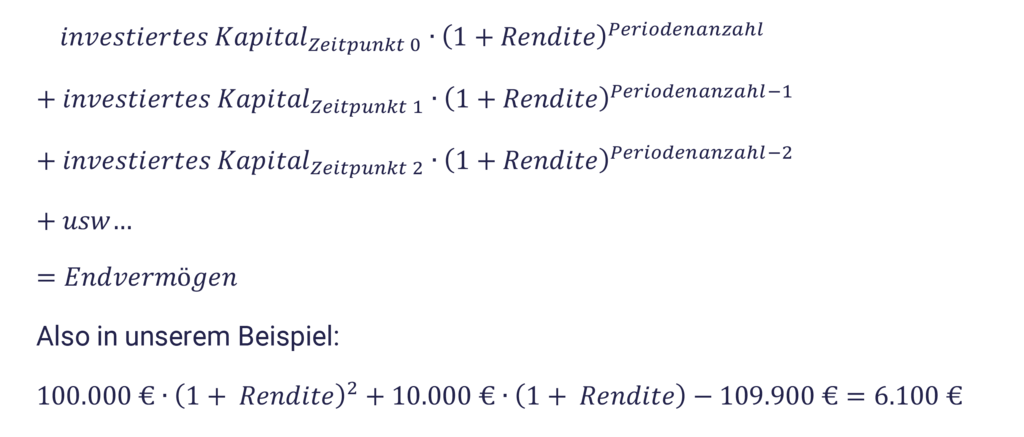
In this formula, the amounts invested now play a role. What's happening here? Following this logic, we break the portfolio down into its deposits and withdrawals AND take their timing into account. In that sense, we earned a return on €100,000 for two years, on €10,000 for one year, and we invested -€109,900 for just a logical second. We now ask ourselves what return, applied in each partial period and to all partial amounts, would have produced the final assets of €6,100 actually achieved.
In our example, the return can still be solved by rearranging the equation. With more than two periods, however, this is no longer possible analytically. But computers can find the result "by trial and error" without any difficulty, even for time series of any length. In our example, a return of 2.8 percent satisfies the equation and gives the MWR return we are looking for.
In our example, the annual MWR return of 2.8 percent is higher than the annual TWR return of 2.5 percent. That is plausible, because we topped up the €10,000 after a price decline and before a price increase: we therefore enjoyed the high return with a larger amount of capital than the negative one. Lucky us.
It can also easily happen that the return is positive under one method but negative under the other. Both results are correct; they simply measure two different variants of return (namely the strategy return versus the investor return). We report the money-weighted return alongside the time-weighted return in your login area.
Total-assets return versus strategy return
In your login area you will find at least two time-weighted and at least two money-weighted returns – so at least four return metrics in total. You'll find the return of your investment strategy (or strategies) when you expand that strategy (or strategies). In the overview area above the strategies, we show you the return of your total assets. The difference is especially relevant if you have opened several investment strategies. But even with just one strategy, the two returns can diverge: because when there is cash sitting in your clearing account, it is included in your total assets. To calculate the overall return, in each period all securities of all strategies are combined with all cash positions into one aggregate portfolio. We then calculate the returns for this portfolio over the entire investment period.
Cash in your clearing account therefore causes an increased cash share in your overall portfolio. This reduces your overall return on days with a positive capital market return and increases it on days with a negative return. Cash itself earns no return; it currently earns 0% interest.
Accounting for costs
Still on board and read the article this far? Congratulations! And did you understand it all? Respect! But we're sorry to say we're not quite finished yet. Because it's not only a matter of distinguishing between the TWR and MWR methods. Another question of interest is which costs are taken into account in the return calculation. Or, as the saying goes: which deposits and withdrawals in your portfolio are performance-neutral, and which affect performance?
A whole host of players reaches into your pocket when it comes to investing, and even though quirion tries to keep costs as low as possible: unfortunately, investing simply isn't possible without any costs. The ETF providers charge a fee. Trading securities costs money. quirion also has to make a living. And ultimately the state demands a share of the return. Which of these costs are factored into the return and which are not?
The ETF costs are already accounted for in the pricing of the ETFs, which is why they are automatically included in the calculation of your performance as well. quirion covers the cost of securities trading for you, so these costs do not reduce your return. The bid-ask spread, i.e. the price difference between the buying and selling prices of securities, is in principle borne by the investor, however, and is taken into account in the return calculation. The bid-ask spread on our ETFs is very small, and your costs at quirion are also lower than if you traded the ETFs yourself: this is because we net daily purchases and sales internally within the bank as far as possible. In these cases, we can settle your transactions entirely without a bid-ask spread.
The quirion fee is not deducted in your return calculation. The reason: it serves to cover the costs of portfolio management, securities trading, and our other services. These are therefore costs that are also not included in index or fund returns and would thus reduce the comparability of strategies. For the same reason, your tax payments ultimately do not flow into the reported returns either: taxes depend on your individual situation and are influenced, for example, by whether you have filed an exemption order with us.
Strategy opened before 1 January 2016
The returns in our dashboard are calculated for your entire investment period, so they start on the date the strategy was opened and end with yesterday's closing prices. For customers with an opening date before 1 January 2016, however, there is one special feature: on that cut-off date, Quirin Privatbank switched its banking system. This system manages your securities holdings and calculates your return figures. For the period before 1 January 2016, we are therefore unable to provide any return figures. For affected customers, the return calculation therefore only begins on 1 January 2016.
Conclusion
After more than 2,000 words, one thing should be clear: calculating returns is complicated, and there is no single "the" return. quirion reports both the time-weighted return (TWR return) and the money-weighted return (MWR return) for you. The time-weighted return measures the investment success of the strategy, whereas the money-weighted return measures the investment success of the investor. Simple return estimates can quickly diverge significantly from these two correct calculation methods. Finally, there are two things you should keep in mind when comparing returns: make sure you are not comparing apples with oranges (for example, pre-cost with post-cost returns, or returns from low-risk investments with those from high-risk ones). And: because chance plays a major role in the capital markets, short- or medium-term returns say nothing about the future success of an investment strategy. Does that mean you read this long article for nothing? We wouldn't go that far, because understanding an investment strategy in particular helps you stay true to it – and thereby protects you from costly back-and-forth in your investing.