When investing in the capital markets, you should never rely on shaky forecasts. We're firmly convinced of that. It's better to diversify as broadly as possible. Here's what makes the case for a globally diversified portfolio in 2025 as well.
Strong price gains, plenty of all-time highs: that was the prevailing picture across many stock markets in 2024 – in spite of all the geopolitical and economic headwinds. Some people are now wondering whether 2025 can be a good year for stocks too. Or how best to position their portfolio with an eye to the future.
Let's say it right up front: no one can reliably forecast how markets will perform. That's because performance depends on far too many influencing factors. In any case, the stock markets fared far better last year than had previously been predicted. And in 2025, too, there are once again plenty of factors that essentially make reliable forecasts impossible.
What will happen in the US?
The world's largest economy recently impressed with an economic performance that was still remarkably robust. The fact that the US economy hasn't long since been slowed down by the interest rate hikes of 2022 and 2023 is quite a surprise. Which doesn't mean that a slowdown couldn't still come.
Against this backdrop, too, there is close attention on how Donald Trump acts in his second term as US president. Some of his campaign promises could – if they are implemented – give stocks a boost. Others would be a risk factor. "Further cuts to corporate taxes would benefit company profits. And new tax breaks for individuals could support consumer spending," notes Arndt Kussmann, head of Investment Communication & Analysis at quirion and Quirin Privatbank. "The plans for tariff increases, on the other hand, should be viewed more critically. On the face of it, they would make US companies more competitive. But export-heavy companies would be at a disadvantage if trading partners responded with retaliatory measures. What's more, tariff increases could fuel inflation."
What's next for interest rates?
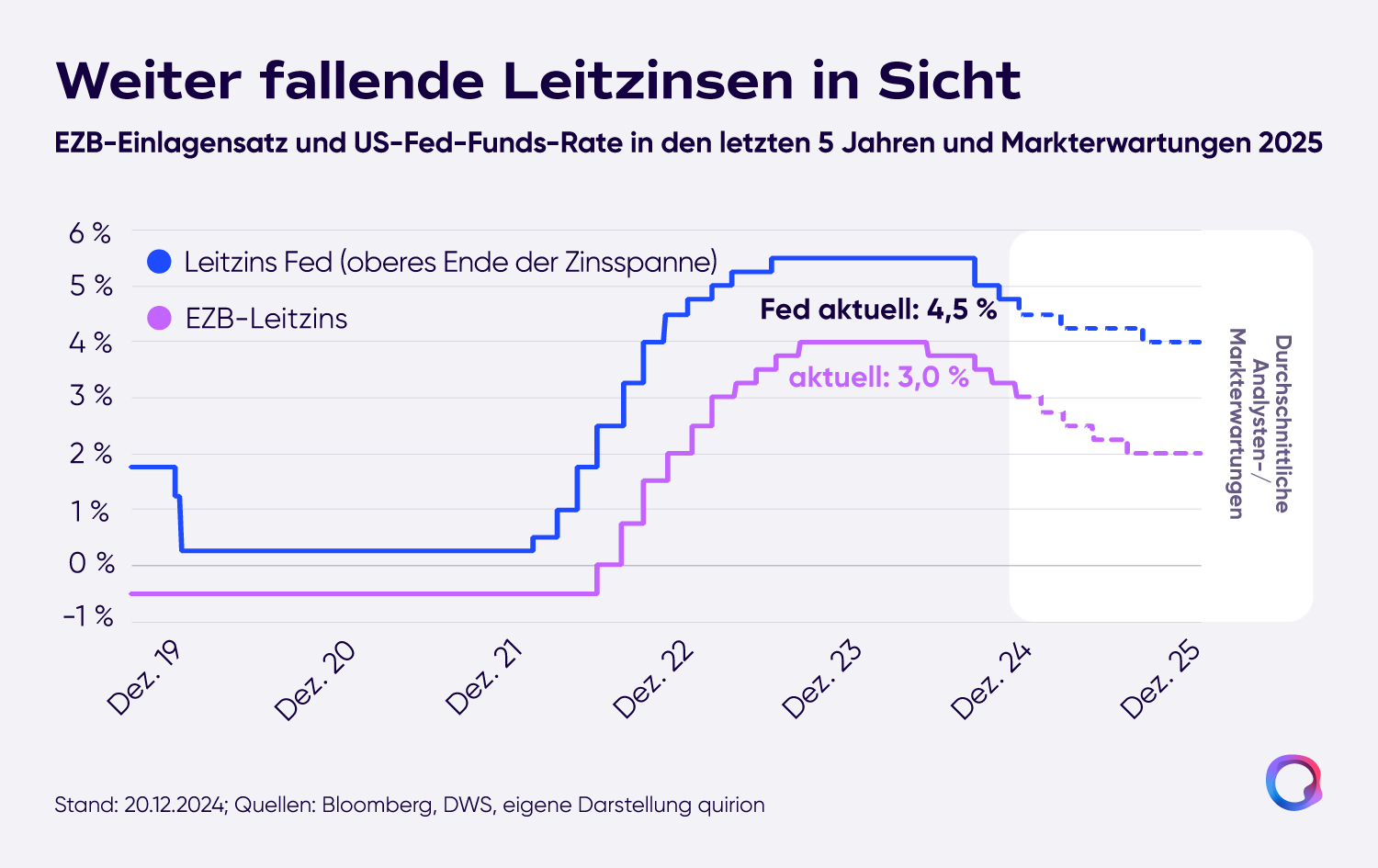
Inflation rates have now fallen sharply in the US and the eurozone. But challenges still remain. The US Federal Reserve in particular isn't quite satisfied yet with the decline in inflation. "In both economic areas, core inflation – that is, inflation excluding energy and food – is still quite high," Kussmann points out. The prevailing expectation right now is that key interest rates will continue to come down – somewhat faster in Europe, somewhat slower in the US. That said, depending on what happens with inflation, expectations can also shift again quickly.
Tech stocks: driving force or risk factor?
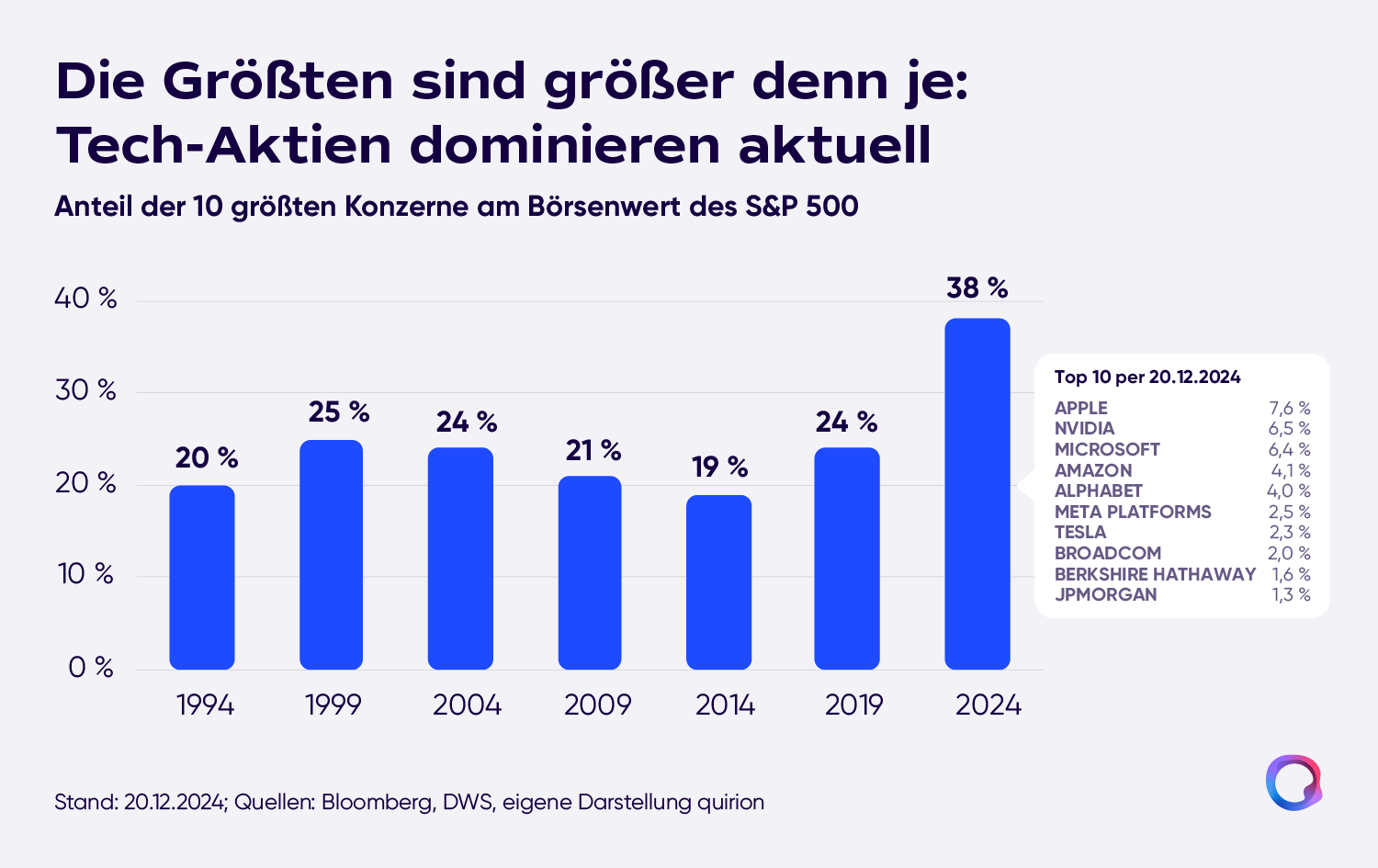
Once again, the technology sector was the driving force behind the pleasing stock market performance last year, especially in the US. As prices rise, however, so does the weighting of some tech stocks in market indices such as the S&P 500. A very high weighting of individual stocks is a risk that shouldn't be underestimated. "That became clear in 2022, for example, when major technology stocks fell by as much as 65 percent," Kussmann emphasizes.
Whether tech stocks will lead the way in 2025 as well remains to be seen. Kussmann is certain: "Sooner or later, there will be a changing of the guard. The favorites shift again and again, unexpectedly and unpredictably."
An investment strategy for all eventualities
Economic developments in individual economies, key interest rate decisions, the momentum of individual sectors: these are just a few of the factors that can play an important role for the capital markets. Whether and how they will shape developments in 2025 remains open for now. Yet performance within a single calendar year isn't the deciding factor anyway. Because when it comes to investing, what matters above all is your investment horizon. And for an investment in the stock markets, that horizon should be geared to the long term.
Even if performance can't always turn out as strong as in the past two years, and even if things may head downward again sooner or later: the long-term trend in the stock markets remains upward. Stocks give you a stake in companies and therefore in the economy. And the economy is fundamentally geared to growth. But because no one can forecast which stocks, sectors or regions will be the next winners, the best strategy is to invest in a portfolio that is as broadly diversified and global as possible, and to stay on board throughout the entire investment horizon. That means not basing your investment decisions on forecasts. This holds true not just in 2025, but well beyond it.