Investing money in several securities and diversifying your portfolio that way: can't anyone do that on their own? Here's why it isn't necessarily "cheaper" than using a digital asset manager.
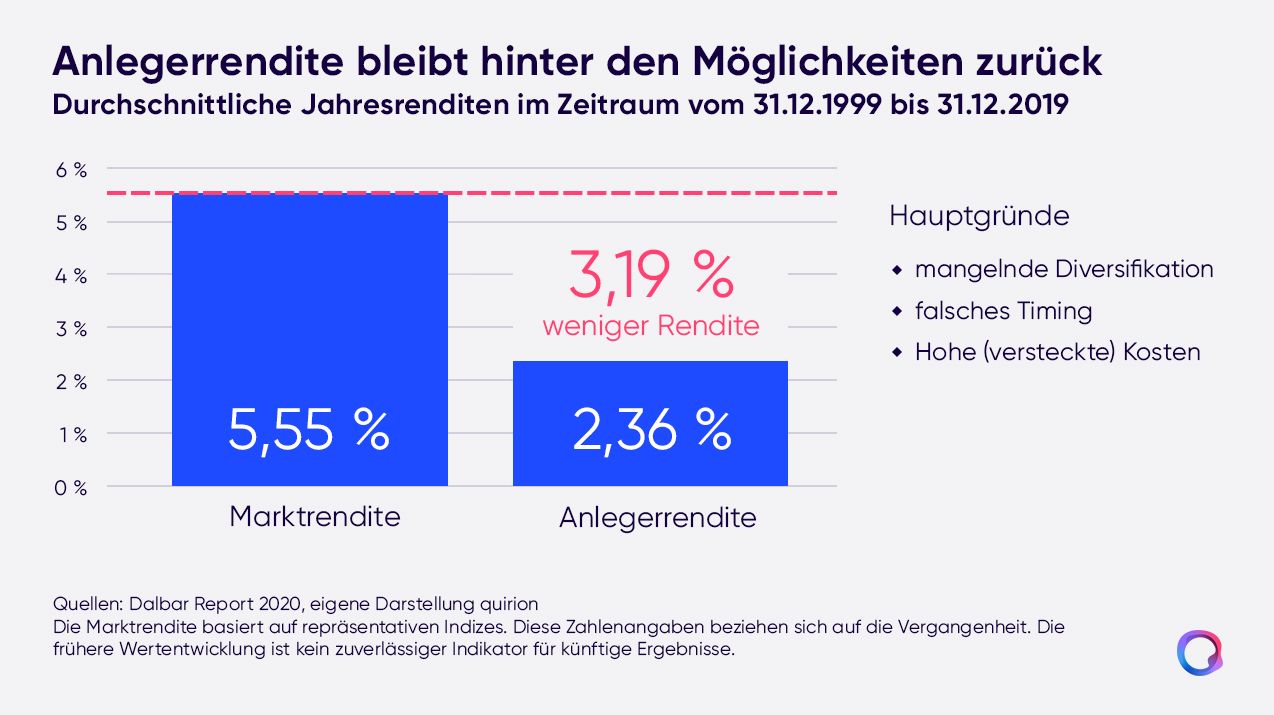
A few funds, perhaps some individual stocks – that's what many private investors' portfolios consist of. Sometimes they trusted a friend's tip, sometimes they invested in a favorite from the top-picks lists in the relevant media. Even when the selection isn't limited to a single security, the combination is usually a matter of chance. The problem with this is that the return often turns out lower than the market would actually allow. "Among the main reasons for this are poor diversification, but also failed attempts to catch the right time to get in and out – and of course high costs, which are incurred particularly with investments in actively managed funds," observes Philipp Dobbert, head of asset management at quirion.
On the right track with ETFs
ETFs can be a springboard for clearing some of these hurdles on the path to capital market returns more effectively. That's true at least for broadly based ETFs that don't limit themselves to specific sectors, themes or regions. Spreading your invested money and avoiding concentration in individual market segments reduces the risks and opens up additional sources of return. The low costs of ETFs help returns as well. More and more investors are recognizing this. "Anyone who positions themselves internationally with ETFs, instead of investing in individual stocks or actively managed funds, has already come a good part of the way," Dobbert notes.
But even if this approach points in the right direction, comparing individual ETFs with quirion's global ETF portfolio quickly reveals one big difference, namely the number of stocks. The MSCI World, for example, represents around 1,500 stocks, whereas quirion's equity portfolio holds over 8,000 stocks.
Tapping into all relevant sources of return
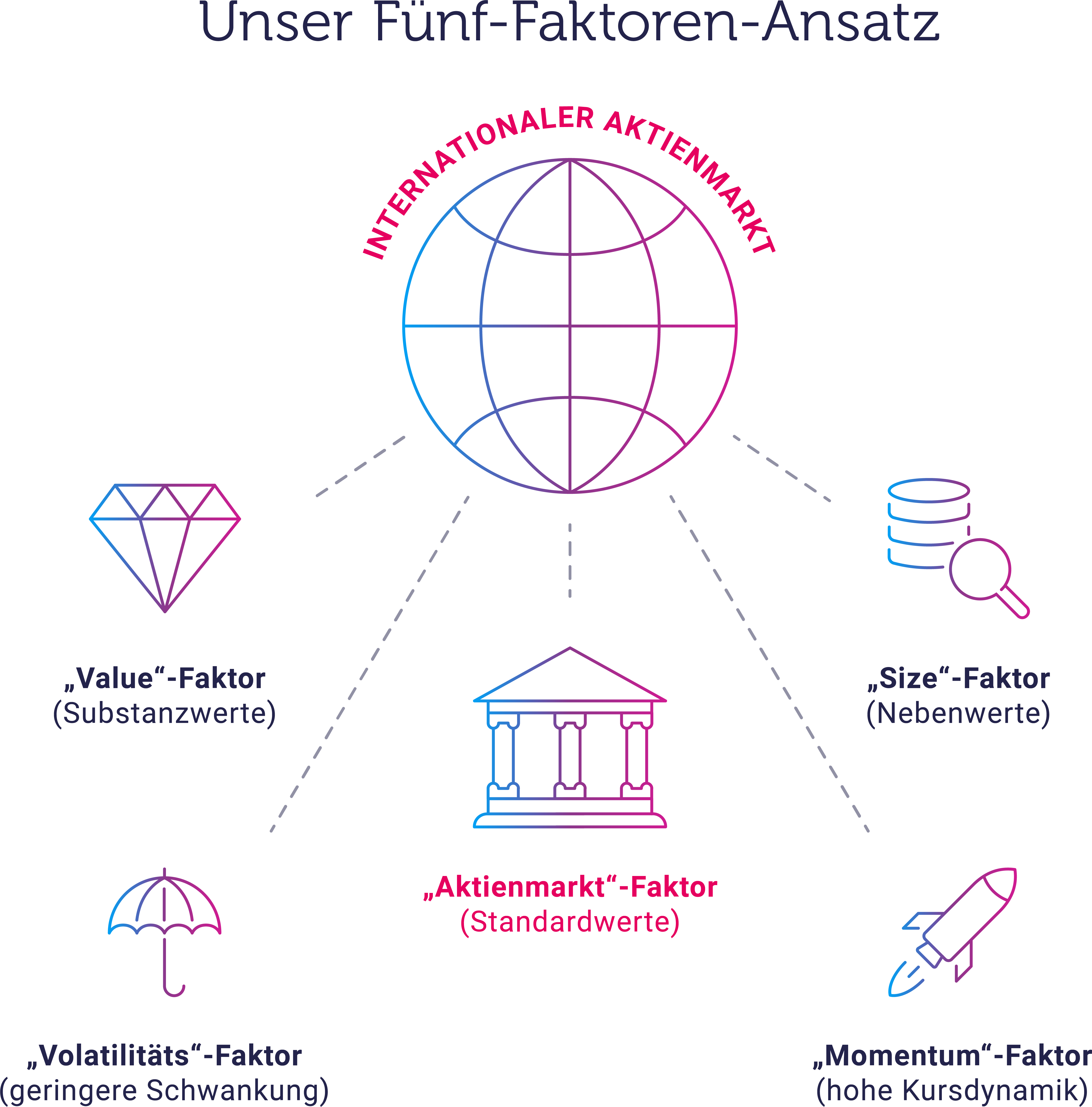
The breadth of the portfolio is important. But for quirion, it's not just about the largest possible number of different stocks. "Every stock has its own characteristics that determine both performance and risk," Dobbert explains. "This includes company size, valuation level, volatility and price momentum." With the major standard indices, a number of these return factors aren't taken into account at all, or not to an appropriate extent.
It's different with quirion's global portfolios. They are designed to track the "global stock market" and its relevant return factors as precisely as possible. The goal is maximum diversification: "That's the only way to optimize the ratio of expected return to expected risk," Dobbert emphasizes.
The investment strategy is grounded in the findings of capital market research and in-depth financial market analyses. "When constructing the portfolio, the dynamic interplay and the interaction of the various factors have to be carefully coordinated with one another," Dobbert stresses. "A portfolio made up of too few indices, or the wrong combination of indices, only approximates the ideal market portfolio very imprecisely."
A lot of work on the details
Once a suitable composition has been found, the work isn't done. Dobbert and his team keep an eye on the factors and how they develop – and likewise on the ETFs that track them. When products come onto the market that allow the investment strategy to be implemented better or more cheaply, the portfolios are adjusted. Private investors, of course, can't operate this way when putting together their portfolios. In its analytical work, Dobbert's team relies on, among other things, special tools and databases that are only worth acquiring for professionals.
What's more: not every investor can stomach a 100% equity allocation. That's why the equity components at quirion are deliberately combined with bond building blocks so that they precisely match the various risk profiles. That's hard to pull off with "do-it-yourself" portfolios. Anyone who wants to optimize also has to pay a great deal of attention to the details. This shows in the implementation as well, for example with savings plans: if you set up a savings plan with quirion, you're not just buying a single product – you're participating in the entire portfolio. But that means the monthly executions sometimes involve ETF units on the order of hundredths.
The world in your portfolio – but affordably
This intricate fine-tuning pays off, as numerous test results confirm. And yet the asset management doesn't cost customers much: the price of the "Digital" package is just 0.04 percent per month, or 0.48 percent per year.
For anyone who doesn't want to stop there: in the summer, quirion expanded its range of services once again. With the "Premium" and "Privat" service packages, there are now two offerings that include financial coaching and independent advice in varying depth and levels of personalization – giving you a bit more support with your investments.