Your investment horizon is one of the most important levers for reaching your financial goals. With enough time and a smart investment strategy, small contributions can grow into substantial wealth.
Which would you rather have: a million euros right now, or a single cent that doubles every day for a month? Perhaps you pause for a moment, because of the way the question is framed. Or perhaps you already know the answer: the "doubling cent" comes out ahead — even though its value grows slowly at first. On day 10, doubling a single cent every day gets you to just €5.12. By day 20 it's €5,242.88, and by day 25 it's already €167,772.16. Finally, on day 28, the "doubling cent" overtakes the "instant million" with a result of over €1.3 million.
Granted, the calculation is contrived. Money doesn't simply double from one day to the next. But the example vividly illustrates that something seemingly small can, over time, turn into something very big.
Getting rich with small contributions
Now let's take a different example. Suppose that when a child is born, you set up a securities savings plan with a purely theoretical return of 8 percent per year. Month after month you invest €60 until the child turns 18. The child takes over the savings plan but doesn't pay in anything more. The money keeps working on its own. By adulthood, the assets amount to over €28,000; by age 35 over €100,000; and by age 63 they surpass a million. A total of €12,960 was paid in.
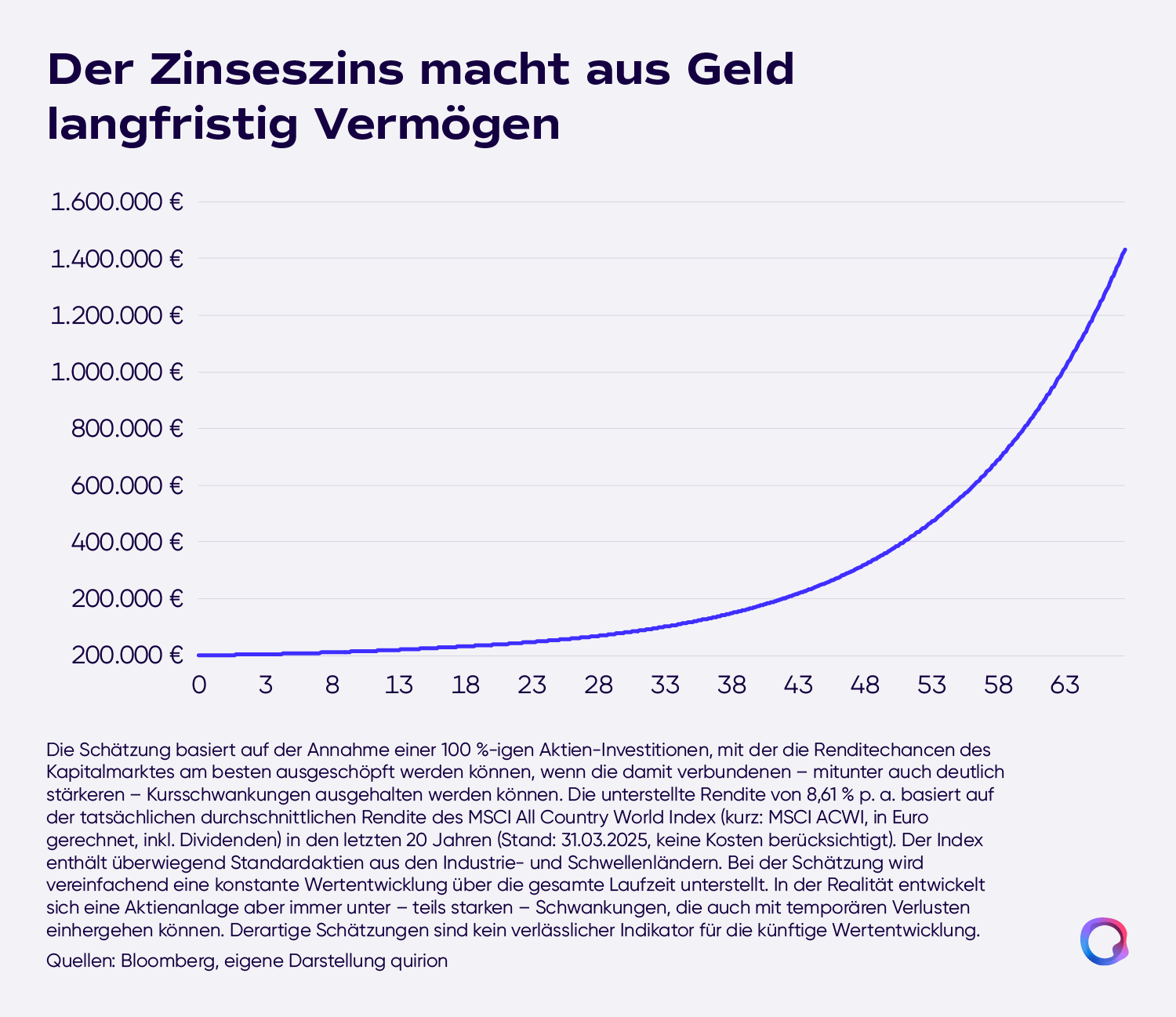
This shows that your time horizon is one of the most important levers for reaching financial goals with an investment. The longer you invest, the better the compound interest effect can unfold its remarkable power. True, the example depends on a particular return assumption that no one can guarantee. But unlike a "doubling cent," this assumption isn't entirely far-fetched. A long-term average annual return of 7 to 8 percent has certainly been realistic on the world's stock markets so far.
Is an early-start pension on the way?
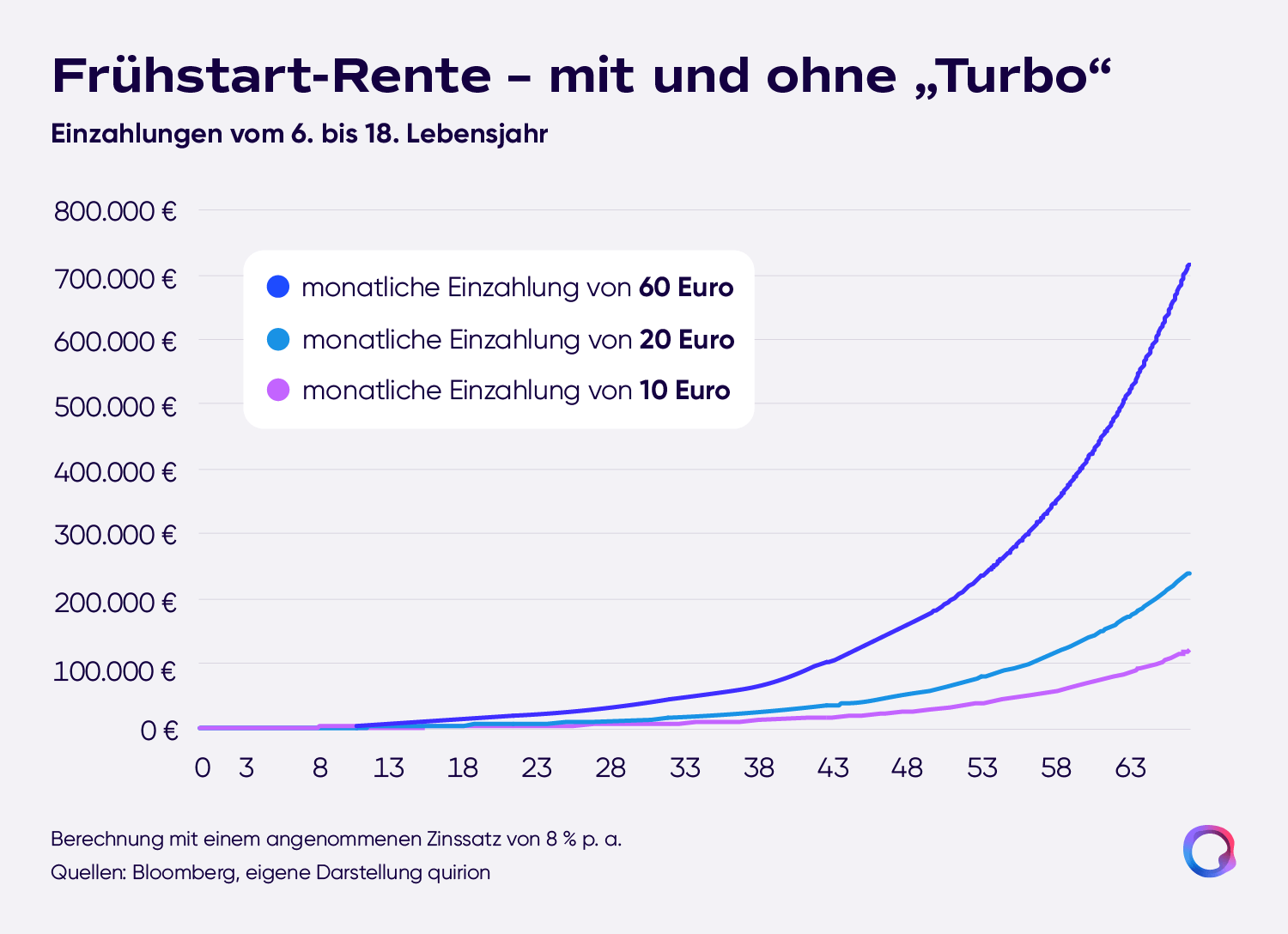
Start saving early and thereby harness the long-term return potential of the capital markets for retirement: Germany's new federal government seems to be convinced of this too. At any rate, the coalition agreement says the following about the planned early-start pension: "For every child who attends an educational institution in Germany, we want to pay ten euros per month, from age six to age 18, into an individual, funded and privately organized retirement savings account." The amount saved up during this period should then, from age 18 until retirement, be eligible for further contributions through private payments. It's set to launch on 1 January 2026. But many questions are still open, for example: Should private contributions really only be allowed from age 18? Small top-ups from parents or grandparents could, after all, achieve a great deal more.
Harnessing the return potential of the stock markets
It's also not yet settled which securities will be eligible for the early-start pension. What is clear: for long-term investment goals, there's no way around the stock markets. In its "Global Investment Returns Yearbook 2025," UBS, in collaboration with the London Business School, looked back at 125 years of capital markets. One finding: across the markets studied, returns were on average higher than for bonds and higher than inflation.
That's no coincidence. Because even though things can get turbulent on the stock exchanges from time to time, over the long term and on average the stock markets trend upward. This is because stocks give you a stake in companies, and thus in the economy, which is fundamentally geared toward growth. But since it's impossible to know which companies, industries or regions will be among the winners in the future, the portfolio should be diversified as broadly as possible.
Investing affordably and on a sound basis
Diversification is especially affordable with an ETF portfolio. With a special combination of ETFs that takes all the relevant return factors into account, quirion's global portfolio gives you a stake in around 8,000 stocks from over 70 countries. For comparison: the popular MSCI World contains around 1,350 stocks from 23 countries.
quirion's global ETF portfolio is also available as a children's savings plan — starting from contributions of just €25 a month. Unlike pure product savings plans, the services of professional asset management are included. This includes, among other things, an investment strategy based on the latest findings from capital market research. Investors don't have to worry about anything else.
If you want to build wealth for your children, you don't have to invest large sums. The main thing is to start saving early — whether with or without government support.
More about the early-start pension and about our children's savings plan.