What can delight the ornithologist gives the financial expert the shivers: the so-called black swans. In stock market speak, these rare birds are used as a metaphor for surprising and unfortunate world events that have far-reaching consequences for markets around the globe.
The insider expression goes back to the international bestseller by New York financial mathematician Nassim Nicholas Taleb, who in 2007 published "The Black Swan: The Impact of the Highly Improbable" (new edition 2015 by Knaus Verlag). Taleb characterizes a black swan by three properties: first, the event is an outlier – it lies outside the realm of regular expectations, and nothing beforehand pointed to it. Second, its impact is enormous. And third, it prompts us to concoct explanations after the fact to make it explicable and predictable. Taleb's book has long been a classic of economic literature and a guide through the uncertain world we live in.
Black swans have many faces
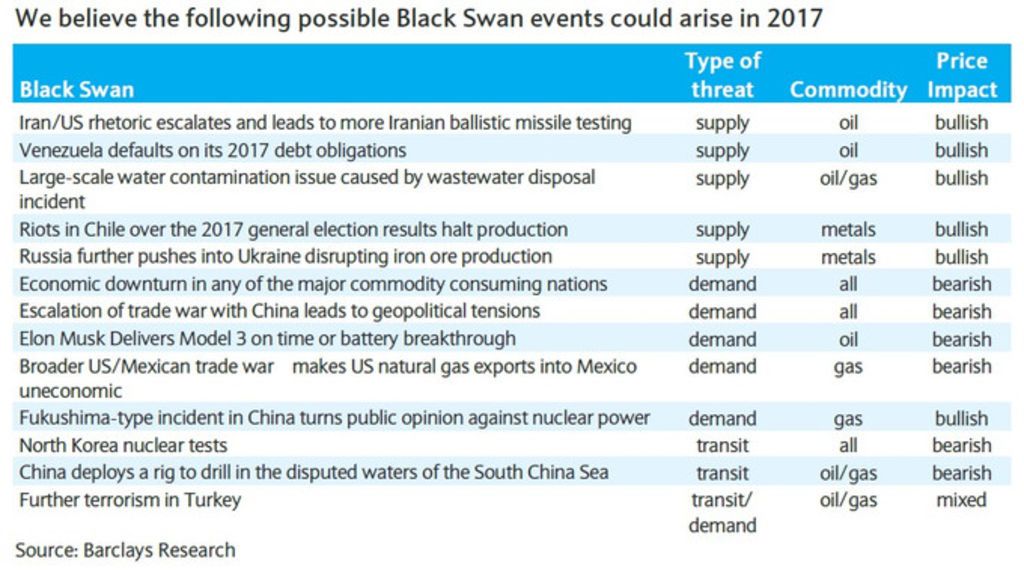
A black swan can appear in the form of a political crisis, a sovereign default, or a terrorist attack. Prominent examples are the attacks in New York on 11 September 2001 and the global financial crisis of 2008. Some experts predict that we'll see more frequent visits from this dark feathered creature in the near future. The research department of investment bank Barclays, for instance, forecasts a "high probability" of such turbulence in a report for the year 2017:
Discipline and rebalancing
But there's a counterpoint to this overview: the greater the probability that one of the events mentioned above will occur, the less justified the label "black swan" becomes. A black swan, after all, comes practically out of nowhere.
But how can and should you, as an investor, deal with incalculable risks? A legendary financial expert like André Kostolany (1906 to 1999) knew the turbulence of the money market well. He trusted in the forces of the markets and invested his money in a broadly diversified way, because he knew: anyone who concentrates the bulk of their assets in individual securities runs the risk of losing a great deal in the event of an unforeseen occurrence. His one piece of advice, delivered with a wink, was: "Buy shares and then go to sleep for at least ten years."
What Kostolany means by this: stay disciplined! Choose an asset manager who, like quirion, invests systematically in the two by far most important asset classes – equities and bonds – and regularly restructures your portfolio through rebalancing. With this approach, we make sure that the risk-return profile of your investment strategy doesn't drift lastingly away from your return expectations and risk appetite, so that you neither take on excessively high risks nor fail to meet your return goals due to structural reasons. This makes it possible to generate predictable returns over a long period, and you don't lapse into panic and blind activism. Believing that you could predict the movement of the markets, or even the next black swan, is a mistake.
Conclusion: anyone who doesn't speculate need not worry about black swans, but can watch them with interest.