Since the start of the year, setbacks and recoveries have been alternating on capital markets worldwide. At times, equities and bonds – just like other asset classes – give way simultaneously. What's going on?
In recent years, a few tweets were sometimes enough to send the shares of little-known companies to dizzying heights. But the wind on the stock markets has changed. These days, even minor disappointments can send the shares of well-established companies into a tailspin. One example among many: Nvidia in the US. As recently as 2021, the processor and chip developer was considered the next candidate for a market capitalisation of over one trillion US dollars, reaching a peak stock-market weighting of over 800 billion US dollars. In May 2022, Nvidia did report unexpectedly high profits for the first quarter, but lowered its revenue forecast for the second. The share was punished. By the start of June, its market value stood at only around 450 billion dollars.
Great uncertainty instead of boundless growth fantasies: in this environment, the sceptics gain the upper hand more often – in the headlines, too. Grounds for pessimistic scenarios are quick to find. Supply chains are still stuttering, and this is causing imbalances between supply and demand. The war in Ukraine is keeping energy prices high, and inflation is spreading ever wider. For the first time in many years, key interest rates are rising – already in the US now, and soon in the eurozone too.
Interest rates as the lever for a repricing
On the equity markets, changed interest-rate expectations affect growth stocks such as technology shares in particular. That is not only because loans become more expensive and investments therefore more costly. To calculate the “fair” price of a share, expected future profits are discounted back to their present value. “When interest rates rise, the present value of expected earnings automatically falls,” explains our Chief Economist Philipp Dobbert. This applies to every company, he says, but affects growth companies in particular. “That's because their profits were projected far into the future to justify the previously very high valuations.”
The rising key interest rates are also a key reason why the prices of equities and bonds on the capital markets are now falling simultaneously at times. The principle: “When key interest rates rise, new paper comes onto the market with more attractive rates of interest,” Dobbert explains. “The bond market anticipates this, and older paper gets sold off.” This puts pressure on the prices of bonds already in circulation.
Expectations as a price driver
At the moment, no one yet knows how far interest rates will rise. Higher interest rates in themselves are no cause for concern. After all, negative interest rates and the central banks' loose interest-rate policy had previously been sharply criticised time and again. A look at the long-term picture shows that interest-rate hikes need not per se be “poison for the stock market”.
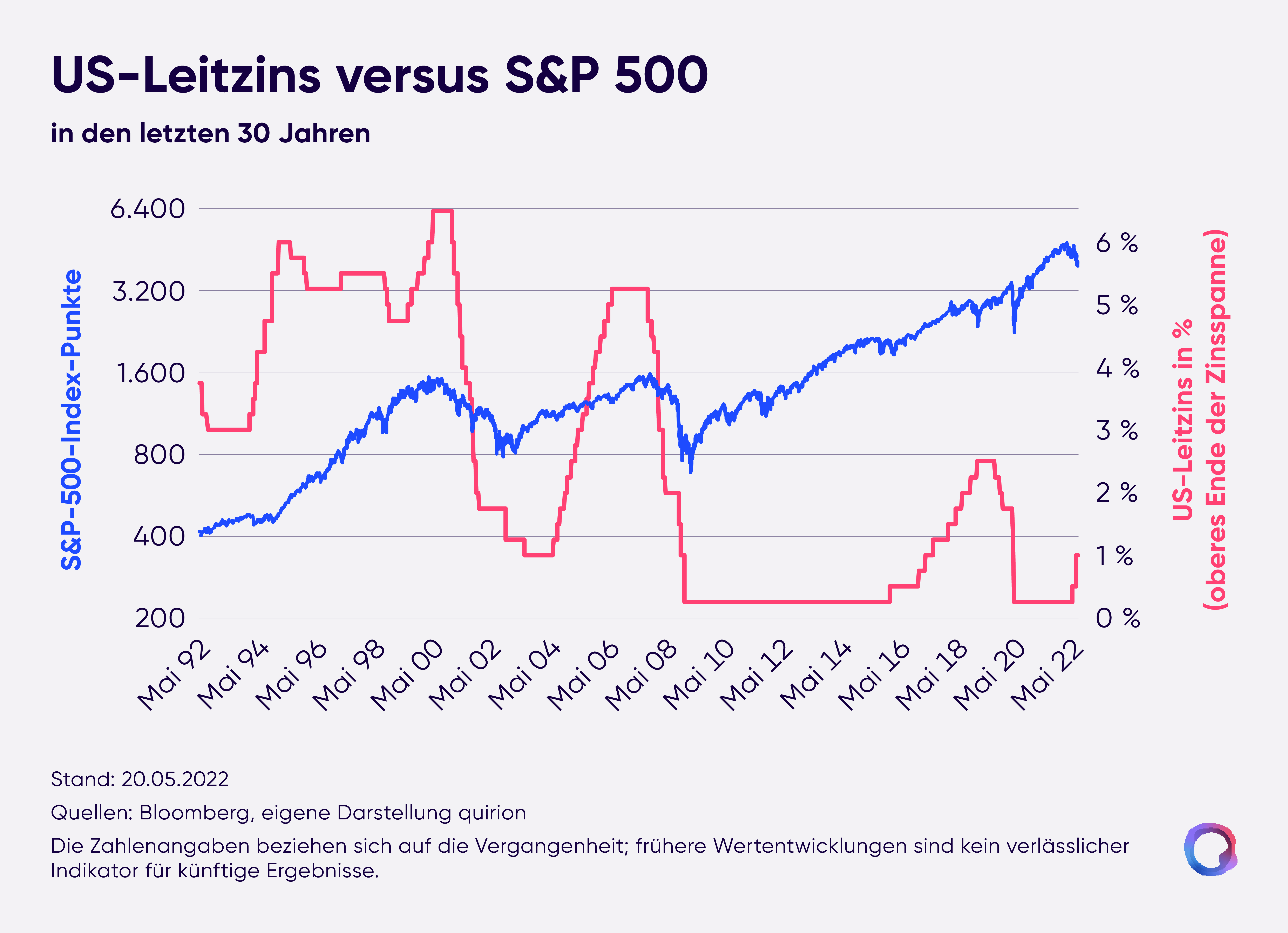
In the current, rather pessimistic mood, however, fears are mounting that the mix of still-shaky supply chains, expensive energy and rising interest rates could put the brakes on the global economy. “In every market phase there are good arguments for both rising and falling prices – that's what makes up the short-term price movements,” Dobbert notes. The stock market doesn't wait until developments actually materialise; instead, it forms prices on the basis of expectations. When these change, prices and directions change with them.
Investing instead of speculating
Does the investment strategy have to keep adapting to changed expectations? “Absolutely not,” Dobbert stresses. Because that would mean forever chasing the market. “A year ago, no one could have said which developments and upheavals we're currently experiencing – whether in world politics, in interest rates, or on the question of which factors now tip the balance for the price of technology stocks. And no one knows what things will look like a month from now, or next year.” In systematic wealth building, he says, one relies permanently on the long-term value creation of the global economy, and therefore invests in the equity markets in as broadly diversified a way as possible.
In doing so, bonds in quirion's portfolios serve the function of reducing fluctuations in such a way that investors with any risk profile can share in the returns of the equity markets. But what happens if equity and bond prices start to wobble in sync? “It's true that 2022 has so far been the worst year for bonds in many years. Yet the bond building blocks continue to dampen the price swings of the equity components,” Dobbert emphasises. “If you compare the risk-return profiles of our global portfolios with those of individual indices, you can quickly see what a broad set-up and a stable investment strategy can achieve.”