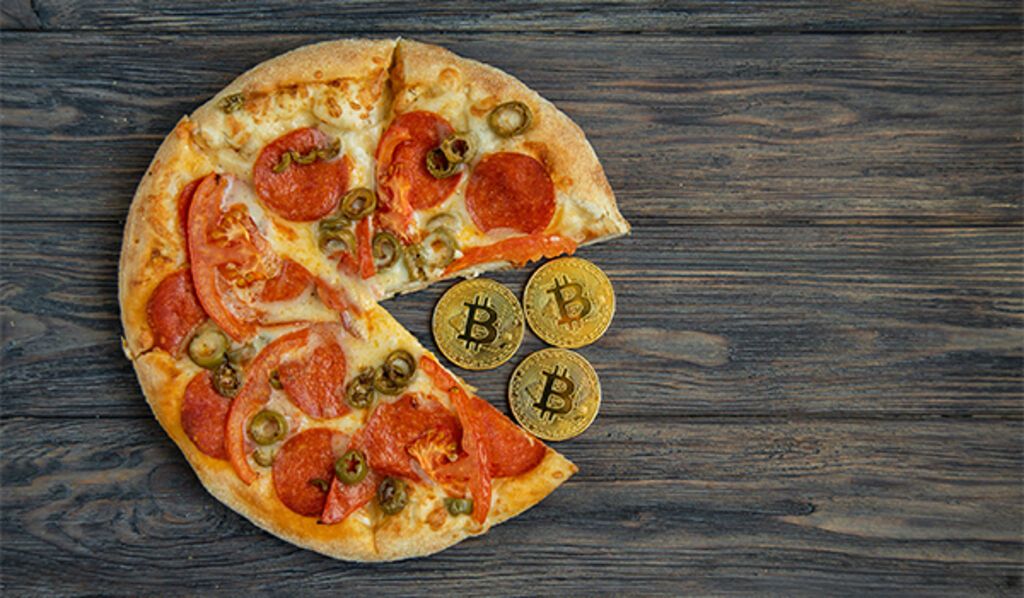
384 million dollars for two pizzas. I thought I was misreading it. In May 2010, Laszlo Hanyecz bought two pizzas worth 41 US dollars - and became the first person ever to pay with bitcoins. The 10,000 digital coins he used to settle the bill back then are worth an incredible 384 million US dollars today.¹
Even I, as a long-time banker, feel a slight flutter in my chest at that. Stories like this one keep fuelling the current hype around Bitcoin, the best known of all cryptocurrencies. The news is coming thick and fast, and not a day goes by without spectacular new headlines. Didn't you too, by the time you'd read for what felt like the tenth time that Bitcoin prices had recently shot right through the roof, catch yourself thinking, "If only I'd bought some back then, right at the very beginning, when they were still so incredibly cheap"?
Another crazy story is that of the German man living in the USA who has forgotten the access code to his Bitcoin vault. He owns bitcoins worth around 220 million US dollars, but he can't get his hands on this incredible fortune unless the code comes back to him². He has two of ten attempts left to enter the right code - otherwise the fortune remains forever out of reach. It is then no more than a few encrypted bits and bytes on a USB stick.
Media interest is enormous, and speculative buyers are driving prices up
A veritable hype has grown up around Bitcoin - more than a few investors want to be part of it and are chasing what looks like easy money. The prices of many cryptocurrencies are currently at an all-time high, and quite often they have risen by several thousand percent since the digital currency was launched.
And if you believe certain analysts, we are still a long way from the ceiling. When it comes to Bitcoin, for example, they assume prices around 100,000 euros (!) are conceivable; right now it stands at roughly 30,000 euros. I have been active in the capital markets for several decades - privately and professionally, I have made mistakes and learned a great deal from them - and so, based on my many years of experience, I say this: when I read these euphoric headlines, all my alarm bells go off.
The dream of getting rich quick
The fatal part: these extremely high price targets suggest to investors what is famously the oldest human dream of all - getting rich quickly without much effort or work. For me it is more of a nightmare: memories of the Neuer Markt, of the bursting of the dotcom bubble around the turn of the millennium, and of various fraud allegations and cases such as Infomatec, EM.TV or Teldafax force their way to the surface. That said, the technology and the idea behind cryptocurrencies do of course fascinate me in and of themselves. Because they undeniably have potential in many respects. And yet caution is called for.
Money changing hands without any vetting authority
But what actually lies behind cryptocurrencies, of which there are now quite a lot? In short: they are digital currencies created artificially on computers. They come into being through the solving of complex mathematical problems. These calculations are handled by the high-performance computers of so-called miners all over the world - they "mine" the digital gold.
What makes this special is that the digital currencies are managed in a decentralised way and are valid internationally, but are not, as is otherwise the case, centrally organised by a government, authority or bank. All transactions, and their creation too, run in a decentralised manner across the computer network of all participants. In doing so, the miners provide the digital service of securing these transactions and documenting them in a tamper-proof way. For these services, for its "mining" work, the miner receives bitcoins. So the bitcoin is the reward for the miners who make their data centres available for these transactions. The total number of bitcoins is capped at 21 million. Currently, around 18.5 million bitcoins have already been mined.
Bitcoins stand for an alternative vision of society
Once you understand what lies behind bitcoins, you quickly grasp the reason for the current hype too. For the first time, the digital coins raised the possibility of a decentrally organised society in which there are no longer any central authorities (central banks or - quite simply - the land register). In other words, the blockchain technology behind Bitcoin makes possible not only cryptocurrencies, but could change society and the everyday lives of us all. It could replace banks and notaries - and thereby deliver enormous efficiency gains.
The advantages: irreversible and tamper-proof
The particular characteristics of bitcoins offer some advantages: they are fast, anonymous, and the transactions made with them are irreversible and tamper-proof. To their supporters, they are THE means of payment of the future. There are parallels with gold, for example scarcity and the relevance as a store of value that rests upon it. Since the mining of bitcoins is capped at 21 million coins, bitcoins are a scarce, digital raw material - and because understanding of this keeps growing, the Bitcoin price is rising.
A client of ours was apparently taken by these advantages too, when she called out to me two years ago at a Quirin Privatbank event that she had never owned shares because they were too dangerous for her, but that she had recently acquired bitcoins. For a moment I was speechless. It is precisely for security-oriented investors (as this client obviously was) that bitcoins are unsuitable. No fundamental (fair) value can be calculated for them, and how prices will develop in the future is pure speculation.
The disadvantages: opaque, illiquid, no real asset behind them
Alongside the opportunities, cryptocurrencies like Bitcoin also carry risks. For instance, they are far too illiquid; at present you can hardly pay with them at all. Nor does the fact that online payment service provider PayPal has announced it will in future also allow Bitcoin for payments change anything about that.
The argument that the digital currency makes processing payments easier is a plain misjudgement, if you ask me! With price swings of often several thousand euros within a single day, how are purchases and sales, rental and loan agreements supposed to be planned and calculated? On top of that, mistaken or erroneous payments cannot be reversed, and hacker attacks cannot be entirely ruled out.
There is also an unfavourable concentration from an investor's point of view: at present, 1,900 "major investors" own around 41 percent of the digital currency. If one major investor exits, a substantial slide in the price can follow.
Cryptocurrencies are also far more dependent on acceptance among the general public than other investment assets, because there is no real asset behind them as there is with shares or bonds. Behind conventional currencies, in turn, stand central banks. For Bitcoin, on the other hand, there is no fundamental value, only a price. And ultimately bitcoins are a piece of technology - if they do not evolve further, they will in future be replaced by better ones.
Some investors nevertheless already see Bitcoin as an alternative to central banks and to so-called "fiat money" (an object with no intrinsic value that serves as a medium of exchange). Yet money essentially has three functions: it is a unit of account, a generally accepted medium of exchange, and a store of value. In its current form, Bitcoin is at best useful as a unit of account. For the other functions, however, it is unsuitable: as a medium of exchange it is still far too little accepted, and as a store of value it is - unlike gold - far too speculative. One should never say never, but before Bitcoin can replace state-controlled money, a number of serious problems still need to be solved.
Ecological madness
Another important aspect for us as Quirin Privatbank is the sustainability angle, which for us is not mere lip service but a serious concern. Producing and using bitcoins consumes a virtually unimaginable amount of energy.
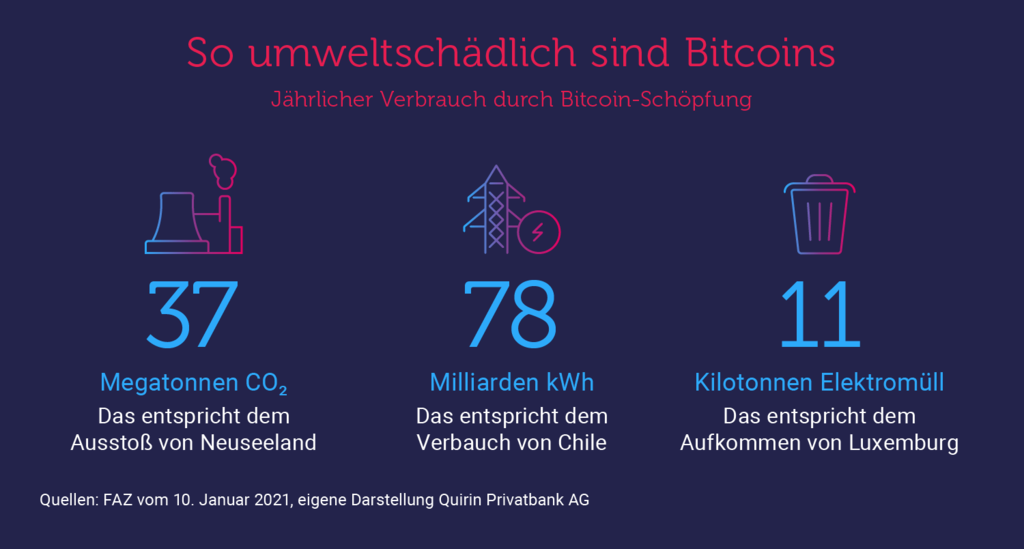
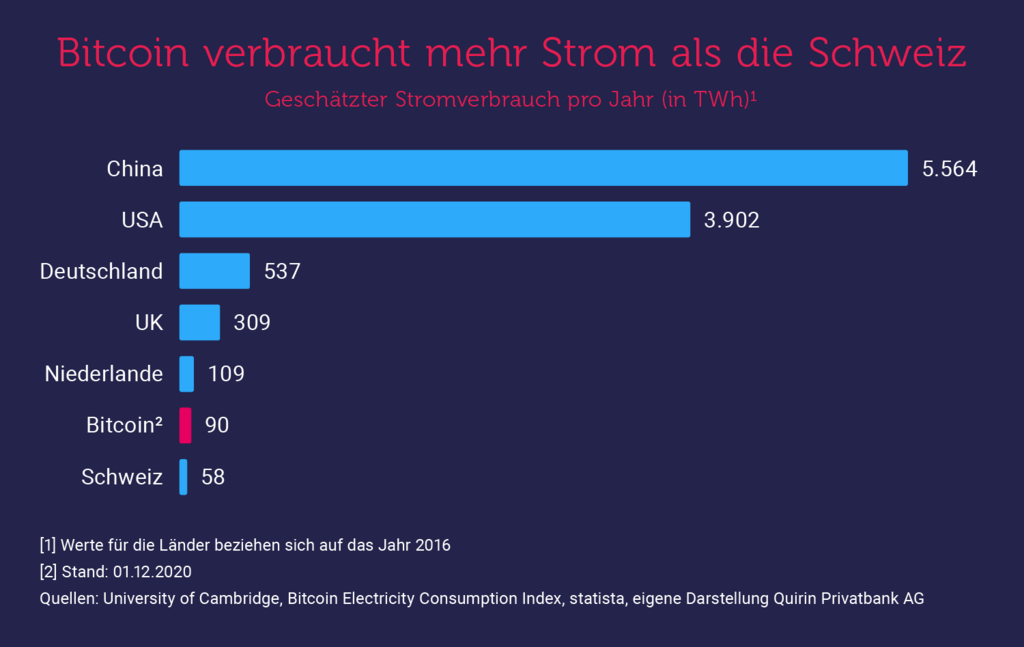
It is paradoxical: more and more people want to invest their money sensibly and sustainably, while at the same time many are flirting with a digital currency that, through its enormous electricity consumption, has become the number one "dirty currency" in the truest sense. Just how much energy Bitcoin actually devours is calculated by the "Consumption Index". A look at a single transaction should strike fear into more than just climate activists: the electricity consumption is as high as that of an average American household over 23 days, and over the course of a year Bitcoin consumes more electricity than the whole of Switzerland.
Possibly tougher government regulation
Climate-policy considerations, as well as the heavy use on the darknet (an anonymous network), could ultimately lead to states banning the production of bitcoins or imposing high taxes on the profits from such transactions. If a significant number of countries were to decide on such a step, doubts about the future viability of bitcoins would likely arise and push the price down sharply.
Last but not least: over the long term, the question also arises as to whether Bitcoin & co. will manage to win the trust of more investors. So far, however, cryptocurrencies' reputation as a favoured tool for financing terrorism and for money laundering stands significantly in the way of that. The operators of some trading platforms, too, regularly have to contend with accusations of market manipulation and lax investor protection.
Hands off bitcoins - unless you need a thrill
As fascinating as I find the idea behind the digital currency and its technical implementation on the one hand, the subject is just as off-putting to me on the other when I look at it more closely through my investor's lens. To put it plainly: an investment in bitcoins is and remains pure gambling and speculation, because no one can gauge when prices will move in which direction. Of course the Bitcoin price may well climb to further heights. But a rise in value cannot in any way be explained, let alone predicted, by developments in the real economy. To get rich(er) with bitcoins, you always have to find someone who buys the digital currency and is willing to pay more than your own purchase price - a risky game.
And as we know from earlier speculative bubbles, sharp price rises always attract new buyers who fuel the prices further - until the house of cards collapses. That is why the hype around Bitcoin can quite reasonably be compared with the situation in Holland in the mid-17th century. Back then, a wave of speculation over tulip bulbs meant that the price of a single bulb reached that of a detached family home. The tulips were not the first speculative wave in human history, and bitcoins will certainly not be the last.
The crowning irony when it comes to cryptocurrencies is this: those who talk the digital currencies up so much often don't own any at all, but merely gamble with (leveraged) certificates on them. Last year, for example, certificates on Bitcoin were once again the most heavily traded product on the Frankfurt certificates exchange, with a turnover of 199 million euros³. That is bringing the supervisory authorities into play too: only recently, ECB chief Christine Lagarde argued for worldwide regulation, since bitcoins are highly speculative investment assets.
That is why, for the vast majority of investors, the rule is: hands off! Bitcoin is and remains nothing other than an artificially created construct and a toy for gamblers. You, dear readers, do know how to do it better: with broadly diversified investments backed by real substance - namely companies, for example - rather than mere speculation. That spares your nerves and protects your wealth - possibly even from a total loss.
Our security for your money. quirion offers you maximum security: this concerns not only your money, but also your personal data.
¹FAZ of 10 January 2021: "Der Hype um Bitcoin"
²https://www.tagesschau.de/wirtschaft/bitcoin-passwort-vergessen-101.html
³https://finanzbusiness.de/nachrichten/fintech/article12689475.ec