Over the past few months, the capital markets and the financial press have once again been speculating about a supposedly imminent turn in interest rates. We simply don't join in. Because bonds are, quite simply, a consistently important component of our global portfolios.
Will central banks soon be forced to rethink their loose interest-rate policy? This is exactly what has recently sparked renewed speculation, especially against the backdrop of rising inflation rates in Europe and the USA. After all, rising key interest rates usually have a dampening effect on price increases. They ripple through the credit market, make refinancing more expensive, and thereby reduce the willingness to take on loans. That shrinks the money supply and ultimately curbs economic activity. On top of that, interest-bearing investments tend to become more attractive, which can slow consumption and thus likewise lower the overall price level.
Prices fall, yields rise
Speculatively minded bond investors in particular keep a meticulous eye on how inflation rates develop, because when the value of money erodes, their already meagre returns are further and painfully diminished once the inflation rate is deducted. Long-term bonds especially were therefore under stronger selling pressure at times, which resulted in price losses and correspondingly rising yields. In light of these developments, many people are asking whether the low-interest phase will soon come to an end and whether bonds are even worthwhile at all, given the possibility of further price losses.
One thing is clear: every market phase is eventually replaced by a new one. The problem, though, is that no one knows exactly when that will happen. Any assumption about it is pure speculation. When interest rates began to slide during the 2008 financial crisis, for example, hardly anyone could have imagined how long and how far they would fall.
How quirion uses bonds
With bonds, therefore, just as with equities, we stay true to our investment strategy: we don't try to foresee the future and pinpoint the "right" moment to invest.
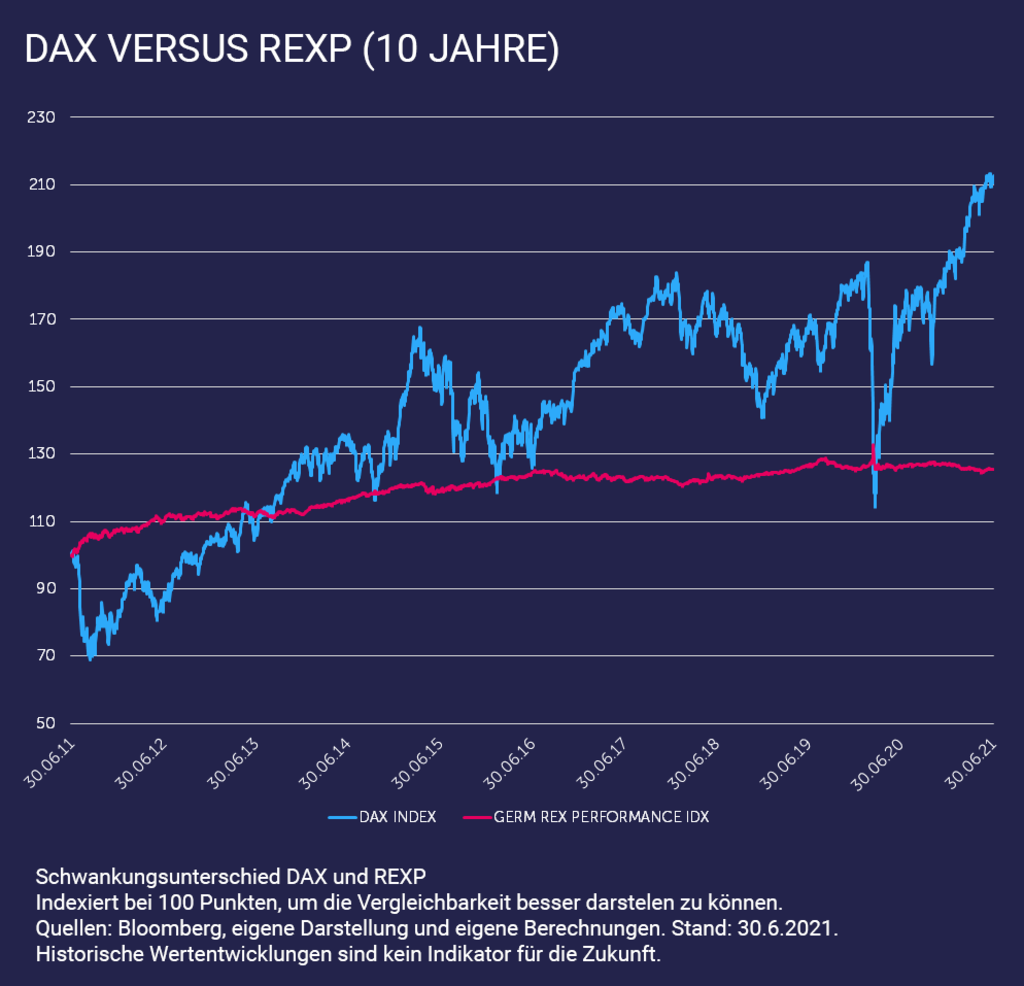
Although, as with equities, we don't rely on forecasts when it comes to bonds, there are nonetheless some differences in our strategy for these two asset classes. To understand this, it's worth first taking a look at a particular characteristic of bonds. It becomes apparent, for instance, when you compare the performance of the German equity index DAX with the bond index REXP, which is based on 30 typical German government bonds with various maturities of between one and ten years. In this comparison, one thing immediately stands out: bond prices move with far less volatility than equity prices.
"Diluting" the risk
As a stabilising factor, bonds serve an important function even during low-interest phases – including in quirion's portfolios. We use bonds to calibrate the portfolios according to the various risk profiles. To illustrate the effect, here's a comparison: when spirits are diluted with water, the distillate is said to be "brought down to drinking strength". Bonds serve a similar function in our global portfolios. Depending on the chosen risk profile, they "dilute" the volatility of the equity components. If, for example, the risk is meant to stay as low as possible, high bond allocations provide stability while the admixture of equities nonetheless delivers returns. That doesn't rule out the possibility that, with the appropriate risk profile, a portfolio can also consist of 100% equities.
Keeping an eye on maturities
To ensure stability, our focus in bonds is on government and corporate bonds with high credit quality. As with equities, we use ETFs to invest in this asset class. This means we are invested in over 1,000 individual bonds, issued by around 500 different debtors. While such a broad set-up keeps the default risk low, we eliminate currency risks through special hedging transactions within the ETFs.
With bonds, however, broad diversification doesn't just mean spreading the investment across different issuers (bond debtors). Maturity also plays an important role with bonds. If the interest-rate level does at some point rise noticeably, it is precisely those bonds with a long maturity – and therefore a long-term fixed interest rate – that lose the most value. In our portfolio, bonds with short maturities therefore carry a comparatively high weighting.
Capturing returns
While stability is the focus of our bond selection, even during the low-interest phase it was still quite possible to earn something in many years, albeit not on a large scale. In our bond portfolio, ETFs holding longer-dated government bonds as well as corporate bonds with higher-risk debtors (high-yield bonds) repeatedly make a noticeable contribution to returns. The longer the maturity and the more uncertain the credit quality, the higher the yield to maturity tends to be. In any case, thanks to its specific selection and diversification, quirion's bond portfolio offers a sensible symbiosis of stability and return opportunities.
More about the ETFs through which we invest in the bond market can be found here.