In mid-November, a lot of securities settlements started showing up again in the account activity of our clients. That's because we carried out the annual rebalancing of the portfolios, realigning them with the target investment mix. After all, that mix is meant to reflect the chosen balance between risk and return.
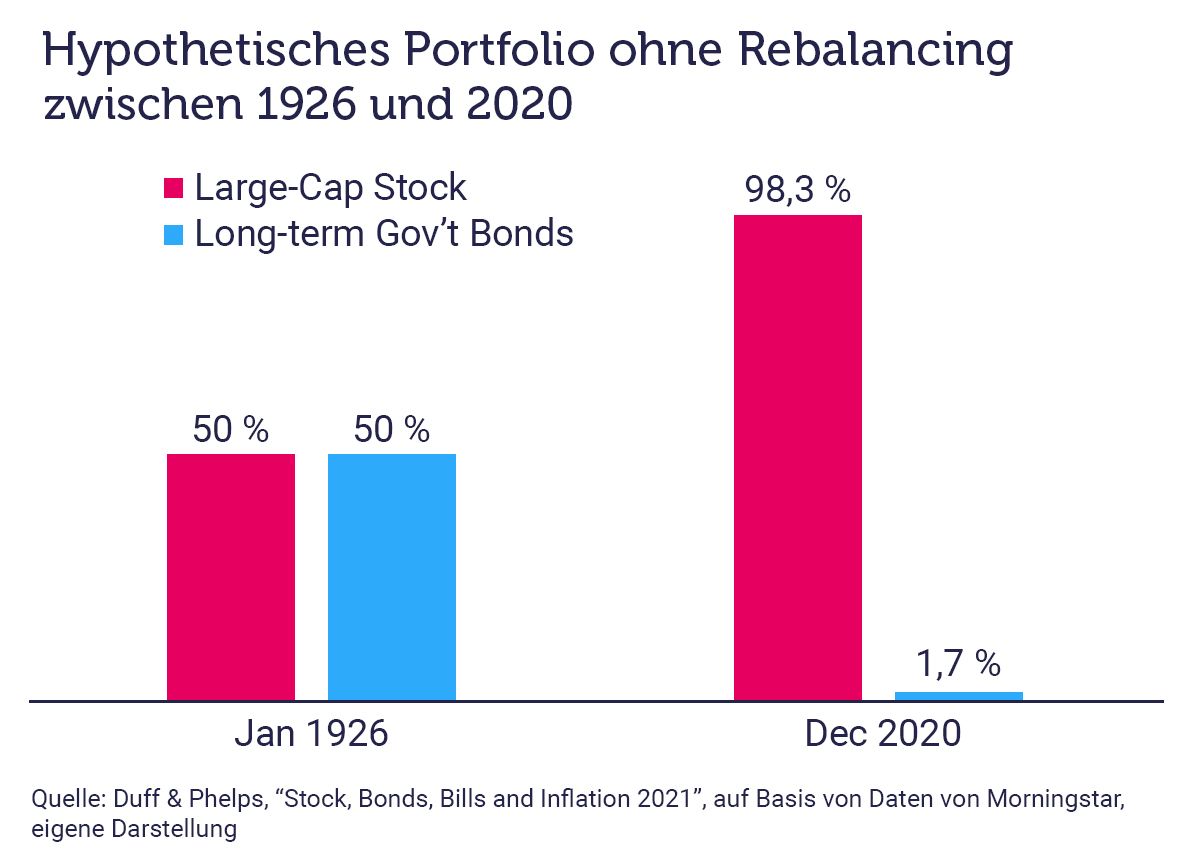
The background: fluctuations in value constantly change a portfolio's risk profile. This effect can be demonstrated particularly clearly using a hypothetical portfolio over a very long time horizon. Started in January 1926 with 50 percent in large-cap US equities and 50 percent in long-term US government bonds, performance shifted those weightings dramatically over the years. The following chart illustrates this:
Over shorter time frames, the effect is usually not so pronounced. But even then, market developments shift the weightings in our clients' portfolios. "That's why we realign them with the target profiles at least once a year through a rebalancing," explains our chief economist Philipp Dobbert. This means that sales are triggered for any securities that have posted price gains, while additional purchases are made for underweighted securities. In the process, it isn't only the ratio of equities to bonds that is brought back into line with the risk profile. All positions are reviewed and adjusted. "We make the details transparent to clients in the securities settlements. In principle, though, we're only correcting the imbalances that have built up over time," Dobbert notes. "And it also means that gains are regularly locked in."
Balancing out fluctuations in value is part of risk management at quirion. "Capital market research shows that if a portfolio moves with the market, a stress event such as a sudden price drop can lead to considerably sharper setbacks than would be the case with systematic rebalancing." So when it comes to risk, too, quirion's investment strategy remains free of forecasts. After all, no one knows when a market will turn.
New products, new return factor
At the same time, we also swapped out a few products – but exclusively in the sustainability portfolio. "Several return factors aren't yet captured as well in our sustainability portfolio as they are in the other strategies. That's because products in the market for sustainable ETFs and asset-class funds that match our target profile are only becoming available gradually," Dobbert explains.
For the premium factor "creditworthiness," which is part of the target profile in the bond segment, there are now more suitable bond ETFs available in the sustainability space as well. These make it possible to invest specifically in high-yield bonds from more sustainable companies. "For short-dated corporate bonds, we've added the BNP Paribas Easy Euro Corporate Bond SRI Fossil Free 1-3 Year ETF, replacing the iShares Euro Corporate Bond 0-3 Year ESG ETF," says Dobbert. "The new ETF has a better ESG score and a lower CO2 intensity." According to the findings of the independent organization ShareAction, it also comes from a highly committed fund company.
In addition, the share of the Lyxor Green Bond ETF was reduced from six to five percent. In its place, the UBS Bloomberg Barclays MSCI Euro Area Liquid Corporate Sustainable ETF was increased from 14 to 15 percent. "The Lyxor Green Bond proved somewhat more volatile than expected, and this is how we're balancing that out."
Weighing the pros and cons
In the sustainability portfolios, we can expect further adjustments as products that better fit the strategy come to market in other areas as well. "Here we're not quite where we ultimately want to be," Dobbert emphasizes. Otherwise, the deputy head of asset management is very comfortable with the products currently in the portfolios.
In any case, products are never swapped out hastily. "Before making changes, we analyze the pros and cons of a swap very carefully," Dobbert underscores. This also includes tax considerations in general. "The markets have performed well. Selling a lot of ETFs would have triggered capital gains taxes." Whether it's taxes or trading fees: "We only swap out products when the advantages in quality or cost outweigh the drawbacks on the whole."
More about the ETFs in quirion's portfolios can be found here.