The compound interest effect works like a lever when you build wealth. If you want to harness it for your retirement, there are two levers to keep an eye on – your time horizon and your return.
What will my bank statement look like after my 67th birthday? For most people, that image rarely comes to mind. Right now, many are mainly preoccupied with what the high rate of inflation means for the household budget. And even beyond that, other questions usually push their way to the front – the next major purchase for the family, for example, or perhaps financing a home of your own.
Even so, it may well be worth doing the math again to see whether you can set aside a little something for your retirement after all. It has long been clear that demographic change poses enormous challenges for the state pension system. The ratio of benefit recipients to contributors is increasingly out of balance. There are now fewer young people in Germany than ever before. According to the Federal Statistical Office, only around 10% of people in Germany were between 15 and 24 years old at the end of 2021. And in the near future, the baby-boomer cohorts will be retiring. To maintain your standard of living in old age, private retirement provision is becoming ever more important.
A lever that helps you save
The earlier you start, the smaller you can begin. That's because one of the most powerful levers in long-term investing is the compound interest effect. The term is a little misleading. This effect isn't just about interest, but about investment returns in general. When earnings are immediately reinvested, they in turn generate further earnings. The longer you stay invested, the greater the effect.
A worked example: assuming a savings rate of €150 a month and a return of five percent a year, after five years you would have accumulated around €10,200. About 90% comes from your contributions, only 10% from returns. Over a savings period of 30 years, your assets would have more than tenfold, reaching around €123,000. More than half of this is attributable to returns, or rather to the compound interest effect.
The effect is influenced not only by the time horizon, but of course also by the type of investment and the return you can expect from it. Here's another example: since 2022, the maximum technical interest rate for new endowment life insurance policies has stood at 0.25 percent. That is the maximum guaranteed rate on the savings component. If you use this return in the example described above, after 30 years you would end up with only around €56,000. Interest and compound interest account for just over €2,000, or 3.7 percent of the total.
Equities – but not just "any" equities
It's true that central banks are now gradually raising key interest rates. In real terms, however – that is, after deducting inflation – interest-bearing products are unlikely to offer a genuine foothold for the compound interest lever for a long time yet. The equity markets hold more promise. Yet even though this asset class has historically delivered higher average returns, it isn't enough simply to invest in just "any" equities. The risks would be too great. After all, who knows whether a particular company will still be thriving in 30 years' time?
It's different with entire markets. They don't just disappear. What's more, the longer your investment horizon, the smaller the impact of price fluctuations – as the example of the broadly based MSCI World shows. The MSCI World Index covers around 1,500 companies.
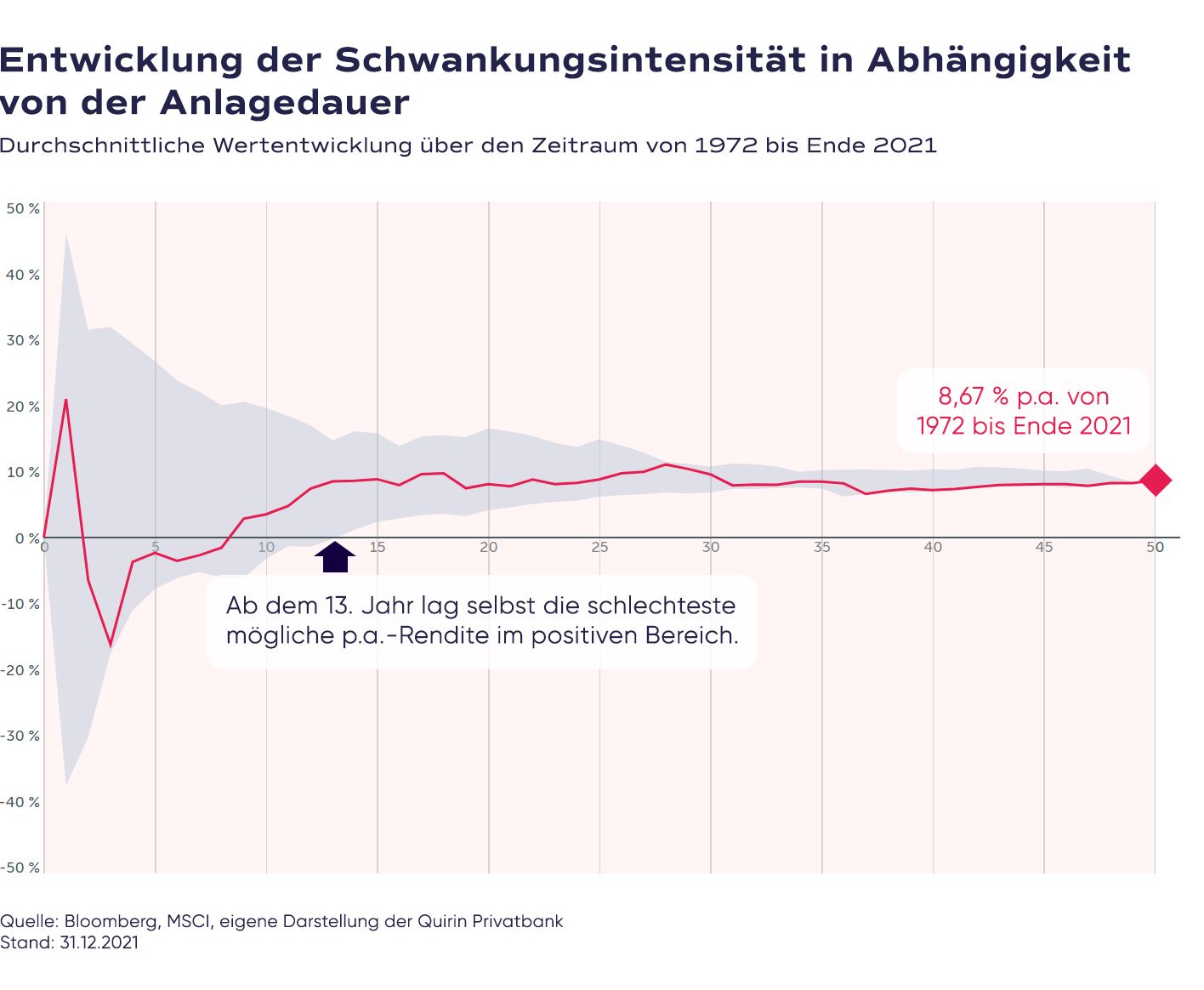
As scientific analyses have repeatedly shown over the past few years, a global portfolio that is as broadly diversified as possible is superior to other investment strategies in terms of the risk-return ratio. This is precisely the strategy quirion pursues with its global ETF portfolios, which give you a stake in more than 8,000 companies. That makes them particularly well suited to the goal of retirement provision. And with a savings plan, you can get started with as little as €25 a month.
What if retirement is drawing closer?
But the equity markets can be put to work for your investment goals not only in your younger years. The average duration for which people now draw the state pension is around 20 years. It has roughly doubled since the 1960s. So even though equity markets fluctuate more sharply at times, it hardly seems advisable to forgo the returns of the equity market entirely just before or after you enter retirement.
quirion's investment strategy comes in ten variants – from 100 percent down to 10 percent equity exposure. In nine of them, bonds are deliberately added to stabilize the portfolio. By setting up several portfolios at once, you can pursue different investment goals simultaneously. That makes it fairly easy to gradually shift money into lower-risk variants as its investment horizon shortens. This way, the equity asset class, with its earning power, can also help maintain your standard of living during retirement.