There are so many other economists who deserve the prize just as much, Shiller says modestly. In fact, he is not the only one to get a call on this 14 October 2013. Alongside him, Lars Peter Hansen and Eugene Fama also receive the Nobel Prize.
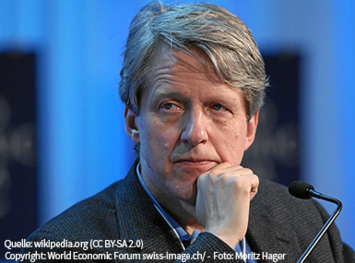
That choice raised more than a few eyebrows. At first glance, Shiller's studies appear to contradict Fama's efficient market hypothesis. It holds that, on capital markets, all trading-relevant information available at any given moment is fully reflected in the prices of the assets being traded — stocks and bonds. It is therefore impossible to gain a lasting advantage by analysing information, no matter how much time you invest in it. The Yale professor Shiller, by contrast, concludes that on financial markets this informational efficiency is not always fully present. The real-estate market and the market for so-called microfinance loans are good examples of this.
The findings of the two researchers do not, however — as one might initially assume — contradict each other. Capital markets may not be perfectly efficient, but it does not follow from this that you can beat the market with market timing and stock picking. Shiller has shown, for example, that the daily movements on the stock markets are far larger than they should be in an efficient market. Yet whether an investor should get in or out cannot be deduced from this insight. Like Fama, Shiller therefore recommends that private investors use low-cost, passive index funds — the only kind used at quirion.
„Inefficient markets need not only limits, but also innovation.“
Share
Not suited to short-term speculation
Shiller hails from Detroit and began his academic career in 1972 with a doctorate from the Massachusetts Institute of Technology. Since 1980 he has been a member of the National Bureau of Economic Research. The leading real-estate index in the United States, the Case-Shiller Home Price Index, is named after the economist, now 71. Shiller drew widespread attention in 2000 with his book „Irrational Exuberance“, published at the height of the New Economy euphoria. The theses he set out in the bestseller were borne out shortly afterwards in the bear market of the years up to 2003.
He also flagged the looming US housing bubble early on, before it burst around 2007. His critics do point out, however, that Shiller warned of the New Economy bubble as early as 1996 — and thus far too soon. Anyone who had followed him back then and exited the stock market would have missed the price gains that followed and, on the whole, would have been worse off than if they had simply held on to their shares. Shiller himself admits that his models are generally not suited to short-term speculation, but merely identify valuation trends that can last for decades.
While traders call Shiller „Dr. Doom“ for his foresight, he prefers to describe himself as a market designer. He wants to understand how economies slide into crises. His terrain is the inefficient financial markets described above. Such markets need not merely legal limits, but innovation, he says. Shiller's aim is to shed light — for instance with new metrics — and to put market participants, as well as society as a whole, in a position to better assess their risks. As a co-founder of what is known as behavioural finance, he tries to take account of irrational excesses and forms of human misbehaviour when designing markets.
Why did he discover economics for himself? „If you love maths and want to be close to people, as I do, you go into economics,“ Shiller says.
This article is part of our series „Experts in Finance“. The following instalments have already appeared:
Part 1: Eugene Fama
Part 2: Daniel Kahneman
Part 3: Harry Markowitz