The escalation of the Russia-Ukraine conflict is sending prices on the world's stock exchanges reeling, though severe upheavals have so far failed to materialise. Even though it remains hard to gauge how things will develop from here, we would like to share our view of the situation with you below, along with the recommendations for action that follow from it. In the face of an armed conflict in the middle of Europe, and the human suffering that comes with it, this is particularly difficult for us right now. But since we are responsible for your assets, we nevertheless feel obliged to do so.
The start of the year on the stock exchanges, overshadowed by military conflict
Moscow's invasion of Ukraine and Putin's fantasies of a Greater Russia coincide with worries about how inflation is developing and about the further course of monetary policy at the central banks in the US and Europe. Since the start of the year, this hard-to-digest mixture has led to a correction in share prices that is now clearly noticeable on the stock markets.
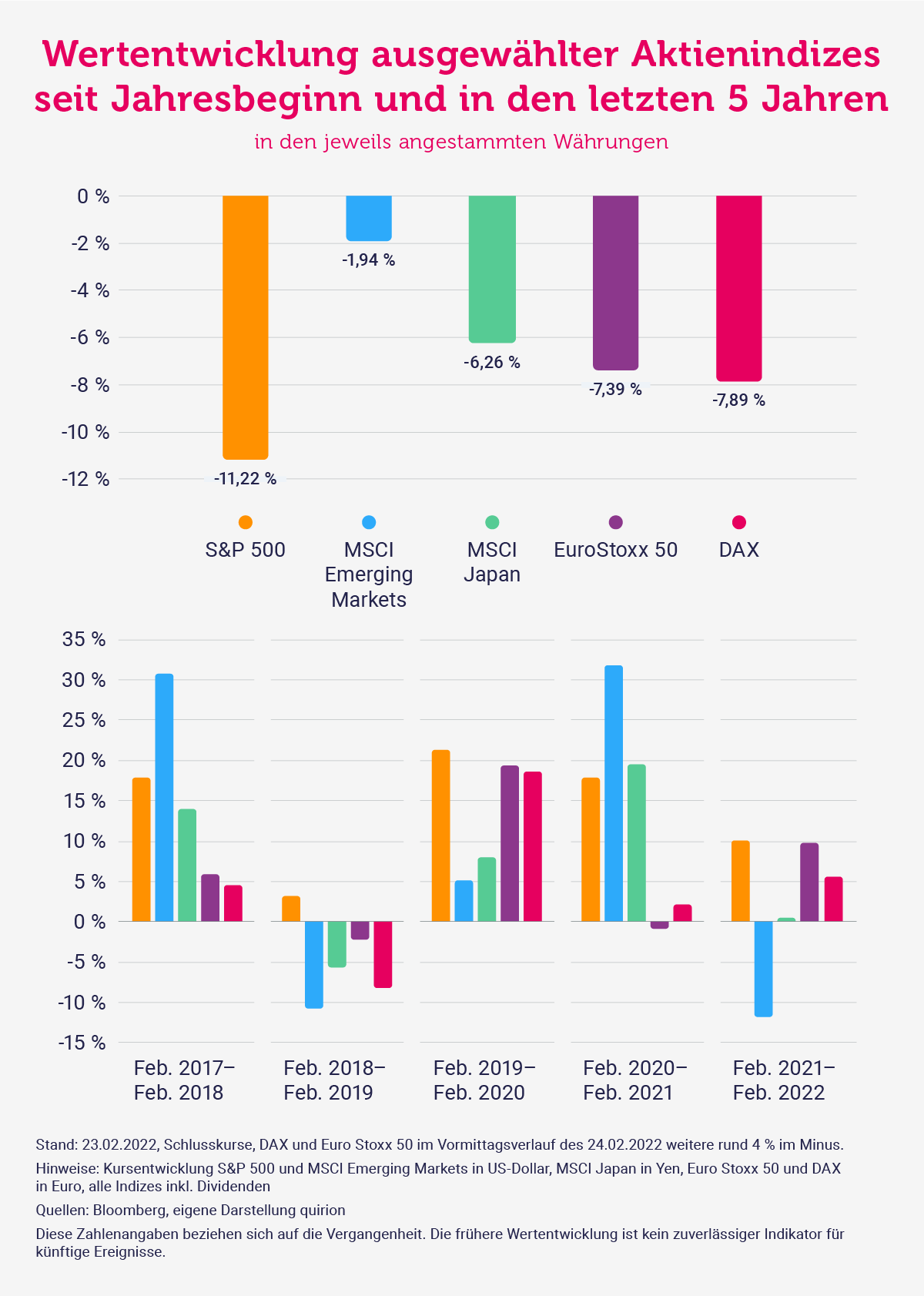
It is striking that, so far, it is above all Japan and the Asian emerging markets that are showing relative strength — the very markets that lagged behind last year (Japan) or clearly disappointed (emerging markets, China first and foremost). One reason could be their geographical distance from the crisis and their lack of political involvement. That said, a further rise in energy prices in the wake of the crisis would be a considerable burden for these regions too. But regardless of the specific reasons, this development underscores once again the value of the broadest possible international diversification for a securities portfolio.
Fear of war and investor worries are growing — a look at history offers some orientation
For many investors, the crisis and the worries that come with it are fuelling thoughts of reducing their equity allocations or perhaps moving entirely to the sidelines — following the motto: "I'll get back in once the situation has calmed down."
At this point, we deliberately do not want to speculate about how the Russia-Ukraine conflict will unfold, because it is uncertain in the extreme. Even though there is a great deal of debate about it, much of it conflicting, one insight ultimately remains: Kremlin ruler Vladimir Putin is and remains unpredictable.
Geopolitical conflicts — or their worst form, armed conflict — unsettle investors and market participants alike, and usually lead to noticeable dislocations on the capital markets. But — and unfortunately this has to be said in all clarity — unlike us humans, the stock markets have little empathy. That means the short-term turbulence usually subsides again quickly, and over the long term geopolitical conflicts and even wars — provided they are geographically limited — have no lasting impact on the performance of a broadly diversified capital-market investment.
To underline this thesis, we would like to briefly recount, by way of example, the results of two studies into this very question.
An analysis by the large Swiss bank Credit Suisse examines how the US stock index S&P 500 reacted to 14 different military conflicts since 1986, such as the annexation of Crimea, the Bosnian War or the Gulf War. The result: from the index's high point before the respective attack to its low point afterwards, only just under a month passed on average. The corresponding average loss came to -8.5% (median: -4.0%). The average index performance in the 100 days after the low point came to +4.2% (median: +8.0%).
The second study was carried out by the US research firm LPL (Linsco and Private Ledger). The subject of this analysis: 21 events of war and terrorism since Pearl Harbor and their effect on the stock market on the day the conflict began. The result: the average loss of the S&P 500 index (or its predecessor, the S&P 50 before 1957) from the day of the event to the low point came to -4.6% — and on average the losses had been fully recovered after 43 days.
The lessons from history and the view ahead
The analyses above suggest that, as a rule, getting out of the market during the phases studied was a bad idea, because the stock markets shook off the events relatively quickly. Catching the (stock market) low point after one of the events described in order to get back in would have been pure luck.
From an investor's perspective, one thing above all is therefore important: keep calm and don't make hasty decisions, because rushing out of the markets is not a good idea. The same goes for all attempts to time supposedly favourable entry and exit points, as well as for speculating on rising or falling prices of individual stocks. Stay calm, don't let yourself be driven to distraction, and above all: stay invested. The moment you start jumping in and out on impulse, a strategic investment turns into pure gambling. That is why we, too, of course remain true to our investment strategy, keep a steady hand and deliberately refrain from hedging strategies of any kind.
At this point, however, we would also like to stress that, by their very nature, backward-looking analyses provide no reliable indication of how the stock market will develop in the course of the current crisis. It remains to be seen how, and to what extent, the international community will respond to Russian aggression, and whether this marks the beginning of a longer geopolitical ice age between East and West. In light of recent developments, however, there is currently no question that price turbulence on the financial markets must be expected in the coming weeks too — the last few days already bear witness to this.
The more the situation escalates, the more prone energy prices, for example, are likely to be to further jumps (above all if Russia sharply cuts its exports of these). That is likely to push the decline in inflation rates that we expect further back on the timeline, which in turn could create additional downward pressure on the stock markets. But, as always with considerations of this kind, the emphasis is on the little word "could". Because the financial markets are influenced by a multitude of factors, and often — precisely in turbulent times, when the path for prices seems inevitably headed south — positive aspects emerge that bring about a trend reversal. A possible release of strategic commodity reserves by the US would be one such aspect.
Our recommendation in a nutshell
We consider getting out of the equity markets to be the wrong move, even in the currently confusing situation — fully aware that investment discipline is no easy emotional exercise, especially in times of armed conflict. It is precisely in such phases that many investors feel almost pushed to act, which is deeply human, after all. In everyday life, we constantly experience that reacting quickly and actively in critical situations is usually better than simply waiting. In contrast, a successful equity investment should never be guided by emotions — however hard that may be in the current situation.
Even in the face of the recent escalation, the best strategy is a triad of forecast-free investing, broad international diversification and investment discipline. An equity allocation tailored to your individual risk capacity puts you in a position to maintain this discipline consistently as well.
Questions and answers on the war in Ukraine and its impact on portfolios are also available in the recording of quirion LIVE from February.
If, in light of current events, you have feedback, questions or topics you would like us to cover, feel free to send them to pk@quirinprivatbank.de.
We wish for all of us that the situation in Ukraine calms down as quickly as possible, and we hope you find this an insightful read.
Yours, Stefan May
Head of Asset Management