Semiconductors are the backbone of technological progress. Powerful chips enable crucial advances, for example in artificial intelligence. However, the semiconductor market is repeatedly subject to cyclical swings. A look at the opportunities and risks of the sector for your investments.
There is one company above all that comes to mind for many investors right now at the keyword "semiconductor market": the chip producer Nvidia. Its steep rise can be illustrated by the development of its market capitalisation: at the end of 2019, Nvidia was valued on the stock market at 144 billion US dollars. In March 2024, the company reached 2.3 trillion US dollars - fairy-tale growth. This success is owed in particular to advances in artificial intelligence. The "brain" of chatbots such as ChatGPT is made up of tens of thousands of Nvidia chips.
It isn't only here that semiconductors are essential to technological progress. Whether in the data centre or the aeroplane, the smartphone or the car, the washing machine or the heating system: there's no getting by without chips in the digitalised world. However, the euphoria surrounding Nvidia and artificial intelligence shouldn't obscure the fact that the semiconductor market is just coming out of a dip. 2023 was, at any rate, not a good year for the sector overall: according to figures from the Semiconductor Industry Association (SIA), worldwide sales in the semiconductor industry fell by 8.2 percent year-on-year to 526.8 billion US dollars - a sharp slump. Demand for smartphones, PCs and servers in particular developed more weakly than expected.
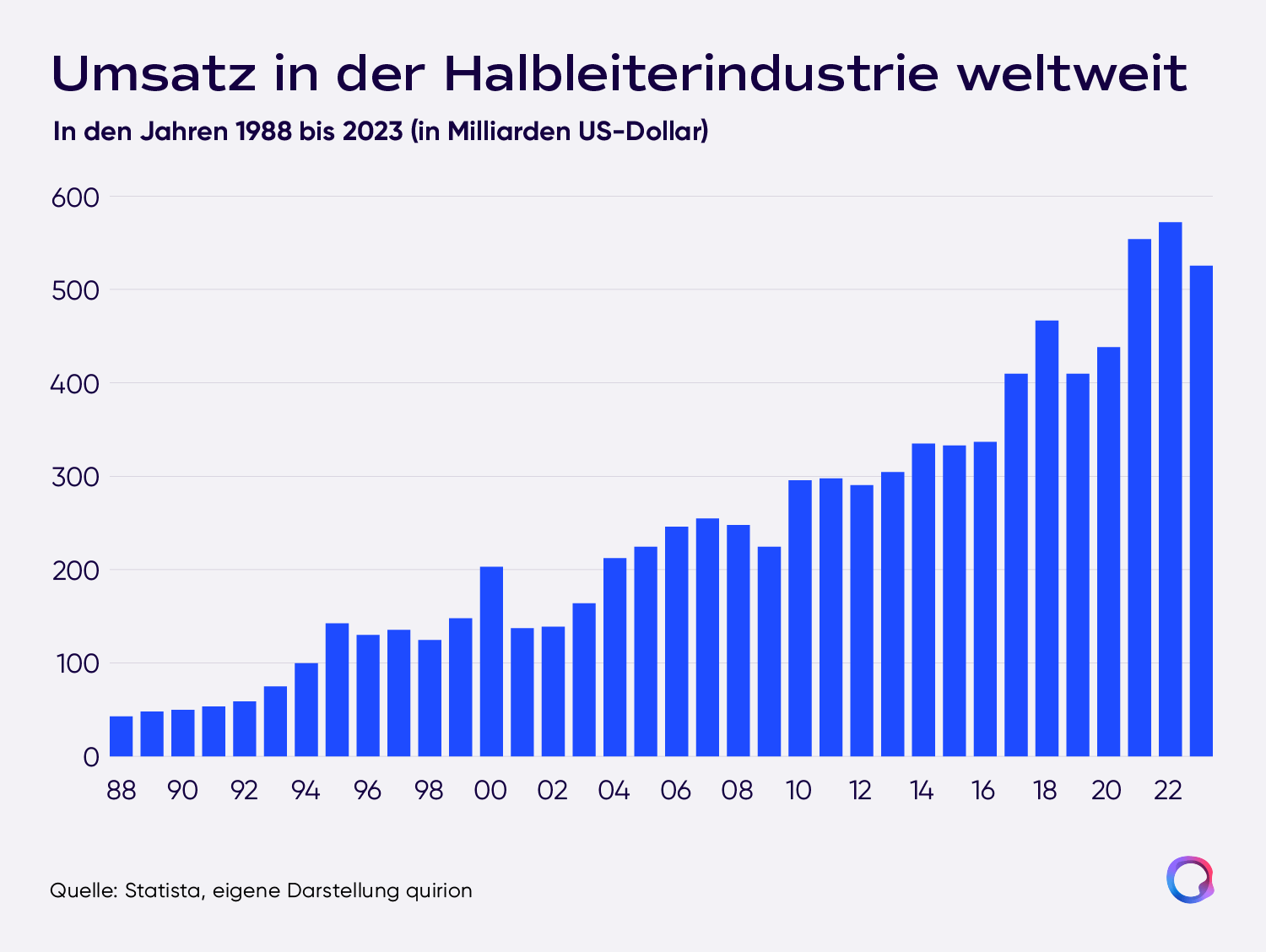
Back in 2021, during the lockdowns of the coronavirus pandemic, smartphones and consumer electronics were in enormous demand. After that, many users' needs were satisfied for the time being. On top of that came the weakness of global economic development in 2023. But the mood has already brightened again. The market researchers at Gartner, for instance, are expecting rising sales and forecast market growth of 17 percent for this year.
An industry in the "hog cycle"
The semiconductor sector is known for its cyclical ups and downs. Building new factories and thereby increasing production capacity takes several years. Once the factories are then running at full tilt and short-term demand weakens, prices tumble. Factories are ramped down again. In this context, there is often talk of a "hog cycle". This term is used in areas of the economy where supply cannot be adjusted at short notice to current demand. The economist Arthur Hanau first described the phenomenon in 1928 for the agricultural sector, hence the name.
At present, the build-up of production capacity, particularly for especially powerful chips, is a dominant topic. High-quality semiconductors for smart applications are in demand - whether for the spread of artificial-intelligence applications, of cloud solutions for data storage, or of autonomous vehicles. Political aspects also play a role in the build-up of capacity. According to the American "Council on Foreign Relations", Taiwanese companies hold a market share of 68 percent in the manufacture of semiconductors. For the advanced chip variants, their market share is estimated at 90 percent. This heavy dependence on exports is a risk. With support programmes, many countries are trying to increase domestic chip production and thereby shorten supply chains.
Investing in the semiconductor sector
Whether on the supply side or the demand side: developments over the coming years will depend on many factors. No one can yet reliably say which companies in the various areas of the semiconductor market will come out ahead over the long term. Accordingly, a certain degree of diversification is advisable when investing in this sector. The "Semiconductors" thematic portfolio from quirion combines selected ETFs for this purpose. In this way, the ETF portfolio can have a more balanced return-risk ratio than individual stocks or single thematic funds.
Investors should nonetheless be aware: an investment concentrated on specific sectors always carries higher risks than an investment in a broadly diversified global portfolio such as the global ETF portfolio from quirion. The weighting of sectors and regions is guided by the respective market capitalisation. Thanks to its strong diversification, the portfolio makes itself less dependent on forecasts or opinions about trends.
But if you want to set your own priorities: quirion offers more concentrated ETF portfolios on a total of 12 individual themes - including, for example, "artificial intelligence". The thematic portfolios consist of 100 percent equity ETFs. During the application process, quirion checks whether this form of investment matches your personal risk appetite and your individual investment horizon.