The number of shareholders in Germany remains at a relatively high level. Yet the potential that equity investments offer is far from being fully tapped here.
1) One in six people puts money into stocks
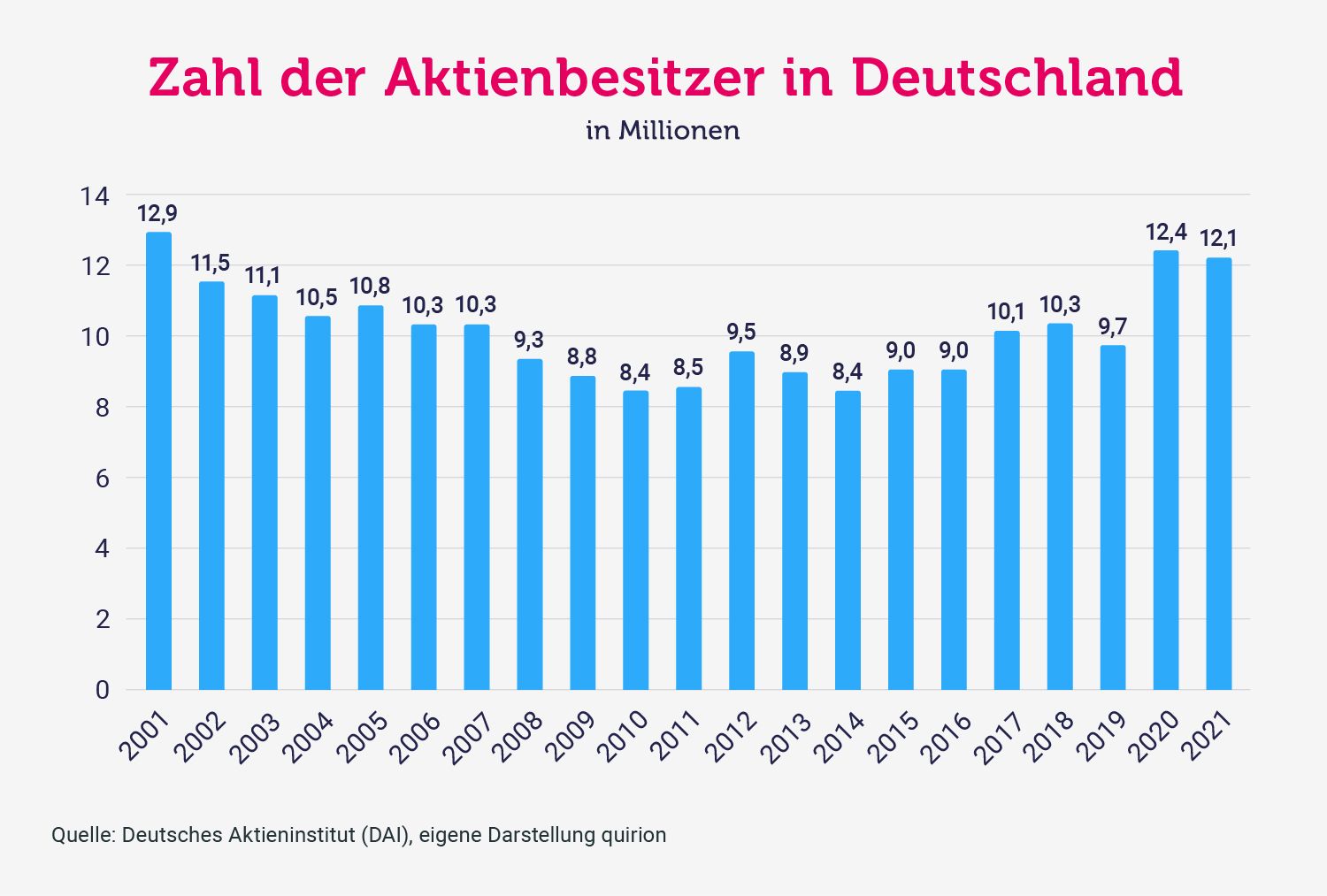
According to current data from the German Equities Institute (DAI), around twelve million people in Germany were invested in stocks in 2021 — whether in individual securities or in funds such as ETFs. Despite dynamically rising prices, with a gain of around 16 percent in the DAX, there were nonetheless slightly fewer equity investors overall than in the previous year. In 2020, the number of shareholders had shot up by 2.7 million. At least the figure has stabilized at a fairly high level.
2) Diversification is good — and popular
According to the DAI figures, equity funds and ETFs remain the most popular form of equity investment. 6.9 million people hold funds exclusively in their portfolios. Around three million relied solely on investing in individual stocks. Two million combine both forms of equity investment. Broad diversification helps reduce risk. quirion's global ETF portfolios, for example, are invested in more than 8,000 companies from over 70 countries.
3) The USA is by far the largest stock market
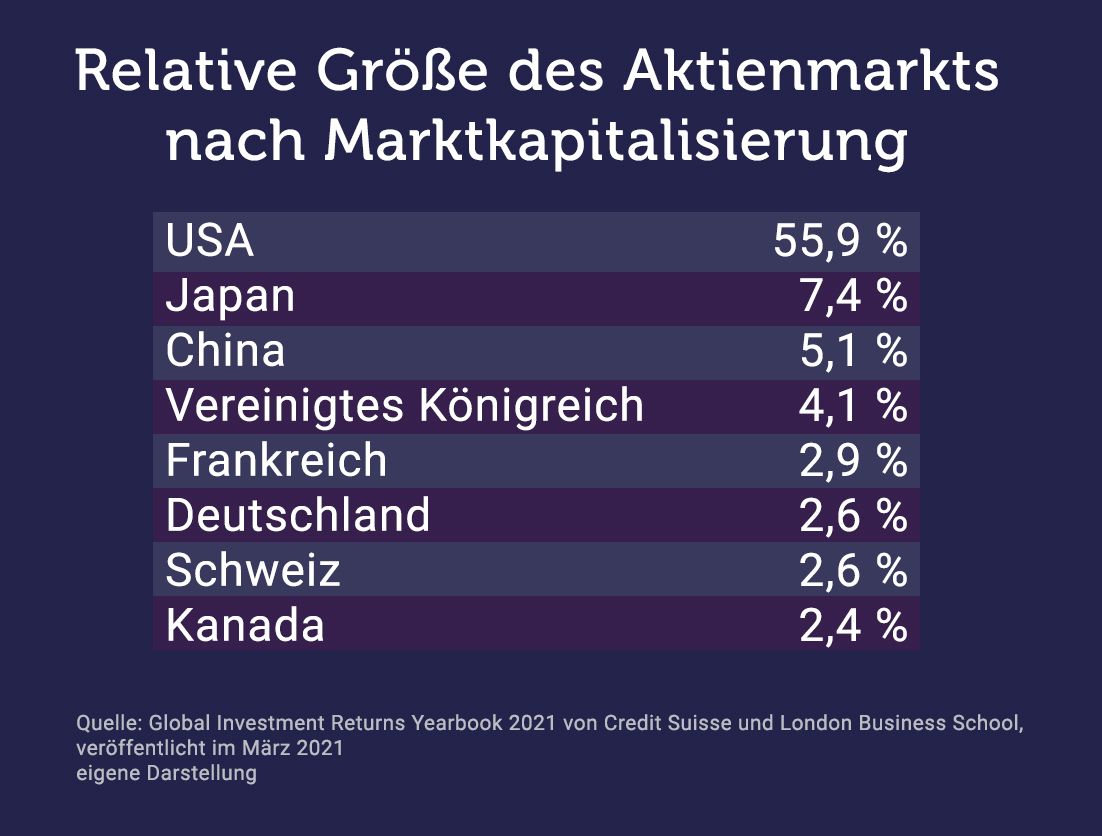
Wall Street sets the pace for stock markets worldwide and is by a wide margin the largest stock market. According to a study by Credit Suisse and the London Business School, the US markets made up around 56 percent of the world's investable free-float market capitalization in 2021. Germany, at 2.6 percent, was level with Switzerland in sixth place.
4) Half of Americans invest in stocks
In the world's largest stock market, investing in stocks is considerably more popular than in Germany. According to a survey by the market research institute Gallup, around 56 percent of Americans said in 2021 that they own stocks or investments such as funds with equity components. That corresponds roughly to the average Gallup has measured since 2009. The shares of men (60 percent) and women (53 percent) are quite close to one another here.
5) In Germany, women are less heavily invested in stocks
Here in Germany, according to DAI statistics, only around a third of equity investments are in the hands of women. This lower proportion of women runs through all age groups — and has done so for many years. That's quite a shame, because relevant studies repeatedly attest that women have excellent qualities for investing. For instance, the two Nobel laureates in economics, Daniel Kahneman and Amos Tversky, described how women, compared with men, less often fall into the trap of "overconfidence," which is frequently responsible for investment mistakes.
6) For over 100 years, stocks have been more lucrative than interest-bearing securities
It isn't only since central banks began their zero-interest-rate policy that stocks have been out in front when it comes to returns.
According to the Global Investment Returns Yearbook 2021 by Credit Suisse and the London Business School, stocks have posted a better performance than bonds since 1900 in all the markets examined. On average, stocks outperformed bonds by 3.1 percent per year — quite remarkable given that interest rates were at times historically high.
7) No amount of wealth is too small for an equity investment
A common prejudice about investing in stocks is that only the wealthy can afford it. Yet ETF savings plans, for example, are available for comparatively little money. A quirion savings plan can be set up starting from a savings rate of just €25 per month. And that's not the only argument in favor of savings plans. With a one-off investment, too, there are no hurdles at quirion, because there is no minimum investment. The amount you invest is therefore entirely up to you.
You can find more information about quirion's savings plans here.