- Costs swallow up a large part of the return
- Products are too complicated and too expensive
- The wrong investments deliver below-average returns
It is too complicated, too expensive, and the money is invested in the wrong way. The contributions paid in are too low, and the returns collected fall far short of what the international financial markets have to offer investors. "The products on offer make no real contribution to solving the retirement provision problem. In the end, the market returns land in the pockets of the insurance and finance industry," says Prof. Stefan May, Head of Asset Management at quirin bank AG.
The attempt to strengthen private retirement provision through state subsidies has failed. This is especially true of the Riester pension. Despite the large number of contracts taken out, it plays no significant role in solving the retirement provision problem. The contributions made and the returns achieved are simply too low for that. "The whole misery becomes clear in three problems: private retirement provision is too complicated, too expensive, and on top of that customers' money is invested in the wrong way," is how capital market researcher Stefan May analyses the dilemma. The Riester pension is a glaring example of this: even experts have lost track of the sheer variety and detail of the different implementation options. "It is downright preposterous to believe that with such monstrously complicated offerings you can get broad sections of the population, young people in particular, to save adequately for old age," said May in Berlin.
The cost factor makes things worse, he added. Because German investors are practically obsessed with everything that promises safety, the insurance industry has been able to declare retirement provision its own domain. "The cost of this appropriation is enormous," says Professor May. Conservative estimates assume additional insurance-related costs of 1.5 to 2.5% per year. "On top of that come the costs of portfolio management. Almost all private provision pots are invested either with insurers or in so-called 'actively' managed investment funds. But these are among the most expensive of all. Cost rates of 1.5% to 2% per year are by no means unusual. As a result, investors lose amounts running into the billions for their retirement provision year after year," says May.
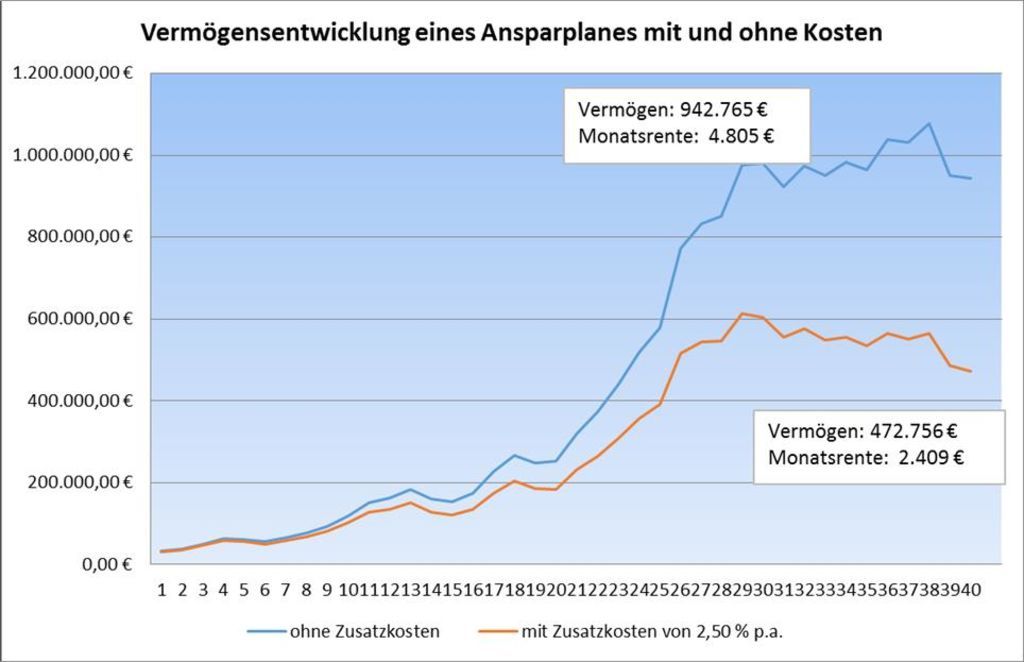
Even when savers do bring themselves to opt for riskier and thus higher-return forms of investment such as shares, the actual gains in value fall far short of what the international financial markets actually offer investors, purely because of the costs (see chart). One reason for this, he says, is the expensive retail funds that are typically offered to investors. Bitter disappointments are therefore pre-programmed, May is certain.
This effect is compounded still further by unsuitable investment strategies. Most funds fail to meet the overarching goal of securing an adequate retirement income. "All three factors, complexity, costs and investments that do not work, sabotage the efforts of broad sections of the population to secure adequate retirement provision," is how investment expert May sums up the alarming finding.